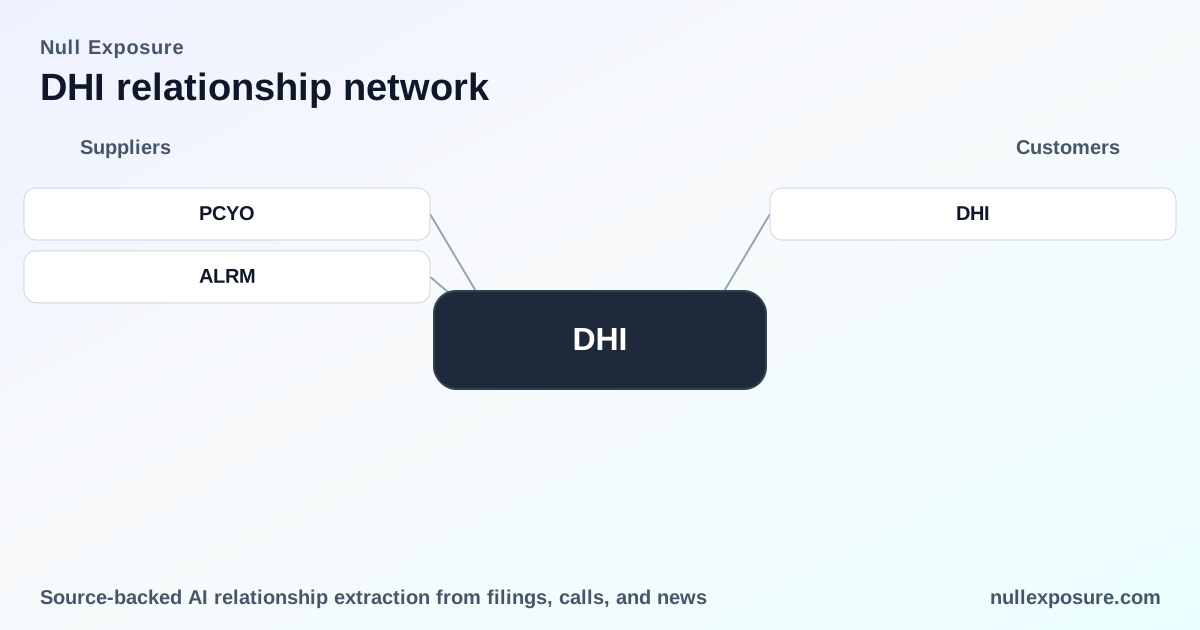
D.R. Horton (DHI): Supplier relationships, operating posture, and what investors should know
D.R. Horton builds and sells single‑family homes at scale, monetizing through land acquisition, lot development, home construction and retail sale, supplemented by ancillary services and upgraded smart‑home features. The company’s economics are driven by large, scheduled land purchase commitments, a subcontractor‑driven construction model, and integration with third‑party technology providers for value‑added features. For investors and operators, the key takeaway is that D.R. Horton’s supplier risk is concentrated around land contracts and a broad ecosystem of construction subcontractors, with selected technology partners supporting product differentiation. Explore supplier signal analysis and monitoring at https://nullexposure.com/.
High‑level supplier posture: long commitments and distributed execution
D.R. Horton combines large, multi‑year purchasing commitments with a predominantly subcontracted construction model. Public filings and company disclosures show three complementary contracting postures that define supplier risk and leverage:
- Long‑term purchase commitments: The company routinely enters land and lot purchase contracts scheduled against planned development. At September 30, 2025 the total remaining purchase price of lots under contract was $26.0 billion, secured by $2.3 billion in earnest money deposits — a clear signal of substantial, locked‑in spend.
- Non‑cancelable operating leases: D.R. Horton reports non‑cancelable office and equipment lease obligations totaling $71.9 million in future minimum payments (scheduled from fiscal 2026 through thereafter), which creates a fixed‑cost base beyond pure build costs.
- Subcontractor execution model: Substantially all land development and home construction is performed by subcontractors selected through competitive bidding and bound by contracts requiring general liability and construction defect coverage.
These are company‑level signals that shape supplier dependency, working capital cadence and operational flexibility. Concentration of spend on land purchases and contractual reliance on third‑party builders are the dominant structural risks.
What public sources show about D.R. Horton’s partners today
Below I cover the supplier and service relationships surfaced in public reporting and filings; each relationship is summarized in plain English with a concise source reference.
Pure Cycle Corporation (PCYO)
Pure Cycle publicly listed D.R. Horton among national homebuilders active in the Denver metropolitan area, indicating an on‑the‑ground commercial relationship where Horton is a customer for local development resources. According to a Pure Cycle news mention on March 9, 2026, D.R. Horton was named alongside other major builders producing entry‑level homes in the market (source: https://intellectia.ai/en/stock/PCYO/news).
Alarm.com (ALRM)
D.R. Horton’s smart‑home packages use a hosted automation platform provided by Alarm.com to integrate doorbells, thermostats, locks, switches, garage openers and smart speakers, positioning Alarm.com as a technology partner for the Horton product offering. A Newswire release describing a D.R. Horton community (March 2026) lists Alarm.com as the platform that integrates the suite of Internet‑connected devices in D.R. Horton Smart Homes (source: https://www.newswire.com/news/d-r-hortons-southwest-florida-division-announces-driftwood-bay-a-new-22738058).
Operational implications for investors and operators
D.R. Horton’s supplier architecture produces a mix of strengths and risks that directly affect margins, working capital and execution.
- Scale and predictability from committed land purchases. The $26.0 billion of remaining lot purchase obligations (secured by $2.3 billion of earnest money) signals predictable, pipeline‑backed revenue but also large, illiquid capital commitments that limit nimbleness in cyclical downturns. This is a capital‑intensive model where land supply effectively anchors future revenue but concentrates balance‑sheet exposure.
- Variable cost control through subcontracting. By outsourcing the bulk of construction to competitively bid subcontractors, Horton reduces fixed labor headcount and preserves geographic flexibility, but this creates operational criticality around third‑party performance, insurance adequacy and local market contractor capacity. The company’s contractual requirement that major subcontractors maintain general liability including construction defect coverage mitigates claims risk but does not eliminate scheduling or quality exposure.
- Product differentiation via tech partners. Integration with providers like Alarm.com supports upsell and price realization on finished homes, which is valuable in competitive markets; the tradeoff is ongoing dependency on a small set of technology vendors for the embedded smart‑home experience.
- Contract term mix and cadence. Documented evidence shows both long‑term contracts (land and certain supplier commitments) and short‑term purchasing (a majority of land and lots under contract are expected to be purchased within three years), producing a hybrid maturity profile that balances backlog visibility with near‑term execution reliance.
Financial context reinforces these operating signals: D.R. Horton reported TTM revenue of approximately $33.5 billion, a market capitalization near $41.4 billion, and an EV/EBITDA around 10.4x, indicating a large, mature residential builder with meaningful scale advantages and cyclical exposure.
If you want to track supplier commitments, counterparties and contract cadence for D.R. Horton in greater detail, visit https://nullexposure.com/ for tailored supplier‑risk monitoring.
How these relationships change the risk profile
- Land contracts are the single largest source of counterparty and liquidity risk given their scale; investors should watch earnest money levels, scheduled purchases and regional concentration.
- Subcontractor dependency is operationally critical but dispersed; issues arise regionally when local contractor supply tightens or defect claims concentrate. Insurance requirements are a mitigating control.
- Technology partners like Alarm.com are lower absolute spend than land or subcontractors but are strategically important for product differentiation and buyer willingness to pay.
Bottom line and actionable next steps
D.R. Horton’s supplier relationships reflect a deliberate tradeoff: large, scheduled capital commitments for pipeline visibility, and decentralized construction execution for operational flexibility. For investors, the focus should be on monitoring the scale and timing of land purchase obligations, subcontractor capacity and localized execution risk, and the select technology partners that support pricing and product features.
To monitor changes in supplier commitments, counterparty exposures, and contract cadence with continuous updates, visit https://nullexposure.com/. For bespoke research or operator‑level supplier intelligence tailored to residential construction portfolios, see https://nullexposure.com/ — the next actionable step for teams that need to convert these signals into risk controls and investment decisions.