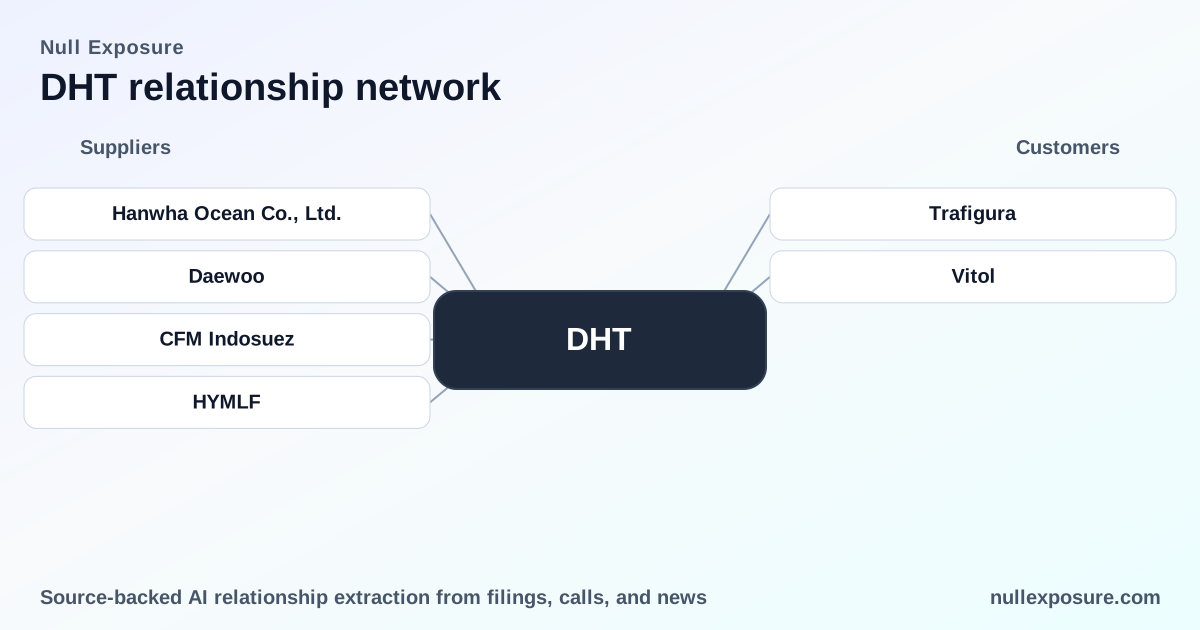
DHT Holdings: supplier relationships driving fleet renewal and cash returns
DHT Holdings operates a concentrated, asset-intensive business that owns and operates very large crude carriers (VLCCs) and monetizes those assets through time charters and spot market voyages, supplemented by strategic asset sales and capital-market activity. Revenue flows come from charter hire and freight, while value creation is driven by fleet renewal, disciplined sales of vintage tonnage, and shareholder distributions (DHT’s trailing dividend yield reported at 9.73%). For investors evaluating supplier relationships, the near-term narrative is clear: DHT is replacing older ships with newbuilds from Korean shipyards, using brokers for capital markets activity and selectively monetizing older assets to crystallize value. Learn more about how these supplier ties affect fleet economics at https://nullexposure.com/.
Why supplier ties matter for an owner-operator like DHT
Supplier relationships are not peripheral for a tanker owner: shipbuilders, brokers and resale buyers are direct levers on cost, timing, and cash generation. DHT’s recent public disclosures for FY2026 reveal a pattern: newbuild deliveries from Korean yards, short-term chartering of fresh production, and sales of older VLCCs built in the mid-2000s. No supplier-specific constraints are recorded in the available dataset; at the company level this signals a clear operational posture: DHT is executing a fleet modernization strategy with concentrated counterparty exposure to large Asian shipbuilders and established brokerage houses. That posture has implications for contracting (capital-intensive, multi-year newbuild commitments), concentration (few shipyards supply multiple vessels), criticality (timely deliveries are mission-critical), and maturity (the company is actively cycling older tonnage).
Explore DHT’s full supplier and market context at https://nullexposure.com/ to inform sourcing and counterparty diligence.
What the public record shows — each supplier relationship
-
Hanwha Ocean Co., Ltd.
DHT has taken delivery of multiple 320,000-dwt VLCC newbuildings from Hanwha and has secured short-term time charters for newly delivered vessels such as DHT Taiga and DHT Redwood in FY2026. According to a GlobeNewswire release and supplemental company announcements in early 2026, Hanwha is DHT’s primary shipyard partner for recent additions to the fleet (GlobeNewswire, Feb–Mar 2026: https://www.globenewswire.com/news-release/2026/02/19/3241552/0/en/dht-holdings-inc-secures-one-year-time-charter-for-dht-taiga.html; https://www.globenewswire.com/news-release/2026/02/23/3243066/0/en/DHT-Holdings-Inc-secures-one-year-time-charter-for-DHT-Redwood.html). -
Daewoo (Daewoo Shipbuilding & Marine Engineering)
DHT completed a sale of a 2007-built tanker that was sold at Daewoo, reflecting the company’s active disposal of older tonnage to recycle capital. Shipping Telegraph reported the vintage VLCC sale as part of DHT’s FY2026 asset management program (Shipping Telegraph, March 2026: https://shippingtelegraph.com/tankers/dht-holdings-wraps-up-vintage-vlcc-sale/). -
Hyundai (Hyundai Heavy Industries group / yards)
Several of DHT’s earlier vessels were constructed at Hyundai yards in 2007, and recent commentary about vintage sales referenced Hyundai as the original builder for those units—an operational footnote that matters for resale value and technical pass-downs. Shipping Telegraph’s coverage of DHT’s vintage disposals notes the Hyundai origin of the sold hulls (Shipping Telegraph, March 2026: https://shippingtelegraph.com/tankers/dht-holdings-wraps-up-vintage-vlcc-sale/). -
CFM Indosuez (broker / capital markets agent)
CFM Indosuez is listed by name in a March 2026 SEC-related filing as a broker associated with DHT’s share activity, indicating a relationship that supports DHT’s capital-market operations, including equity placements or block trades. The broker name appears in the filing made public in early March 2026 (SEC filing reference published via StockTitan, March 2026: https://www.stocktitan.net/sec-filings/DHT/144-dht-holdings-inc-sec-filing-8ba987ea3455.html).
What these relationships mean for investors
- Concentration and counterparty risk are real but manageable. The record shows repeated interactions with a small set of large Korean yards—Hanwha is the dominant newbuild counterparty in FY2026—which concentrates delivery and technical risk but also benefits DHT through scale and standardized VLCC construction economics.
- Fleet renewal is improving cash generation and optionality. New 320,000-dwt VLCC deliveries increase earnings potential and reduce operational downtime; DHT’s FY2025 metrics (Operating margin 47.8%, Profit margin 38.3%) reflect strong operating leverage across the fleet. Selling 2007-built tonnage converts age-related maintenance and fuel inefficiency into liquid proceeds.
- Capital markets access is intact. The named broker relationship with CFM Indosuez and the company’s continued public disclosures support rapid access to liquidity and secondary-market placement when required. DHT’s trailing dividend yield (9.73%) and a Forward P/E of 8.18 signal management’s willingness to return cash and an earnings base capable of sustaining distributions.
- Timing and delivery are mission-critical. Newbuild deliveries from Hanwha directly influence utilization and near-term revenue recognition; any slip in shipyard schedule would compress free cash flow and defer intended charters. Operational diligence on delivery schedules and warranty/acceptance terms is therefore a primary investor focus.
If you want a deeper supplier risk map tied to earnings scenarios, review DHT’s supplier signals and fleet schedule at https://nullexposure.com/.
Operational takeaways and risks to monitor
- Monitor Hanwha delivery cadence and acceptance reports; a clustered delivery schedule concentrates operational risk but offers near-term earnings upside if charters are secured.
- Track the pace of vintage sales—aggressive monetization of older hulls reduces opex and supports capital returns but can be earnings-neutral if replacement supply is slow.
- Watch broker activity and any SEC disclosures for accelerated equity moves or block trades that impact free float and institutional positioning.
Bottom line
DHT’s FY2026 supplier trail shows an orderly fleet renewal financed through disciplined asset sales and supported by established brokerage relationships. For investors, the core conclusion is straightforward: Hanwha-driven newbuilds and selective disposals of Hyundai/Daewoo-built vintage ships are central to DHT’s immediate value creation plan. That operational clarity reduces strategic ambiguity and concentrates diligence on delivery, chartering, and capital-market execution.
For a concise, investor-focused supplier dossier and scenario workups, visit https://nullexposure.com/ and assess how vendor timelines feed into projected cash flows and dividend sustainability.