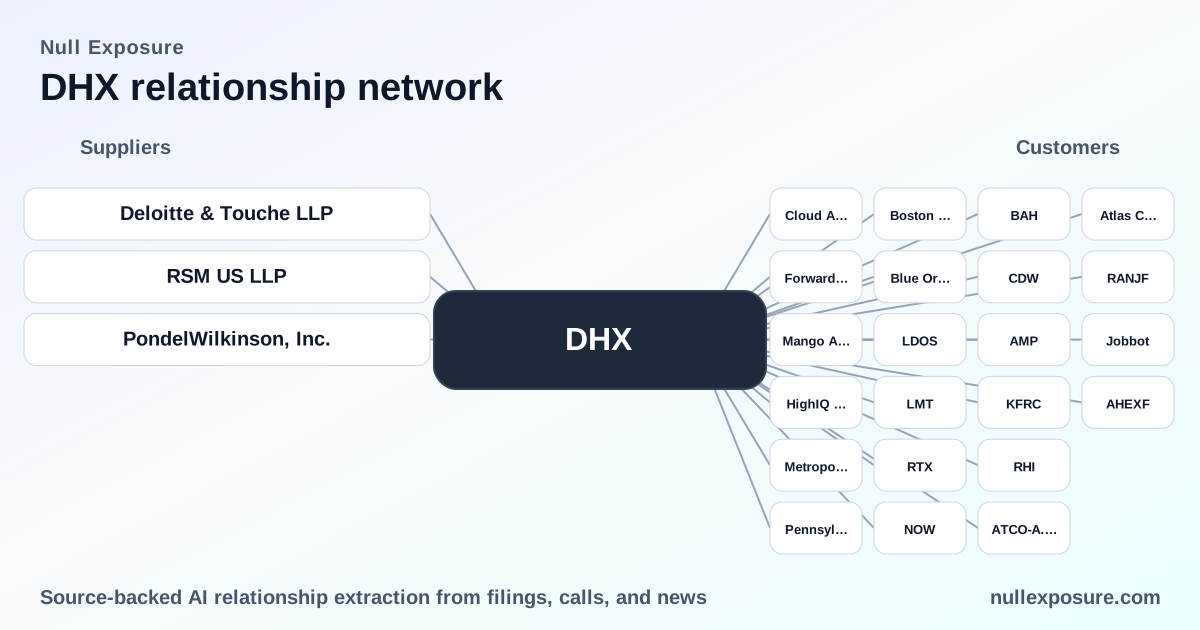
DHI Group (DHX): Supplier relationships, controls and what they mean for investors
DHI Group operates a portfolio of specialized career marketplaces and data products for technology professionals and recruiters, monetizing through subscription services, job posting and advertising sales, and corporate recruiting solutions. Revenue comes from recurring platform access and short-cycle ad buys rather than large multi‑year professional services contracts, which concentrates cash flow sensitivity on retention and advertising spend. This review unpacks every supplier relationship surfaced in recent filings and news, assesses the company-level contracting posture and constraints, and flags the practical implications for investors and operators. For more supplier intelligence and relationship mapping, visit https://nullexposure.com/.
What the recent filings changed: auditor and IR moves matter to governance
DHI filed an 8‑K in March 2026 that documents two governance‑level supplier decisions: the company dismissed its prior independent auditor and engaged a new one, and it continues to use outsourced investor relations support. These are not operational vendor swaps; they are governance and market‑facing relationships that influence transparency, audit risk and investor communications. Auditor transitions are material for control continuity and the audit opinion timeline, and IR providers shape investor access and message discipline.
Every supplier relationship surfaced (complete coverage)
Deloitte & Touche LLP — former independent auditor
DHI dismissed Deloitte & Touche LLP as its independent auditor in FY2026 after a competitive process, ending that auditor relationship for present and future reporting periods (see the company 8‑K filed March 9, 2026: https://www.stocktitan.net/sec-filings/DHX/8-k-dhi-group-inc-reports-material-event-e1d1a4d51619.html). This change signals a leadership choice about audit approach and audit fees tied to FY2026 reporting.
RSM US LLP — new independent auditor
Following the dismissal of Deloitte, DHI engaged RSM US LLP as its new independent auditor in FY2026, selected after a competitive process according to the same 8‑K (https://www.stocktitan.net/sec-filings/DHX/8-k-dhi-group-inc-reports-material-event-e1d1a4d51619.html). A switch to RSM brings a different national audit footprint and may adjust audit scope and timing; investors should watch the next 10‑Q/10‑K for auditor reporting changes.
PondelWilkinson, Inc. — investor relations contact
DHI lists PondelWilkinson, Inc. as an investor relations contact for FY2026 filings and press distribution, providing media and analyst outreach services (see investor release distribution notice, February 2026: https://markets.financialcontent.com/stocks/article/bizwire-2026-1-20-dhi-group-inc-to-report-fourth-quarter-and-full-year-2025-financial-results-on-february-4-2026). Outsourced IR is standard for small‑cap names and influences the cadence and clarity of market communications.
How these relationships map to operational risk and governance
- Audit transition is governance‑critical. Changing auditors mid‑cycle creates a read on management’s priorities for audit cost, scope and historical control remediation. Expect focused disclosures in subsequent SEC filings about any audit differences, restatements, or emphasis‑of‑matter language.
- Investor communications are outsourced but visible. PondelWilkinson handles outreach; this centralizes messaging and lowers the marginal cost of IR, but it also means DHI’s narrative is filtered through a third party during earnings and guidance seasons.
- No supplier relationships surfaced that indicate long‑term lock‑in. The supplier list includes governance and communications firms rather than backbone technology or infrastructure vendors.
For a supplier‑level intelligence view across peers and categories, check the platform at https://nullexposure.com/.
Company‑level constraints and what they imply for vendor strategy
DHI’s own disclosures characterize its third‑party ad purchases as short‑term commitments paid monthly, with no significant long‑term minimums: “We make commitments to purchase advertising from online vendors, which we pay for on a monthly basis. We have no significant long‑term obligations to purchase a fixed or minimum amount with these vendors.” This establishes several operating model characteristics:
- Contracting posture — short‑term and flexible. The firm sources advertising and likely other marketing spend on month‑to‑month terms, enabling rapid reallocation of budget in response to demand or margin pressure.
- Role orientation — buyer of ad inventory and marketing services. DHI functions as a purchaser rather than a strategic supplier to others in these relationships, which reduces vendor lock‑in but increases exposure to ad pricing volatility.
- Concentration and criticality — marketing is important but not long‑term locked. Marketing vendors are operationally important for demand generation, yet their short‑term contracts lower supplier concentration risk at the contract level; however, performance dependency on high‑quality ad platforms is still a business risk.
- Maturity — standard commercial terms for digital publishers. Short monthly commitments align with modern digital advertising practices and indicate an operational model focused on nimble marketing rather than fixed capacity investment.
These constraints are company‑level signals from SEC disclosures and should be integrated into any vendor risk assessment or procurement playbook for DHX.
Investment implications and risk checklist
DHI’s revenue mix of subscriptions plus advertising means cash flow sensitivity to ad spend and platform retention. The auditor switch elevates near‑term governance focus; watch for the first set of financials produced under RSM for any adjustments in audit opinion language. Outsourced IR supports orderly market communications but does not substitute for clear underlying economics improvements.
Key investor actions:
- Monitor the next 10‑Q/K for auditor commentary and any notes on accounting policy changes (RSM transition).
- Track quarterly marketing spend versus bookings to quantify the impact of short‑term ad purchases on revenue growth and margin.
- Evaluate management’s narrative delivered through PondelWilkinson alongside direct filings for consistency.
If you want systematic tracking of supplier changes and governance signals for DHX and its peers, visit https://nullexposure.com/ to explore integrated supplier intelligence.
Bottom line and what to watch next
DHI’s supplier signals are governance‑focused rather than operationally entangled. The auditor swap to RSM and continued use of an outsourced IR firm are material for investor transparency and messaging but do not, in themselves, indicate a change in core operating strategy. The company’s explicit short‑term ad contracting posture reinforces an operating model that is flexible but sensitive to ad market cycles. Track auditor‑related disclosures in upcoming filings and compare marketing spend to revenue momentum to assess the sustainability of the current recovery thesis.
For ongoing supplier monitoring and deeper relationship context across the tech jobs sector, return to https://nullexposure.com/ to subscribe or request a demo.