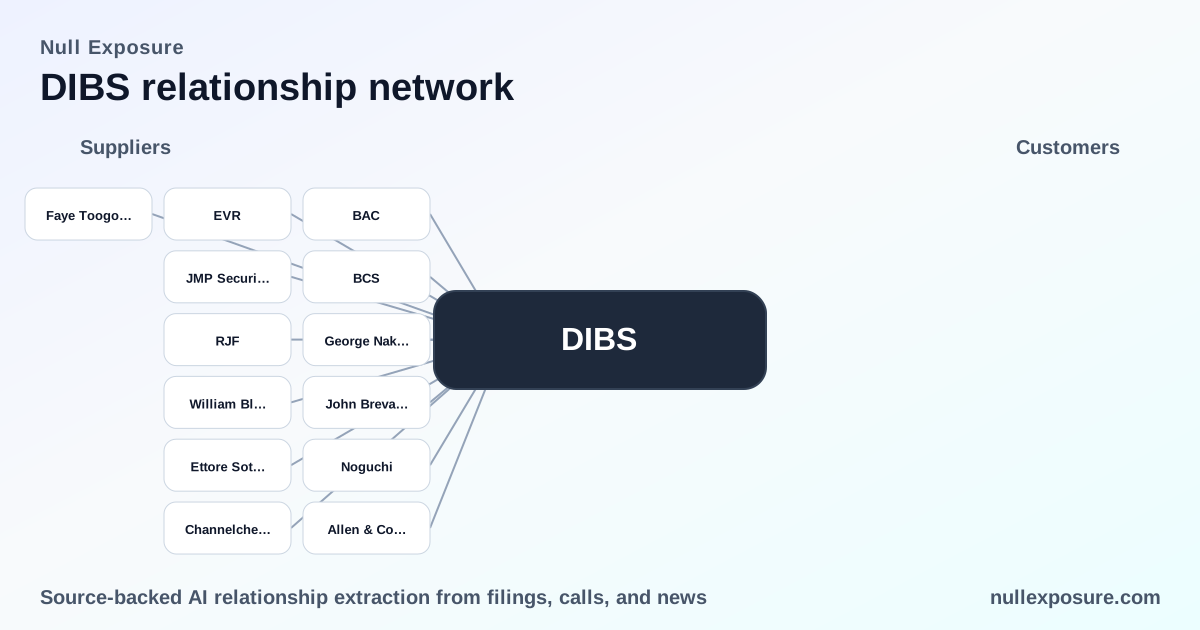
1stDibs (DIBS): supplier map, contractual posture and what underwriters + sellers signal for investors
1stDibs operates a curated online marketplace for high-end furniture, art and design, monetizing through marketplace fees, ancillary services (including facilitated shipping and payment processing) and subscription or service sales to vetted sellers; its value proposition is premium curation and global reach to attract high-consideration buyers. Investors should evaluate 1stDibs as a vertical marketplace where platform economics depend on seller quality, payments/shipping integrations, and operating leverage against long-term real estate and vendor commitments. For a concise vendor and supply-side risk view, visit https://nullexposure.com/.
How the supplier network actually drives dollars and risk
1stDibs is a two-sided commerce business with a concentrated mix of small-business sellers and high-end design suppliers; the company books revenue from transactions and related services while taking on operational roles for payments and shipping. Key commercial levers are seller acquisition/retention, take rates on transactions, and margin contribution from shipping and payment facilitation. The balance sheet and contracts evidence a company that runs with multi-year fixed obligations and a global counterparty footprint.
- The company reports $29.2 million of non-cancelable contractual commitments, anchored in operating leases and software/support services, reflecting a long-term contracting posture and predictable fixed cost pressure.
- 1stDibs operates globally, giving sellers access to roughly 7.0 million users in over 190 countries, which commoditizes scale but increases tax and compliance complexity.
- Sellers are predominantly small businesses, and 1stDibs functions as both marketplace operator and service facilitator (payment processing receivables and shipping facilitation are explicit operational roles).
Visit https://nullexposure.com/ for a compact supplier-risk briefing tailored to investors evaluating marketplace vendors.
Every named relationship and what it implies for investors
BofA Securities — IPO lead bookrunner
According to the GlobeNewswire press release announcing the IPO pricing dated June 9, 2021, BofA Securities acted as a joint lead book-running manager for 1stDibs’ initial public offering, which priced 5,750,000 shares at $20.00 per share and generated gross proceeds of approximately $115 million prior to fees. (GlobeNewswire, June 2021)
Barclays — IPO co-lead
Barclays served as the other joint lead book-running manager on the same IPO placement, sharing underwriting and distribution responsibilities with BofA as documented in the June 2021 GlobeNewswire announcement. (GlobeNewswire, June 2021)
Allen & Company LLC — bookrunner
Allen & Company LLC is listed as a joint bookrunner on the IPO, indicating a traditional investment-banking relationship used to execute the public listing and capitalization strategy. (GlobeNewswire, June 2021)
Evercore ISI — bookrunner
Evercore ISI participated as a joint bookrunner on the IPO, reflecting the engagement of multiple advisory and distribution partners to syndicate the offering. (GlobeNewswire, June 2021)
William Blair — co-manager
William Blair appeared as a co-manager on the IPO syndicate, contributing to distribution and placement activities for the June 2021 offering. (GlobeNewswire, June 2021)
Raymond James — co-manager
Raymond James was a co-manager on the IPO syndicate, consistent with a multi-firm underwriting strategy to broaden investor reach. (GlobeNewswire, June 2021)
JMP Securities — co-manager
JMP Securities joined as a co-manager on the IPO, participating in the underwriting group that executed the June 2021 pricing and distribution. (GlobeNewswire, June 2021)
George Nakashima — high-end inventory supplier
A Business of Home piece profiling the online luxury market cited George Nakashima as one of the top-selling home goods examples on 1stDibs, signaling the platform’s inventory includes recognized high-value designers that support premium price realization. (Business of Home, article on online luxury market)
John Brevard — specialty maker listed on platform
The same Business of Home article highlights John Brevard as an example of high-end, custom pieces listed on 1stDibs, underlining the marketplace’s access to artisanal and bespoke supply that drives high-consideration transactions. (Business of Home, online luxury coverage)
Noguchi — legacy-design inventory
Business of Home lists Noguchi pieces among top listings on the platform, reflecting 1stDibs’ role as a destination for legacy and collectible design where provenance and curation support pricing power. (Business of Home, online luxury coverage)
Ettore Sottsass — collectible design presence
The Business of Home roundup includes Ettore Sottsass mirrors among top pieces on 1stDibs, which signals the platform’s inventory depth in collectible modern design. (Business of Home, online luxury coverage)
Faye Toogood — contemporary designer supply
Business of Home names Faye Toogood’s designs as among frequently seen high-value listings on 1stDibs, reinforcing the company’s curated contemporary designer supply. (Business of Home, online luxury coverage)
Channelchek.com — investor presentation distribution
A stock news clipping referencing Channelchek.com noted that an archived replay of a 1stDibs presentation would be available on the company’s investor relations site and on Channelchek.com for one year following the event, indicating the company’s investor communication and IR distribution channels in FY2025. (StockTitan/Channelchek.com, FY2025)
Contracting, concentration and operational constraints investors should price
The company-level constraints disclose a set of durable operational characteristics:
- Long-term fixed commitments. The $29.2 million of non‑cancelable obligations, primarily leases, create a fixed-cost base that amplifies operating leverage and requires sustained top-line performance to cover occupancy and contracted services.
- Government counterparty complexity. 1stDibs recognizes liabilities for indirect tax contingencies ($1.1 million in 2024, $2.5 million in 2023), which is a recurring tax and compliance vector as the business sells into many jurisdictions.
- Seller composition and criticality. The platform’s sellers are largely small businesses, making seller retention and brand curation critical to protecting revenue; the company also operates as a service provider for payments and shipping, which creates operational dependency on third-party processors and carriers.
- Scale and geography. The platform reaches users in over 190 countries, which supports growth but increases cost and complexity for tax, logistics and fraud controls.
- Spend band and maturity signal. Contractual commitments in the $10m–$100m band signal a company running established vendor relationships (leases, software, support) rather than an early-stage spend profile.
Investment implications and a short checklist for due diligence
1stDibs’ financials show revenue of $89.6M and gross profit of $65.4M (TTM) but negative operating margins and EPS (operating margin TTM -10.1%, diluted EPS -$0.38), which underline the tension between attractive take-rates on luxury listings and the fixed-cost commitments the firm carries. Insiders hold ~12.2% and institutions ~69.7% of shares, indicating a governance mix tilted to professional investors. Key investor questions: can seller churn be contained while shrinking operating losses; how will tax and logistics costs scale as international volume grows; are payment/shipping integrations robust enough to protect service margins?
For a concise supplier-risk scorecard and to benchmark 1stDibs against peer marketplaces, see https://nullexposure.com/.
Bottom line
1stDibs runs a curated luxury marketplace supported by recognized underwriters from its IPO and a supply base that includes collectible and contemporary designers; its business model is differentiated by curation and service facilitation but constrained by long-term lease commitments, tax exposures across jurisdictions, and dependency on small-business sellers and third-party payment/shipping providers. For investors focused on supplier-side concentration and contractual risk, the platform requires monitoring of seller retention, gross-margin trends from shipping/payment services, and the company’s ability to cover fixed obligations as it scales. Learn more and access tailored supplier risk profiles at https://nullexposure.com/.