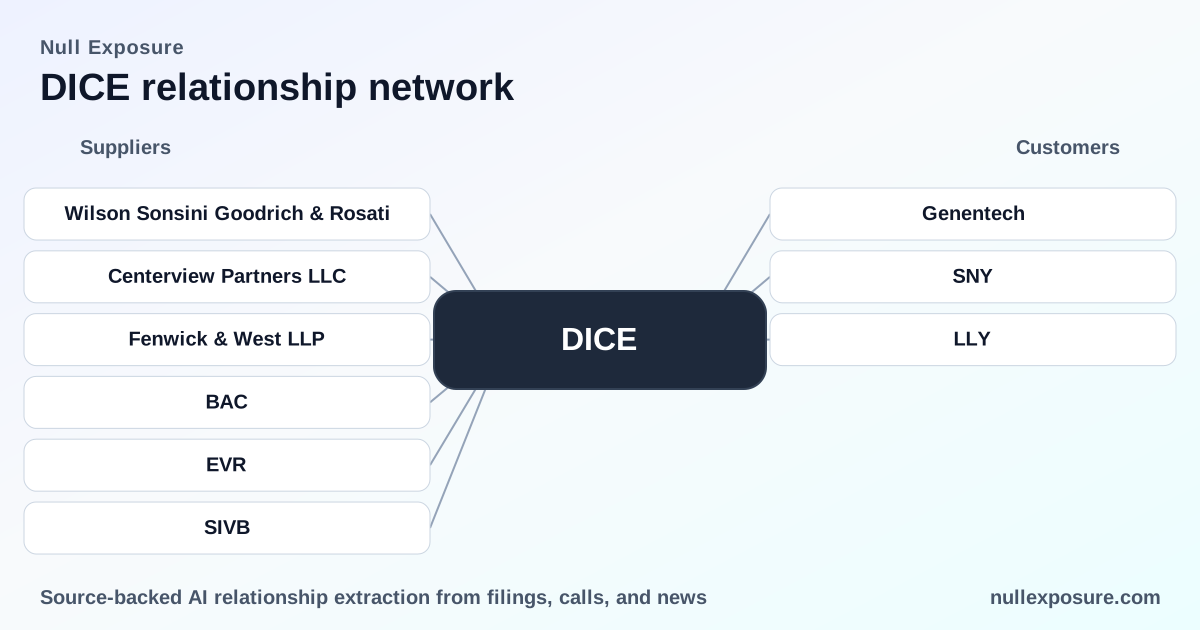
DICE supplier relationships: who advised the company through IPO and sale — and what investors should infer
DICE Therapeutics operates as an asset-centric biotech that developed small-molecule therapeutics and monetized its R&D through public equity markets and a strategic sale. The company generated value by advancing clinical-stage assets to points of de‑risking attractive to acquirers, then realized returns through an IPO in 2021 and an acquisition announced in 2026; its commercial monetization has been transactional rather than revenue-driven. For investors and operators, the relevant signal is that DICE runs a capital‑markets and M&A-focused operating model where external advisory relationships are critical to value realization.
Learn more about supplier risk and relationship intelligence at https://nullexposure.com/.
Why the advisor roster matters for valuation and execution
High-quality financial and legal advisors reduce execution risk, accelerate deal timelines, and increase buyer confidence — all of which directly affect exit valuation. DICE’s list of counterparties reflects conventional choices for a small-cap biotech pursuing a public listing and a strategic sale: elite investment banks for underwriting and sell‑side advisory, and specialist law firms for IP and transaction work. The set of suppliers signals a transactional, deal-centric posture rather than an operating company built on recurring commercial revenue.
If you are benchmarking advisory spend, counterparty strength, or contractual criticality across biotech portfolios, this supplier map is a concise starting point. For a deeper vendor analysis, visit https://nullexposure.com/.
Who provided what — concise relationship summaries
-
Wilson Sonsini Goodrich & Rosati: Wilson Sonsini advised DICE on intellectual property matters in connection with the sale transaction, reflecting engagement of a top-tier tech and life‑science firm for IP protection and transfer issues. This engagement was documented in a firm insights post published March 9, 2026.
Source: WSGR insights (March 9, 2026). -
Centerview Partners LLC: Centerview acted as DICE’s exclusive financial advisor in the acquisition process, indicating a retained sell‑side mandate to steer the negotiation and valuation mechanics for the company. This role is stated in the acquisition press release from March 2026.
Source: PR Newswire — Lilly completes acquisition of DICE Therapeutics (March 2026). -
Fenwick & West LLP: Fenwick & West served as legal counsel to DICE in the transaction, providing counsel on corporate, securities, and transactional law aspects of the sale. The engagement was noted in the same March 2026 press release.
Source: PR Newswire — Lilly completes acquisition of DICE Therapeutics (March 2026). -
BofA Securities: BofA Securities acted as a joint bookrunning manager for DICE’s upsized initial public offering in 2021, demonstrating access to top‑tier underwriting for the company’s capital raise. This role was announced at the time of the IPO pricing on September 15, 2021.
Source: GlobeNewswire — DICE Therapeutics Announces Pricing of Upsized Initial Public Offering (September 15, 2021). -
Evercore ISI: Evercore ISI was named a joint bookrunning manager for DICE’s 2021 IPO, representing institutional distribution capability used during the company’s market debut. The engagement is recorded in the IPO announcement from September 2021.
Source: GlobeNewswire — IPO pricing announcement (September 15, 2021). -
SVB Leerink: SVB Leerink was also listed as a joint bookrunning manager for the 2021 offering, providing life‑science specialist distribution and syndicate coverage for the IPO. This was disclosed in the September 2021 IPO release.
Source: GlobeNewswire — DICE IPO pricing (September 15, 2021).
Operating-model signals and business-model constraints
The dataset does not contain explicit constraint excerpts, so the following are company‑level signals derived from relationship activity and transaction history rather than named constraint documents.
-
Contracting posture: transactional and short‑horizon. DICE engaged boutique and bulge‑bracket advisors for discrete events (IPO, sale), indicating preference for event-driven contracts over ongoing operational vendor relationships.
-
Concentration: moderate diversity of top advisors. Multiple investment banks and law firms appear across the lifecycle, suggesting the company did not rely on a single supplier for capital markets or legal needs, reducing single‑vendor concentration risk for transaction work.
-
Criticality: high for advisory relationships. Financial and legal advisors were critical to capital formation and exit execution; failure or misalignment in these relationships would have materially affected timing and price realization.
-
Maturity and lifecycle: advanced transaction lifecycle. Public listing in 2021 followed by an acquisition announced in 2026 implies a progression from capital raising to exit, signaling a company that executed a planned de‑risking and monetization pathway rather than pursuing long-term commercialization independently.
Investment implications — what this roster says about risk and upside
The supplier map reinforces a straightforward investor conclusion: DICE built value chiefly through R&D to strategic inflection points and relied on external advisors to capture that value. For portfolio managers and operators, the following takeaways matter:
-
Advisory quality lowers execution risk. Engagement of Centerview and major underwriting banks indicates a professionalized sell‑side process that supports full‑value realization at exit. That reduces deal execution discount risk.
-
Legal/IP protection was prioritized. Use of firms like Wilson Sonsini and Fenwick signals attention to IP transfer and corporate documentation, an important factor in biotech transactions where intangible assets drive price.
-
Capital markets vintage matters. The presence of primary-market bookrunners in 2021 demonstrates the company’s ability to access public capital when needed, but the subsequent sale confirms that long‑term commercialization was not the chosen path for investors seeking recurring cash flows.
-
Residual risks for acquirers and counterparty exposures: integration of assets into a larger pharmaceutical platform transfers development and commercialization risk to the buyer; for sellers’ investors, the exit crystallizes returns but eliminates future upside.
Bottom line and action items
For investors evaluating supplier relationships, DICE is a case study in executing a capital-markets and M&A monetization strategy — high-quality advisors, clear transactional posture, and a realized exit. If your due diligence priorities include advisory strength, contractual criticality, or vendor concentration, this company provides a concise blueprint for how those factors influence valuation outcomes.
Explore supplier intelligence and comparative analytics for your portfolio at https://nullexposure.com/.
If you want a tailored supplier risk brief or a cross‑company comparator for life‑science exits, start here: https://nullexposure.com/.