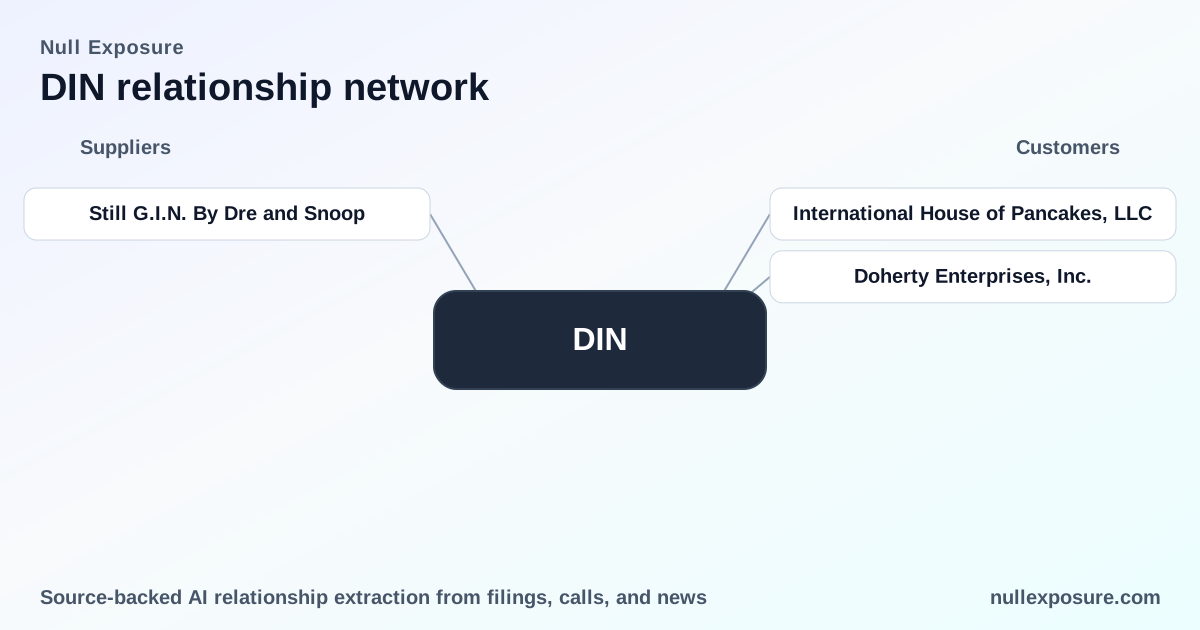
Dine Brands Global (DIN): Supplier relationships, leases and where revenue actually comes from
Dine Brands Global operates two legacy full‑service restaurant franchises — IHOP and Applebee’s — and monetizes through a mix of franchise fees, royalties, rental income and corporate‑operated restaurant profit. The company’s balance of long‑term leases and usage‑linked rents creates a hybrid cash flow profile: stable, contractually anchored cash from long leases combined with volatility tied to system sales through percentage rent. With ~ $879M of trailing revenue and $186.5M EBITDA (FY TTM), the investment case is driven by franchising economics, real estate leasing income and margin expansion on branded menu and beverage programs.
If you want a structured view of supplier and partner exposure for diligence or vendor risk modeling, visit https://nullexposure.com/ for detailed supplier relationship mapping.
The business model in plain English: fees, leases, and distribution muscle
Dine Brands is first a franchisor and second a landlord/operator. The company collects:
- Franchise and royalty income from domestic and international franchisees.
- Rental income and lease‑related cash flows from IHOP and Applebee’s locations where Dine owns or leases real estate.
- Ancillary revenue from corporate‑operated restaurants, beverage and limited‑time promotions, and centralized procurement benefits.
Two constraints in the public record shape how suppliers and partners influence outcomes: long‑term contracting posture and usage‑based (percentage) rent provisions. Lease terms are typically measured in decades, which enforces stability in occupancy and capital deployment; simultaneously, lease language that ties rent to gross sales introduces sensitivity of corporate cash flows to consumer demand. These characteristics define a company that is capital‑intensive, contractually sticky, and partially exposed to top‑line volatility.
Operationally, Dine Brands centralizes purchasing through a cooperative structure for distribution, which creates efficiency but also concentrates sourcing decisions. That dynamic is material for suppliers: winning the co‑op’s approval gives national scale; losing it constrains access to nearly all U.S. Applebee’s and IHOP restaurants.
What the current supplier news says: celebrity gin in the Applebee’s beverage lineup
Two recent media mentions record the same supplier/partner relationship — a promotional beverage tie‑in between Applebee’s and the celebrity brand Still G.I.N. By Dre and Snoop. Each mention is brief and focused on a limited‑time cocktail promotion.
-
Applebee’s rolled out two cocktails featuring Still G.I.N. By Dre and Snoop as part of a “Still Together Sips” menu; the announcement framed this as a limited‑time offer to guests. This was reported by StockTitan on March 9, 2026.
Source: StockTitan news release, March 9, 2026. -
RestaurantNews likewise documented the same limited‑time cocktail promotion, noting the use of the ultra‑premium spirit in Applebee’s promotional menu; the piece ran in February 2026.
Source: RestaurantNews, February 18, 2026.
Both items are tactical marketing and product placement actions rather than a strategic procurement shift; they generate short‑term lift to beverage mix and traffic and are consistent with the company’s pattern of time‑limited menu tie‑ins.
Commercial implications for investors and operators
Promotional supplier relationships like the Still G.I.N. tie‑in are marketing and margin lever for a franchisor operating a hybrid franchising/landlord model:
- Revenue economics: Limited‑time beverage promotions improve beverage unit economics and increase check averages, which feeds through to percentage‑based royalties and, where applicable, percentage rent. Given Dine’s usage‑based lease language, beverage sales lift has the potential to increase landlord receipts alongside franchise/royalty income.
- Procurement and distribution: Dine Brands operates a centralized purchasing cooperative for Applebee’s and IHOP distribution in the U.S., which means national roll‑outs of promotional items are efficient and can be executed at scale. That co‑op is the sole authorized purchasing organization domestically and creates a single channel for supplier access.
- Contracting posture and cash flow profile: The company’s long‑term leases (10–25 years with options) produce durable cash flow but also lock in capital exposure to real estate; percentage rent provisions align landlord and franchisee incentives but introduce sales volatility into cash collections. These are company‑level signals — they affect how suppliers price national programs and how investors model cash flow sensitivity to consumer trends.
- Geographic concentration: Dine’s recent acquisition activity across several U.S. states (e.g., Tennessee, Arkansas, Illinois, Kentucky, Missouri, Mississippi) reaffirms a North American footprint, which supports domestic supplier scale but reduces geographic diversification benefits.
For operators evaluating supplier relationships, the combination of a centralized co‑op and long lease horizons means winning Dine Brands’ procurement channel unlocks significant national volume and stable reorder windows. For investors, these same features imply predictable base cash flows with episodic upside tied to promotional success and macro demand.
Explore a full map of Dine Brands supplier relationships at https://nullexposure.com/ to see how promotional deals, distribution partners, and lease structures interact in cash‑flow models.
Risks and sensitivity — what to watch
- Sales‑linked rent increases volatility: Because many leases guarantee the higher of fixed rent or a percentage of gross sales, system sales shocks flow directly into Dine’s real estate receipts and, indirectly, into royalties.
- Co‑op concentration: Centralized purchasing reduces supplier fragmentation but creates a single point of negotiation power; suppliers face tougher terms to secure system‑wide placement.
- Promotional dependency: Frequent limited‑time offers drive short bursts of traffic but can compress long‑term brand differentiation if overused. Promotional beverage partnerships help margins but do not replace structural sales growth.
Bottom line and next steps
Dine Brands is a franchisor/landlord hybrid that generates stable long‑term cash from lease contracts while capturing upside through percentage rents and promotional programs. The Still G.I.N. placements are symptomatic of a broader go‑to‑market play: leverage national distribution and marketing to lift beverage mix and system sales. Investors should model both the durability of long leases and the volatility introduced by sales‑linked rent language; operators and suppliers should prioritize engagement with the centralized co‑op to win system scale.
For a deep dive into supplier exposures and to map contractual risk across Dine Brands’ network, start here: https://nullexposure.com/. For diligence requests or to subscribe to ongoing supplier relationship monitoring, visit https://nullexposure.com/ — the fastest route to supplier‑level insights on branded restaurant systems.