Daily Journal Corp (DJCO): Supplier Relationships and What They Signal for Investors
Daily Journal Corporation operates as a combined publishing and software business that monetizes through paid legal and regional news publications plus software and services tied to the legal industry. The company generates revenue from subscription and advertising revenues for newspapers and websites, as well as packaged software and services sold to courts, law firms, and legal professionals; this hybrid publisher-software model produces a compact but recurring revenue base and concentrated supplier and vendor needs. For investors evaluating supplier risk and counterparty exposure, the key questions are concentration of counterparties, the historical nature of supplier dealings, and whether supplier relationships are operationally critical or episodic. Learn more at https://nullexposure.com/.
High-level takeaways for investors
Daily Journal is a small-cap, niche operator with a concentrated investor base and modest operating margins. Market capitalization stands around $643 million with trailing revenue near $89.5 million and gross profit around $27.9 million, reflecting a business that is sizeable in niche terms but not broadly diversified. Institutional ownership is high (about 82%), float is limited, and insiders hold a small proportion (4.4%) — these governance and ownership signals influence contracting posture and strategic flexibility.
- Contracting posture: Historical asset purchases and a long operational history indicate the company negotiates both one-off acquisitions and recurring vendor agreements.
- Concentration: The organization’s scale and focused product set imply a limited supplier footprint compared with large media or software incumbents.
- Criticality: Core operations depend on content production and specialized software delivery, so a small number of critical suppliers (printing, hosting, software partners) would have outsized impact if disrupted.
- Maturity: Established publishing roots and a software-industry classification point to a mature, cash-generative entity with conservative capital deployment tendencies.
If you want a concise supplier-risk profile and due diligence workflow built for operators, consider starting with our homepage: https://nullexposure.com/.
All supplier relationships uncovered in public records
Below I cover every supplier relationship identified in the available search results.
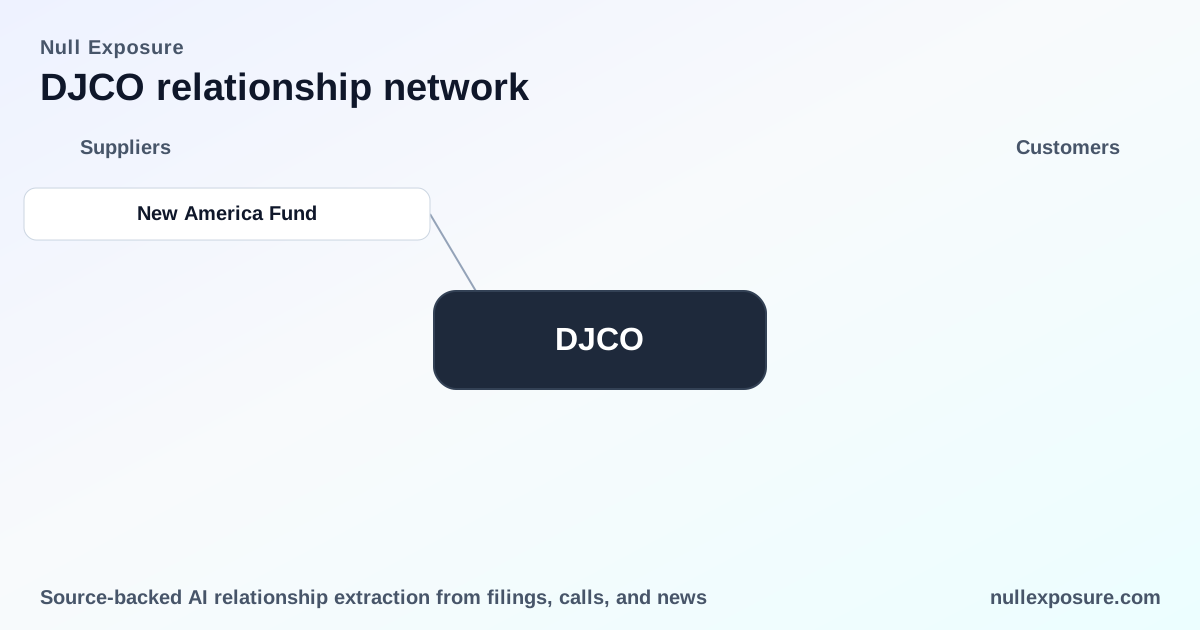
New America Fund — a historical purchase-related counterparty
Daily Journal paid $3 million to the New America Fund in 1986 for the acquisition of the Daily Journal and other newspapers, and the Fund was later liquidated; the payment is noted as a one-time transaction rather than an ongoing supplier arrangement. According to a MetNews feature on Charlie Munger (Nov. 29, 2023), “Munger never received a cent from the newspaper except when the Daily Journal Corporation paid $3 million to the New America Fund in 1986,” a historical corporate finance event rather than a recurring supplier contract (http://www.metnews.com/articles/2023/munger_112923.htm).
How to read that relationship in a supplier-risk framework
The single relationship listed is historical and acquisition-related. This signals two practical points for investors evaluating vendor exposure:
- Operational supplier risk is low in the public record: the only uncovered relationship is a one-off purchase from 1986, which does not indicate current third-party supplier dependency disclosed in the same manner.
- Acquisition activity is part of the corporate DNA: the company has transacted on assets historically, which influences how it negotiates with vendors and counterparties today — management demonstrates willingness to use capital for strategic purchases when judged valuable.
For a practical supplier due-diligence, prioritize printing, hosting, and software-deployment vendors since those are the operationally critical categories for a publisher/software operator like Daily Journal even though they are not surfaced in the search result.
If you need a deeper mapping of supplier criticality and third-party exposure, visit https://nullexposure.com/ for tailored supplier intelligence workflows.
Financial and operating signals that inform supplier strategy
Use the company’s financial profile to infer likely supplier dynamics:
- Small but profitable core: Revenue TTM is roughly $89.5 million with gross profit near $27.9 million and operating margin around 5.5%. These numbers support ongoing vendor payments but leave limited margin for expensive supplier concentration.
- Strong return on equity: ROE near 27.7% signals efficient capital use and strong returns to shareholders, which correlates with disciplined supplier negotiations and a preference for cost-effective contracts.
- Capital structure and valuation factors: Trailing P/E at 7.34 with forward P/E materially higher suggests investors price some near-term earnings variability; enterprise-value multiples (EV/Revenue ~2.32, EV/EBITDA ~1.64) indicate a compact valuation that could constrain aggressive supplier commitments or large multi-year vendor lock-ins without clear ROI.
- Ownership concentration: High institutional ownership and small float increase the likelihood that management will prioritize predictable cash flow and conservative supplier terms to protect margins and reported earnings.
Together, these signals show a company that will favor stable, low-cost suppliers and transactional vendor relationships over expensive strategic vendor lock-ins unless the ROI and strategic value are clear.
Risk indicators and what operating partners should watch
- Lack of public supplier disclosures in the reviewed results means counterparties should request direct contract-level transparency when negotiating with DJCO.
- Concentrated operations make single-supplier failure (printing, hosting, or critical software vendors) more impactful than in larger diversified peers.
- Historical willingness to transact for assets suggests DJCO will use cash to acquire capabilities if supplier economics become unfavorable — a negotiating lever for counterparties but also a potential competitive threat if you supply strategic services.
Final recommendations for investors and operators
For investors, the absence of multiple disclosed supplier relationships and the presence of a historical acquisition payment to New America Fund indicate limited public evidence of supplier concentration but non-negligible operational dependency on core vendors. Demand contract transparency as part of due diligence when assessing counterparty or vendor risk.
For operators and potential suppliers, structure offers that demonstrate clear ROI and predictable cashflow; prefer shorter commitments with renewal options rather than multi-year fixed-cost lock-ins given the company’s margin profile.
If you want continuous monitoring of supplier relationships and targeted alerts for changes that affect DJCO’s counterparty exposure, explore actionable services at https://nullexposure.com/.