Supplier Risk Brief: Trump Media & Technology Group (DJTWW) — vendor posture, contracts, and what the Crypto.com link means for investors
Trump Media & Technology Group (ticker DJTWW) operates and monetizes a proprietary social media platform by combining advertising revenue, platform services, and expanding FinTech features. Revenue recognition is driven by ad sales (the company acts as agent in advertising arrangements), licensing and ownership of core source code, and new product initiatives such as Truth.Fi and prediction markets; these commercial streams are supported by third‑party infrastructure and service providers rather than a vertically integrated stack. For investors and operators evaluating counterparty exposure, the critical signals are long‑dated licensing commitments, outsized reliance on third‑party infrastructure and ad managers, and concentrated, material discretionary spend tied to new financial products. Read more vendor intelligence at https://nullexposure.com/.
Quick read: headline supplier relationships and the single new market-facing tie
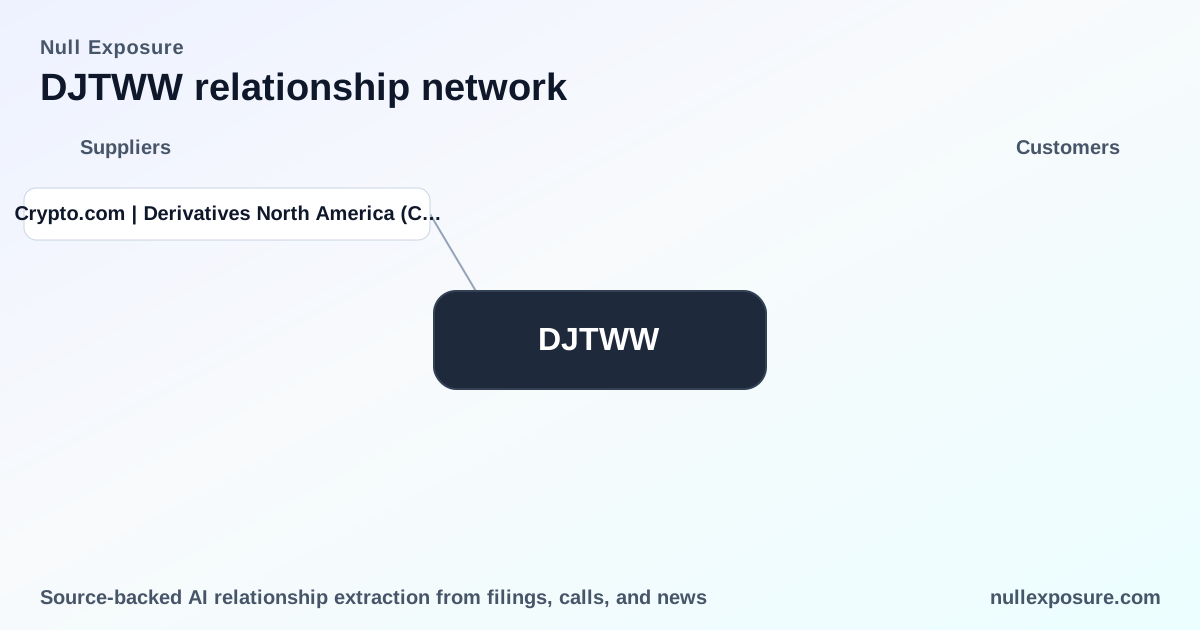
- Crypto.com | Derivatives North America (CDNA): Truth Social will host prediction markets enabled through an arrangement with Crypto.com’s CFTC‑registered derivatives arm. According to a Crowdfund Insider report from October 2025, this partnership positions Truth Social to add derivative-style, crypto-enabled market products directly into its user experience and revenue funnel. (Crowdfund Insider, Oct 2025: https://www.crowdfundinsider.com/2025/10/255115-truth-social-to-serve-as-social-media-platform-offering-prediction-markets-via-crypto-com-partnership/)
How the company’s contracting posture shapes supplier risk
Company filings lay out a mixed contracting posture: the firm holds perpetual, irrevocable rights for certain core software assets while simultaneously outsourcing a substantial portion of the live operational stack to external providers. That combination reduces the risk of losing intellectual property but increases operational concentration and vendor service risk.
- The firm obtained an irrevocable, non‑exclusive, worldwide, perpetual license to CDN-related source code under a Source Code Purchase Agreement; the agreement explicitly grants TMTG broad rights to retain, modify, sublicense and exploit the compiled software for commercial use. According to the company filing describing the Asset Acquisition and Source Code Purchase Agreement, this is a permanent software control signal.
- Simultaneously, TMTG confirms that “a substantial portion” of network infrastructure and operational services are delivered by third parties, including web hosting, content moderation, ad manager platforms and other technology vendors, which makes supplier continuity a first-order operational risk (company filings; latest periods through FY2025).
- Leases and explicit multi‑year restrictions appear in filings: Perception agreed not to permit the Source Code’s use in competing U.S. platforms until August 9, 2029, and the company’s leases show a remaining weighted average term of roughly 3.7 years as of Dec. 31, 2024 — indicating multi‑year stability on property and intellectual property fronts but also fixed cost commitments that limit near‑term flexibility (company filings).
The Crypto.com (CDNA) relationship — short, focused summary
Crypto.com | Derivatives North America (CDNA): Truth Social will offer prediction markets through an arrangement with Crypto.com’s CFTC‑registered derivatives and clearinghouse arm, enabling new product monetization tied to crypto‑enabled market instruments on the platform. A Crowdfund Insider report in October 2025 describes the partnership as the mechanism by which prediction markets will be made available on Truth Social. (Crowdfund Insider, Oct 2025: https://www.crowdfundinsider.com/2025/10/255115-truth-social-to-serve-as-social-media-platform-offering-prediction-markets-via-crypto-com-partnership/)
Other named counterparties and company-level operational signals
While the relationship feed shows one active external partnership, the company disclosure references several named counterparties and service classes that materially affect supplier risk and capital allocation:
- Perception and WCT: The Source Code Purchase Agreement and Asset Acquisition Agreement explicitly reference Perception and WCT, including a non‑compete use restriction through August 2029 and a staged purchase price (the purchase price of $17.5 million payable over three years). These are contractual restraints that secure software control and structure payments (company filing; Asset Acquisition disclosures).
- Advertising manager service companies: Filings state that TMTG enters into ad manager arrangements where third parties supply ad placement services and TMTG recognizes its share of advertising revenue on a net basis (company filings). This makes advertising manager platforms critical revenue conduits rather than replaceable back‑office vendors.
- HIVE (AI moderation vendor): The company names HIVE as an AI moderation supplier supplementing human moderators; this flags dependence on a specific content‑safety vendor for platform trust and compliance (company filings).
- Charles Schwab custody arrangement: TMTG announced up to $250 million to be custodied by Charles Schwab for its Truth.Fi financial services initiative, a material capital allocation signal indicating heavy planned spend in FinTech product development and custody relationships (press release, Jan. 29, 2025).
These excerpts are drawn directly from the company’s public filings and press announcements covering FY2024–FY2025.
Concentration, criticality and spend — the investor implications
- Concentration of operational delivery: A substantial share of hosting, content monitoring, ad serving and other core platform services are external. Operational outages or vendor disputes could directly depress engagement and ad revenue.
- High‑value, staged spend: The Source Code purchase price structure ($17.5M over three years) and the stated plan to custodian up to $250M with Charles Schwab reveal material, targeted capital commitments to platform capability and financial product rollouts.
- Revenue model sensitivity: Advertising revenue is recognized net of ad manager arrangements and TMTG’s disclosures indicate a 70/30 allocation in some ad revenue structures, with Ad Units forming a dominant share of paid ads. Platform monetization is highly dependent on execution of ad manager relationships and marketplace features such as prediction markets.
For ongoing monitoring, prioritize vendor SLAs for the hosting and CDN suppliers, the legal mechanics of the Source Code license and non‑compete terms, and the timeline and governance of the Crypto.com (CDNA) integration for prediction markets.
If you want a structured vendor exposure report or a tailored supplier risk matrix for DJTWW, start here: https://nullexposure.com/.
Practical investor checklist
- Confirm the timeline and commercial terms of the Crypto.com prediction markets rollout and the revenue share/fee model tied to those products. The partnership is product‑level transformative and will affect revenue composition.
- Review the Source Code Purchase Agreement and non‑compete language with Perception and WCT to understand enforced exclusivity periods and any residual operational dependencies.
- Verify ad manager counterparty concentration and contractual termination provisions, since ad revenue is net‑recognized and operationally mediated by these vendors.
- Monitor custody and capital deployment tied to Truth.Fi — funds custodied at Charles Schwab and the stated up‑to $250M commitment are a clear signal of capital intensity for FinTech expansion.
For a detailed supplier risk scorecard, explore our tools and reports at https://nullexposure.com/.
Bottom line
DJTWW is a media‑technology operator that combines ownership of critical software IP with a heavy operational reliance on third‑party service providers and large, staged capital commitments to new financial products. That hybrid model lowers IP loss risk but raises operational concentration and integration risk — the Crypto.com (CDNA) relationship is an important strategic lever that changes the revenue mix if executed cleanly. Investors should treat vendor SLAs, ad manager economics, and the legal framing of source code ownership as the primary determinants of operational resiliency and near‑term revenue trajectory.