Delek US (DK) — Logistics exposure defines the downstream margin story
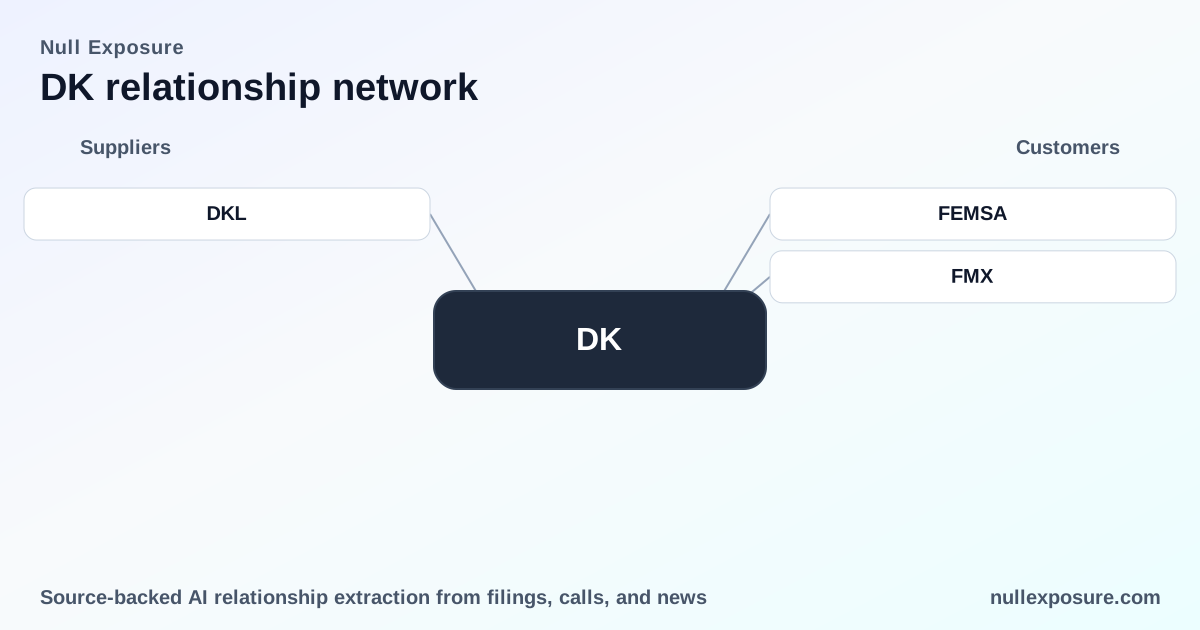
Delek US operates an integrated downstream energy business: it refines crude, distributes finished product, and owns a controlling interest in logistics assets that capture both tariff and throughput economics. The company monetizes through refining margins, retail and wholesale fuel sales, and logistics fees/tariffs generated by Delek Logistics — a relationship that is both an internal profit center and a core supplier for feedstock and distribution. For investors evaluating DK supplier exposure, the Delek Logistics relationship is material, long-term, and operationally critical to refinery uptime and working capital flows. Learn more at https://nullexposure.com/.
Why the logistics tie matters to equity returns
Delek’s financial profile shows a leveraged dependence on refining margins (Revenue TTM $10.7B; Operating Margin ~7.1%) while ownership of logistics gives the company a dual role as operator and customer. Ownership of the general partner and a majority LP interest in Delek Logistics aligns cash flow capture with operating needs, but also concentrates counterparty, geographic, and contract risk into a single operating footprint across Arkansas, Louisiana, Oklahoma, Tennessee and Texas. The economics are not trivial: intercompany costs and throughput fees in the latest reporting are in the hundreds of millions, creating both upside from integrated margins and downside from any disruption to pipeline or terminal services. If you want a concise portal to supplier risk and relationship analytics, visit https://nullexposure.com/.
Relationship: Delek Logistics Partners, LP — Form 10‑K notice (StockTitan)
Delek US owns the general partner interest and a majority limited partner stake in Delek Logistics and is described as a significant customer of that business, embedding the logistics business into DK’s operating model and cash flows. (Source: StockTitan news item referencing Delek Logistics Partners, LP Form 10‑K, posted 2026-03-09 — https://www.stocktitan.net/news/DK/delek-logistics-partners-lp-2025-form-10-k-available-on-fhm8qoh9glc5.html)
Relationship: Delek Logistics Partners, LP — Distribution and distribution fee update (StockTitan)
Public communications around distribution changes reiterate that Delek US both controls Delek Logistics and uses its pipelines, terminals and tankage as a primary supplier for crude and refined products, reinforcing economic integration and operational dependency. (Source: StockTitan news item on quarterly cash distribution increase, posted 2026-03-09 — https://www.stocktitan.net/news/DK/delek-logistics-partners-lp-increases-quarterly-cash-distribution-to-j7s3kkaf0uy8.html)
What the disclosures and constraints tell investors (practical implications)
The company disclosures and extracted constraints paint a clear operational picture useful for due diligence and scenario planning:
-
Long-term contracting posture: DK discloses several long-term pipeline, terminal, tankage and throughput agreements with initial terms of five to seven years and options to extend; many agreements run through 2025–2036, which makes capacity and service continuity contractually anchored. The FY2026 Form 10‑K language confirms the multi-year nature of these arrangements and the refineries’ reliance on those assets.
-
Geographic concentration with operational consequences: Delek Logistics’ network sits inside Delek’s footprint in Arkansas, Louisiana, Oklahoma, Tennessee and Texas while natural gas sourcing skews Gulf Coast and Permian supplies; this regional concentration increases single‑event exposure to Gulf Coast/Permian supply chain shocks.
-
Materiality and criticality: The refineries at Tyler, El Dorado and Big Spring are stated as substantially dependent on Delek Logistics’ assets and services, making the logistics relationship material to production continuity.
-
Dual relationship role — buyer and service provider: Internally, Delek’s refining segment purchases finished product from the logistics segment and pays terminalling and storage fees, while Delek Logistics generates revenues from tariffs, capacity leases and storage fees to third parties; this creates intercompany flows that are both revenue and cost drivers for consolidated results.
-
Active, mature relationship: The relationship is not nascent — agreements are active and contract terms exhibit mid-to-long maturity, producing predictable cost baselines and capacity commitments for planning.
-
Distribution/transportation segment exposure: The relationship sits inside the distribution/terminalling segment, so logistics operational performance directly influences throughput economics and refinery gross margins.
-
High spend band at the company level: Reported intercompany costs and fees were $516.3 million in 2024 and $562.2 million in 2023, and total obligations under an Inventory Intermediation Agreement were reported at $408.7 million — a company-level signal that working capital and service fees are substantial line items even after consolidation.
Investment implications — key risks and levers
-
Upside — integrated cash capture: Ownership of logistics creates recurring tariff income and reduces third‑party transport friction, supporting higher free cash flow potential when refining margins are healthy.
-
Risk — concentration and single‑counterparty exposure: With refineries substantially dependent on Delek Logistics and geography concentrated in the Gulf and Permian corridors, a regional outage or asset impairment would have outsized earnings impact and could raise replacement transport costs.
-
Contract stability reduces short-term operational risk: The presence of long-term agreements through 2025–2036 shifts some operational exposure into contractual risk rather than spot availability, improving predictability of throughput fees.
-
Working capital and intercompany flow sensitivity: Large intercompany fees and inventory agreements imply that cash flow timing, collateral and inventory financing terms are material; investors should treat working capital volatility as a first-order earnings risk.
Consider reviewing counterparty continuity clauses, tariff pass-through mechanics, and inventory financing terms before sizing a position — for practical supplier risk analytics, see https://nullexposure.com/.
Actionable next steps for investors and operators
-
Request the latest Form 10‑K/10‑Q exhibits that enumerate the pipeline and terminalling contracts and the specific expiry/extension schedules to model tail‑risk beyond 2036. The FY2026 narrative is explicit about contract terms and regional footprint.
-
Stress-test refinery throughput against regional outage scenarios and alternative logistics sourcing costs to quantify downside to EBITDA under interruption.
-
Monitor distributions and tariff changes from Delek Logistics as leading indicators of capital allocation shifts between the logistics and refining segments.
For a consolidated view of supplier relationships, contract maturities and spend exposures tailored to investment diligence, visit https://nullexposure.com/ — the hub for relationship‑level insight and supplier risk signals.
Bottom line
Delek US’ ownership and operational dependence on Delek Logistics is a strategic advantage that also concentrates risk. Contractual terms provide stability, but geographic concentration and large intercompany fees create leverage to logistics performance and working capital mechanics that investors must explicitly model into valuation and stress scenarios. For deeper supplier relationship intelligence and to download the supplier report referenced here, go to https://nullexposure.com/.