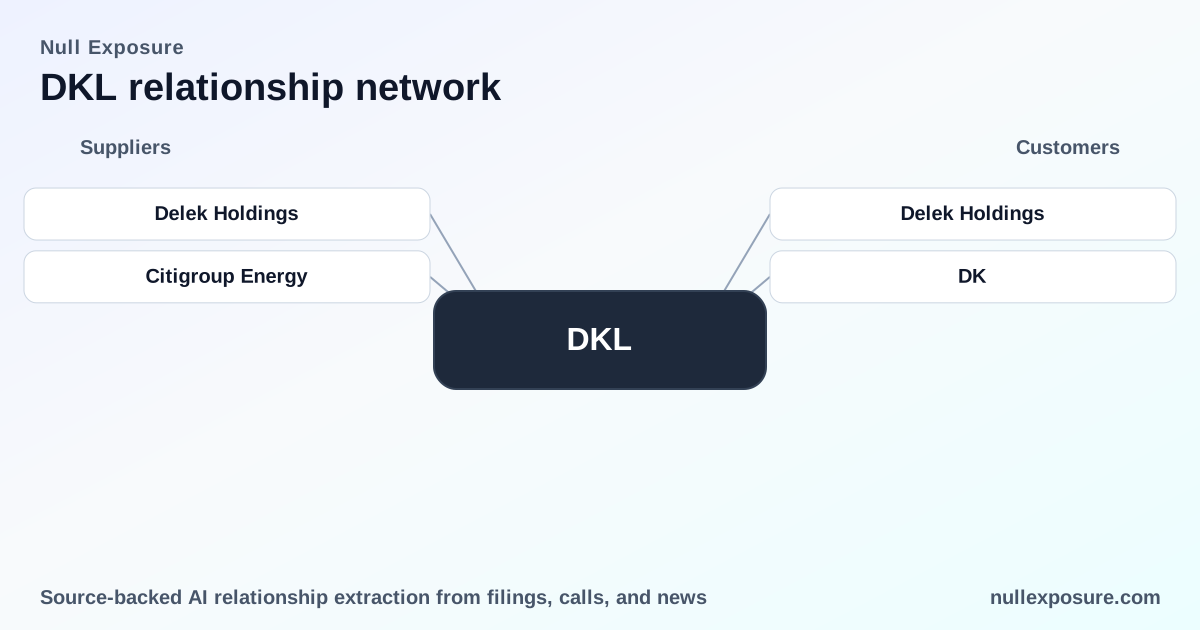
Delek Logistics (DKL) — supplier relationships, concentration, and what investors should price in
Delek Logistics monetizes a set of midstream assets by charging fee‑based and commodity‑linked fees for crude gathering, transportation, storage, terminalling and marketing services, while also transacting product purchases and sales with affiliate and third‑party counterparties. Revenue derives from a mix of long‑term, fee‑based contracts and commodity flows, with material purchases from an affiliate that create both revenue capture and counterparty concentration. For primary disclosures and model inputs, consult the partnership's filings or visit the research hub at https://nullexposure.com/ for fuller context.
How DKL makes money and why its counterparty footprint matters
Delek Logistics is an asset‑centric midstream operator: pipelines, terminals, storage tanks, gathering systems and related marketing functions generate cash through long‑term fee schedules, throughput charges and product margins when the partnership purchases and resells refined volumes. The company reports meaningful fee‑based agreements with Delek Holdings and sells services broadly to third parties across Texas, New Mexico, Tennessee and Arkansas, so its operating cash flow is a hybrid of durable fee revenue and working‑capital driven commodity turnover. According to the FY2024 Form 10‑K, the Partnership emphasizes long‑term, fee‑based commercial agreements with Delek Holdings for gathering, transportation, storage, and marketing services.
For a quick gateway to the supplier network and relationship details, see https://nullexposure.com/.
Key relationship snapshots you need to know
Below are the counterparties cited in DKL’s FY2024 disclosures and the practical takeaways for investors and operators.
-
Delek Holdings
Delek Logistics maintains long‑term, fee‑based commercial agreements with Delek Holdings covering crude gathering, transportation, storage, marketing, terminalling and offloading; in addition, the Partnership purchased $349.3 million of refined products from Delek Holdings during the year ended December 31, 2024, creating material bilateral flow and spend concentration. According to the Partnership’s FY2024 Form 10‑K, these arrangements are a core component of DKL’s revenue and purchase activity. -
Citigroup Energy
Under financing arrangements between Delek Holdings and its subsidiaries and Citigroup Energy, Delek Holdings assigned certain rights to Citi under specific terminalling, pipeline, storage and asphalt services agreements, creating a financing‑linked claim on contractual rights rather than a traditional service relationship. The FY2024 10‑K documents that assignment as part of Delek Holdings’ financing structure, which impacts how contractual cash flows and rights can be encumbered for lenders such as Citigroup Energy.
What the constraints and contract signals say about DKL’s operating model
The filing language and evidence excerpts define the partnership’s contracting posture and risk profile in investor‑relevant terms:
-
Contracting posture: a mix of long‑term fee contracts and spot activity. The business emphasizes long‑term, fee‑based contracts with affiliate customers for core midstream services, while also conducting spot purchases for West Texas barrels that support trading and local flows—this combination drives both revenue stability and working‑capital volatility. The FY2024 filing explicitly notes long‑term, fee‑based agreements alongside the statement that “the remainder of the barrels we sell in West Texas are spot purchased.”
-
Concentration: material affiliate exposure. The disclosed $349.3 million of purchases from Delek Holdings signals concentrated bilateral flows; that level of affiliated spend is a meaningful input to counterparty and cash‑flow risk assessment. This is presented in the FY2024 10‑K’s discussion of related‑party transactions.
-
Criticality: services are operationally essential. Contracts with Delek Holdings cover gathering, transportation, storage and marketing, functions that are core to both producers’ and refiners’ operations and thus critical to throughput and revenue generation for DKL. The 10‑K frames these services as principal revenue drivers.
-
Maturity and encumbrance: financing can attach to contract rights. The assignment of rights to Citigroup Energy under financing arrangements demonstrates that contractual cash flows and operating rights can be used as collateral or assigned in support of financing — a structural consideration for lenders and equity holders assessing recoverability. The FY2024 disclosures on Citi’s assignments describe this dynamic.
-
Service‑provider posture for non‑core capabilities. The Partnership references leveraging third‑party managed security services to enhance cybersecurity capabilities, indicating a selective outsourcing strategy for non‑core but critical functions (company‑level signal from the FY2024 filing).
Collectively, these signals describe a business that balances durable, fee‑based midstream cash flows against commodity exposure, affiliated‑counterparty concentration, and financing encumbrances.
Financial impact and risk profile for investors
From a valuation and risk allocation perspective, the mix of fee revenue and purchase/sale activity gives DKL both defensive and cyclical characteristics:
-
Defense via fee contracts: Fee‑based throughput and storage revenues underpin predictable EBITDA; the FY2024 financials show a reported EBITDA of approximately $295.5 million and a trailing operating margin that supports distributable cash flow assumptions used by midstream investors.
-
Volatility via commodity and affiliate flows: Spot purchasing and large affiliate purchases (>$300M annually) introduce working‑capital swings and counterparty concentration risk that can amplify earnings variability and expose the partnership to affiliate credit or operational shocks.
-
Structural leverage via assigned rights: Financing arrangements that assign contractual rights to lenders (e.g., Citigroup Energy) reduce unencumbered free cash flow and can limit operational flexibility under stress scenarios.
These dynamics should be priced into relative valuation metrics such as EV/EBITDA (reported ~10.8x) and forward multiples; the company’s dividend profile and reported yield also reflect management’s allocation of cash to distributions.
If you need the full relationship map and document references for diligence, view the supplier dossier at https://nullexposure.com/.
Operational and counterparty diligence checklist for owners and operators
Operators and risk managers should prioritize the following when evaluating exposure to DKL relationships:
-
Confirm the tenor and termination mechanics of the fee‑based agreements with Delek Holdings and whether volumes or fees reset with market indices. The 10‑K highlights long‑term fee structures but operational schedules require contract text review.
-
Model cash‑flow sensitivity to spot purchase volumes in West Texas and the working‑capital impact of affiliate purchase cycles.
-
Assess the priority of assigned rights under financing arrangements to determine recovery seniority and restrictions on asset transfers or collateral substitution; the FY2024 filing documents Citi’s assignment activity.
-
Validate cybersecurity and outsourced service SLAs where DKL relies on third‑party managed security services to protect operational systems.
For direct access to the partnership’s summaries and supplier analytics, return to https://nullexposure.com/.
Bottom line and investor actions
Delek Logistics combines stable fee‑based midstream revenue with meaningful commodity flow and affiliate purchase exposure. Investors should value the cash‑flow durability provided by long‑term contracts while explicitly modeling counterparty concentration (notably Delek Holdings) and the implications of assigned contractual rights to financiers like Citigroup Energy. For active managers and operators, the priority is tight contract diligence and stress testing around spot purchase cycles.
Explore supplier-level intelligence and primary‑document references at https://nullexposure.com/ to support underwriting and operational oversight.