Dick’s Sporting Goods (DKS): the supplier map investors need
Dick’s Sporting Goods generates revenue by retailing sporting goods through a mix of owned brands, national suppliers and experiential formats (House of Sport, Fieldhouse). The company monetizes via merchandise margin, extended-store formats that drive higher sales per square foot, marketplace/commerce-media placements, and loyalty-driven repeat purchases — all supported by long lease commitments for flagship locations and short-term purchase arrangements with vendors. For investors evaluating supplier risk and opportunity, the interplay of vendor concentration (notably Nike), real-estate partnerships, and strategic service deals (Adobe, Fluent, payments and resale tech) is central to revenue durability and margin expansion. Explore supplier relationships and operating constraints below.
Learn more at NullExposure.
Why the supplier map matters now
Dick’s is shifting from pure retail into an experience-anchored operator: House of Sport rollouts, vertical brands scale, and commerce-media tie-ins change the nature of supplier leverage. That translates into larger, more strategic vendor relationships for premium launch windows and exclusive SKUs, and parallel exposure to landlord and logistics counterparties. The items below summarize how those relationships show up in public filings and recent press.
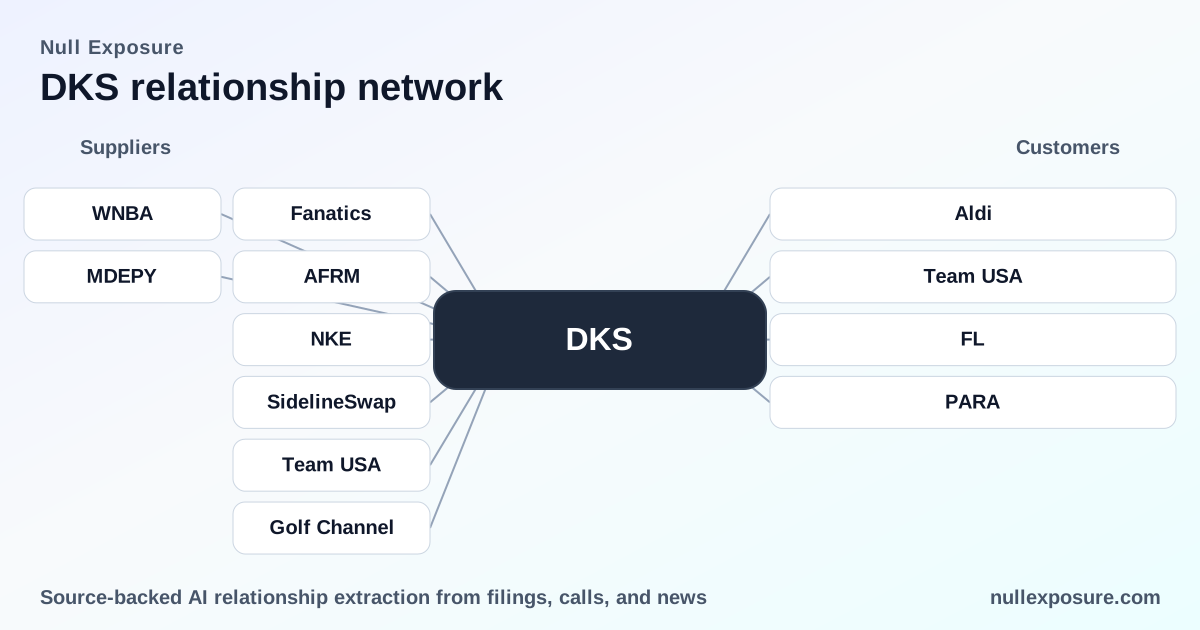
Every supplier and partner called out in the documented results
- Fanatics — Dick’s partners with Fanatics on collectibles and trading-card experiences; the company stated the Collector’s Clubhouse is live in 20 House of Sport locations and will be included in future openings (Q3 2025 earnings call, March 2026 transcript).
- MAC (Macerich) — Macerich notes multiple committed House of Sport locations and expects a new House of Sport at Crabtree Valley Mall in fall 2026, signaling landlord demand for DKS anchor leases (Macerich earnings / press, FY2026).
- PINE (Alpine Income Property Trust) — Alpine’s disclosures list Dick’s as a top tenant representing roughly 10% of ABR and show Dick’s credit rating placements, highlighting Dick’s importance to single-asset and REIT cash flows (Alpine quarterly reports, Q1 FY2026 / FY2026 filings).
- FLNT (Fluent Inc.) — Fluent lists Dick’s among retail partners for commerce-media offers, indicating DKS is a client for performance-driven marketing programs that open an incremental revenue channel (Fluent press and earnings commentary, FY2026).
- Nike (NKE) — Nike accounted for approximately 25% of Dick’s merchandise purchases in FY2025, making it a structural sourcing concentration and a critical brand for key drops and activations (DKS FY2025 10‑K).
- Under Armour (UA / UAA) — Under Armour product launches and youth-sports collaborations with Dick’s are part of shared go-to-market initiatives and co-branded programs (company press releases and PR wires, FY2026 period).
- Adidas / Jordan — Dick’s cited NBA All‑Star activations with Nike, Jordan and Adidas as examples of coordinated brand launches that drove exceptional sell-through, reflecting block-booking and event-based inventory leverage (DKS Q4 FY2025 earnings transcript, May 2026).
- Gymshark — DKS serves as Gymshark’s first U.S. wholesale partner, with Gymshark rolling out through House of Sport and broader Dick’s formats (DKS earnings commentary, FY2026).
- New Balance — New Balance product placements and launch management are noted in DKS merchandising narratives tied to footwear and lifestyle displays (DKS Q4 FY2025 transcript, FY2026).
- Columbia (COLM) — Columbia reports tripling certain product placements in Dick’s stores, signaling expanded wholesale shelf space and distribution reach via DKS (Columbia investor commentary, FY2026).
- Peloton (PTON) — Dick’s sells Peloton equipment in-store as part of broader fitness-equipment assortments and experiential demos (Peloton executive commentary, FY2025).
- SidelineSwap — Dick’s launched a trade‑in program for baseball/softball bats powered by SidelineSwap resale technology, formalizing a circular-retail channel (DKS press release, March 2026).
- Affirm (AFRM) — Dick’s extended Affirm checkout partnership to provide flexible payment options online, supporting average order value and conversion improvements (news reporting on partnership renewals, FY2026).
- Adobe (ADBE) — DKS partnered with Adobe to deploy enterprise solutions and AI-driven personalization to tailor athlete experiences across channels (Adobe press release and DKS filings, April 2026).
- FLNT (additional references) — Fluent’s commerce-media mentions reinforce DKS’s role as an advertising and offer distribution partner (Fluent press coverage, FY2026).
- FVR (Frontview REIT) — Frontview reported acquiring a Dick’s House of Sport as a large asset purchase, demonstrating third-party investor appetite for DKS-anchored properties (FVR earnings/press, FY2026).
- SPG-P-J (Simon Property Group) — Simon’s redevelopment projects include planned Dick’s House of Sport openings, a sign that premier mall owners continue to trade space for experiential anchor tenants (Simon/press release, FY2025/2026).
- CTO Realty Growth — CTO’s acquisition materials describe Dick’s as an anchor at Ashley Park, emphasizing Dick’s role stabilizing off‑mall centers (market press, FY2025).
- SITC (Site Centers) — Site Centers highlights properties anchored by Dick’s, signaling steady leasing demand from the retailer (market press, FY2025).
- UE (Urban Edge Properties) — Urban Edge disclosed a lease termination with Dick’s at Sunrise Mall, an example of portfolio-level tenant turnover impacting mall dynamics (Urban Edge earnings transcript, FY2026).
- SRG-P-A (Seritage Growth Properties) — Leasing brochures show Dick’s co-tenant status in shopping centers formerly owned/managed by Seritage, illustrating Dick’s footprint in repositioned retail assets (local leasing materials, FY2023).
- SBDS (company filings / 10‑K references) — SBDS filings reference customer concentration risk connected to Dick’s, underscoring Dick’s pull as a wholesale/retail partner across brand rollouts (SEC filings, FY2024).
- Team USA — DKS’s official partnership with Team USA includes merchandising rights across stores and digital channels, expanding licensed product revenue (DKS press release, FY2026).
- CBL — Mall-asset owner commentary noted that Dick’s and other national anchors backfilled closed department-store boxes, supporting property stabilization (local press/asset sale commentary, FY2018–ongoing).
- AS (Amer Sports) — Tests like the Tennis 360 pilot were run in Dick’s formats, suggesting DKS is a launch partner for sporting-technology programs (industry press, FY2025).
- Golf Channel / MDEPY / Arnold — Product and media tie-ins (e.g., ad spots for golf product launches) show coordinated marketing campaigns across broadcast and in-store merchandising (campaign press, FY2026).
- On (ONON) and Hoka (DECK) — Brand reception for running and performance categories within DKS formats was discussed on earnings calls, showing DKS’s role in expanding category mix beyond basketball/heritage footwear (DKS earnings transcript, FY2026).
- WNBA — DKS extended merchandising and partnership deals with the WNBA, integrating league merchandise and promoting sports equity initiatives (partner press, FY2026).
What this map means for investors
- Concentration risk is real and measurable: Nike accounted for ~25% of merchandise purchases in FY2025, creating a vendor-dependence vector that directly affects inventory cost and promotional dynamics (DKS 10‑K, FY2025).
- Real estate anchors stabilize cash flows: Multiple REITs and mall owners list Dick’s as a top tenant, and DKS’s long initial lease terms (10–15 years with renewals) make the company a durable landlord counterparty — in parallel, most merchandise purchases are short-term purchase-order based, so DKS carries supplier flexibility rather than long purchase commitments (company lease language and purchase-order disclosures).
- New monetization channels reduce product-only reliance: Partnerships with Adobe and Fluent introduce higher-margin services (personalization, commerce media) and amplify owned-brand economics. These service relationships reshape margin drivers away from pure wholesale trading.
- Physical expansion is strategic and capital-intensive: House of Sport openings are drawing landlord and REIT investment but increase exposure to construction and location risk; several mall redevelopments and asset purchases referenced Dick’s anchors in FY2025–FY2026 press.
Operational constraints investors should treat as company-level signals
- DKS stores generally have long lease terms (10–15 years) with renewal options, creating durable occupancy cost structure that underpins experiential formats.
- At the same time, vendor purchases are transacted via short-term purchase orders, preserving buying flexibility but increasing exposure to supplier negotiation cycles.
- Vertical brands are material, representing roughly $1.7bn or ~13% of net sales in fiscal 2024, a structural driver of margins and private-label upside.
- A meaningful portion of merchandise is manufactured abroad, exposing margin to trade policy, tariffs and logistic disruption.
- Reported funded participation liabilities in accounts payable (~$45–$50m range historically) indicate mid-range vendor financing and working-capital commitments consistent with a $10m–$100m spend band signal in certain supplier arrangements.
Visit NullExposure for an interactive supplier risk dashboard and primary-source highlights.
Bottom line: Dick’s Sporting Goods combines high brand concentration with a diversified partner set that extends from manufacturing and wholesale to marketing technology and real‑estate landlords. Investors should weigh the margin benefits of owned brands and experiential stores against vendor concentration and international supply-chain exposure documented across filings and recent press.