dLocal (DLO): Underwriters, partners and what supplier relationships signal to investors
dLocal operates a cross-border payments platform that connects global merchants to local payment rails in emerging markets, monetizing primarily through transaction fees, settlement spreads and value-added payment services. The company’s scale (Revenue TTM $960m, Market Cap $3.35bn) and strong margins position it as an attractive payments infrastructure supplier for large e‑commerce and tech clients; capital markets relationships and fintech partnerships shape both its funding runway and product roadmap. For investors evaluating supplier exposure, the recent underwriting syndicate and stablecoin partnerships are the most material supplier relationships to track. Learn more at https://nullexposure.com/.
Why the underwriting syndicate matters for supplier risk and liquidity
dLocal deployed a formal underwriting group to execute a secondary offering and related transactions in 2025–2026, an action that both provides liquidity for shareholders and signals ongoing access to top-tier capital markets. Engagement with global coordinators such as J.P. Morgan, Goldman Sachs and Morgan Stanley demonstrates institutional distribution capability and a willingness by large banks to underwrite follow-on supply. That distribution capability reduces immediate refinancing risk for the company but introduces share-supply dynamics that investors must price into valuation and liquidity models. A news release and subsequent press coverage documented the launch, pricing and eventual closing of the offering. For a deeper view of dLocal’s supplier relationships and market signals visit https://nullexposure.com/.
The supplier network, one relationship at a time
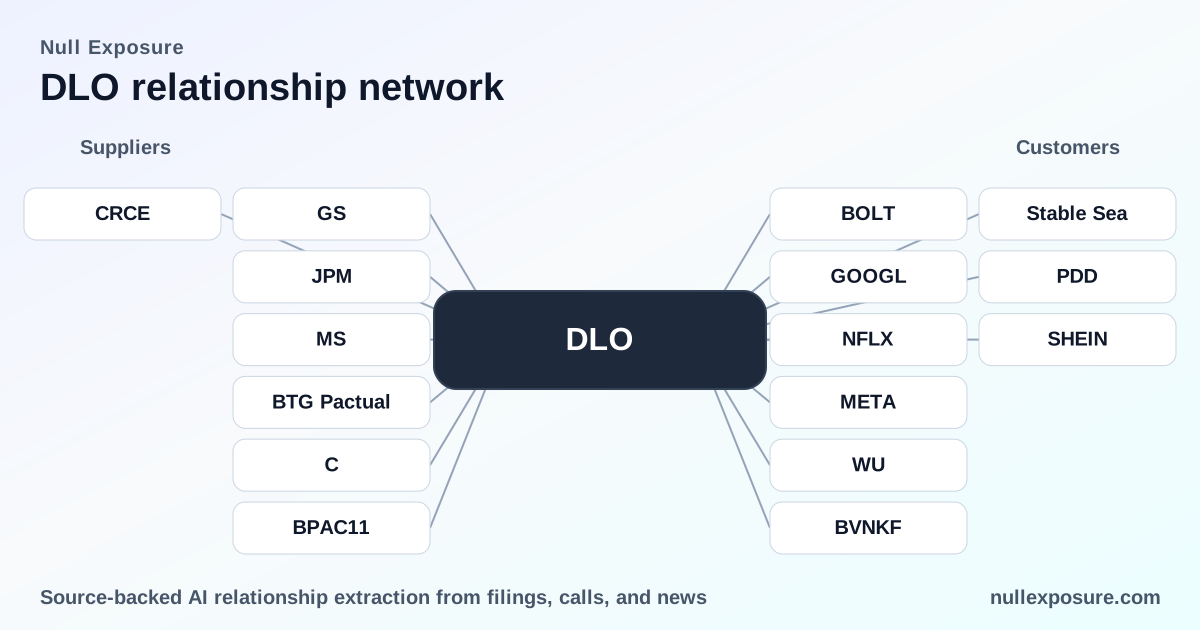
dLocal’s public reporting and market coverage identify a small set of repeat counterparties tied to its secondary offering and a fintech partnership. Below are the relationships surfaced in public sources and what each partner contributes in plain language.
J.P. Morgan
J.P. Morgan acted as a global coordinator and joint bookrunner for dLocal’s underwritten secondary offering, leading syndicate distribution and underwriting oversight. According to the GlobeNewswire press release (September 3, 2025) and multiple market reports, J.P. Morgan led the underwriting group alongside Goldman Sachs and Morgan Stanley.
Goldman Sachs & Co. LLC
Goldman Sachs served as a global coordinator and joint bookrunner on the secondary offering, providing sell-side distribution and placement capabilities to institutional investors. Market coverage and the company announcement confirmed Goldman as a lead manager for the transaction (GlobeNewswire, September 3, 2025).
Morgan Stanley
Morgan Stanley was named as a global coordinator and joint bookrunner on the underwritten secondary, participating in the underwriting syndicate and distribution to buy-side clients. Press reports and secondary offering disclosures list Morgan Stanley alongside J.P. Morgan and Goldman as a coordinator (GlobeNewswire; stocktitan and quiverquant coverage, FY2025).
Citigroup
Citigroup participated as a joint bookrunner in the underwriting group, supporting distribution in key institutional channels and regional desks. The company’s offering documents and press distribution note Citigroup’s role in the syndicate (GlobeNewswire; stocktitan coverage, FY2025).
BTG Pactual
BTG Pactual joined the syndicate as a joint bookrunner, bringing Latin American distribution reach and local market placement that complements the global banks’ networks. The underwriting announcement lists BTG as a joint bookrunner for the offering (GlobeNewswire and stocktitan reporting, FY2025).
Circle
dLocal has active partnerships with Circle to enable stablecoin settlement and on/off‑ramp services, integrating crypto-native settlement rails into its product set to accelerate cross-border transfers and reduce settlement friction. FXCintel research and earnings commentary cataloged the Circle partnership and related stablecoin initiatives as part of dLocal’s strategy to expand payment rails (FXCintel, Q2 2025 research).
What the relationships imply about contracting posture, concentration and criticality
- Contracting posture: Engagements with top-tier global banks for underwriting work indicate an institutional, arm’s-length contracting posture for capital markets activity; dLocal sources capital-market services through established global providers rather than boutique or in-house placement. This is a maturity signal for corporate financing practices.
- Concentration: Although the syndicate is concentrated among a handful of large banks, the mix includes both global coordinators and regional players (BTG) — a balanced concentration that provides depth in distribution while keeping counterparty risk manageable.
- Criticality: Underwriters are critical to share liquidity and investor access but are not operational suppliers to dLocal’s payments processing; conversely, partners like Circle are operationally significant because they affect settlement rails and product scope.
- Maturity: The composition and execution of the syndicated offering demonstrate corporate sophistication and market acceptance by leading investment banks, which is consistent with a company that has matured from early-stage capital raises to structured secondary-market transactions.
Note: no constraints were returned in the supplier relationship payload as direct contractual restrictions; the above observations are company-level signals derived from the relationship mix and public announcements.
Investment implications — what investors and operators should watch
- Positive: The presence of J.P. Morgan, Goldman Sachs and Morgan Stanley as global coordinators is a clear positive for market access, reducing the probability of a failed raise and supporting liquidity for shareholders. dLocal’s growth metrics (quarterly revenue growth YOY 52.1%) and profitability (Operating Margin TTM 19.7%) underpin a valuation supported by both growth and margin profile.
- Risk: Secondary offerings increase share supply and can pressure near-term share performance; the underwriting syndicate’s 30‑day option to purchase additional shares (reported in market coverage) introduces a potential for further supply if exercised. Market reaction to the launch and pricing was visible in coverage that noted notable share volatility around the announcement (The Globe and Mail / Motley Fool coverage, FY2025).
- Product angle: The Circle partnership for stablecoin settlement is material to product differentiation — it reduces settlement friction and supports merchant demand for fast, low-cost cross-border settlement, shifting operational risk from fiat rails to stablecoin rails that require monitoring of regulatory and custody exposure.
For further analysis of dLocal’s supplier relationships and how they affect financing and operational risk, visit https://nullexposure.com/ for our full supplier intelligence coverage.
Final takeaways
- dLocal has institutional underwriting relationships with major global banks, which preserves market access and institutional distribution for equity transactions.
- Operational partnerships such as Circle change the settlement economics and represent a strategic expansion of dLocal’s payments rails.
- Investors should weigh capital-market liquidity benefits against dilution and short-term share pressure from secondary offerings; tracking underwriter option exercises and partnership rollouts is essential.
If you are evaluating counterparty risk or sizing exposure to payments suppliers, our platform synthesizes these relationship signals into actionable intelligence — start your review at https://nullexposure.com/.