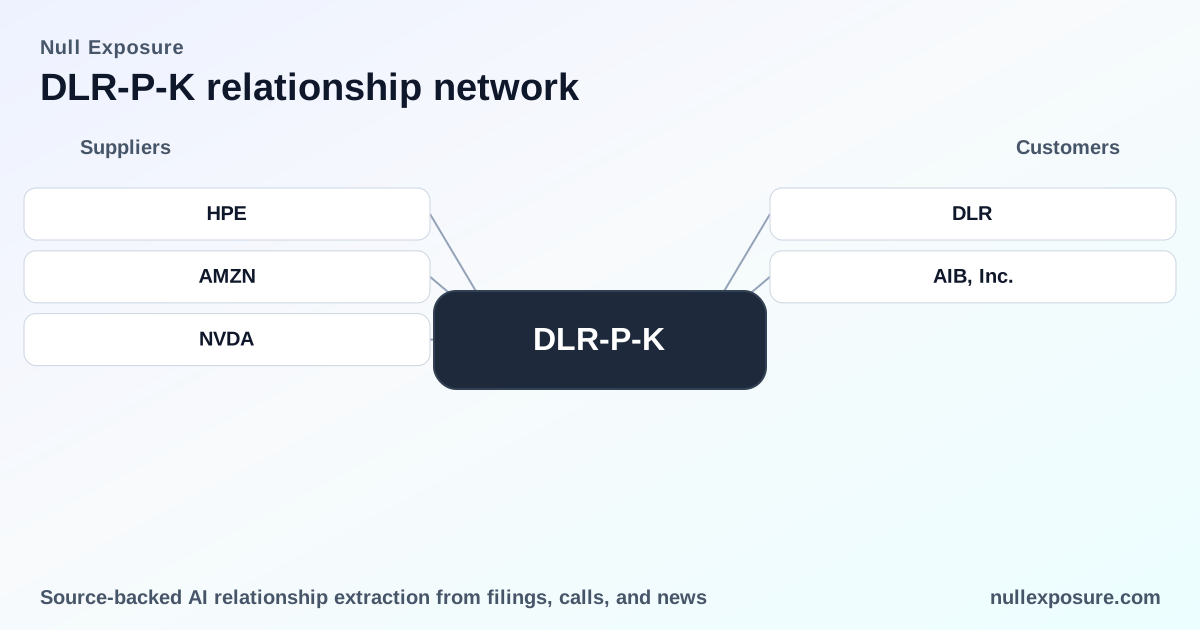
Digital Realty (DLR-P-K): Supplier relationships that underwrite a global data-center tollroad
Digital Realty operates and monetizes a global portfolio of carrier‑neutral data centers through long-term leases, colocation services, and an interconnection platform (PlatformDIGITAL) that turns physical proximity into recurring revenue and premium connectivity fees. The firm's commercial model extracts value from scale, location, and ecosystem density: tenants pay for space, power, and high‑performance connectivity while hyperscalers and enterprise customers anchor large, multi‑year commitments that stabilize cash flow. For investors and operators, supplier and technology partnerships are not marginal marketing deals — they are leverage points that shape capacity utilization, product differentiation, and the pace at which Digital Realty captures new AI and cloud workloads. Explore strategic supplier signals and relationship facts with more detail at the NullExposure homepage: https://nullexposure.com/
How Digital Realty’s supplier ties translate into economic power
Digital Realty’s contracts and partner integrations convert infrastructure into sticky, higher‑margin services. Long-term leasing and platform interconnections create structural pricing power: once a hyperscaler, cloud provider, or enterprise is colocated and peered on PlatformDIGITAL, switching costs and latency advantages make that location a persistent revenue source. The company’s revenue model therefore combines traditional real‑estate cash flows with utility‑like, capacity-based network fees.
Company-level operating characteristics to watch as investor signals:
- Contracting posture: Predominantly long‑dated leases and enterprise/hyperscaler contracts that prioritize occupancy stability over transactional flexibility.
- Concentration: Revenue is sensitive to commitments from a relatively small set of very large cloud and network customers; ecosystem density in key metro markets drives pricing power.
- Criticality: Facilities host mission‑critical workloads (cloud, AI, financial systems), making uptime, connectivity capacity, and partner integrations central to market positioning.
- Maturity: Digital Realty runs a mature REIT platform with global footprint and productization of interconnection and cloud onramps; incremental growth depends on capacity expansion and higher‑value services rather than core real‑estate innovation.
If you are benchmarking supplier exposure for portfolio stress tests or sourcing diligence, see more context and tooling at our home page: https://nullexposure.com/
What recent relationship headlines actually say — the three current items
Below are the publicly reported supplier relationships tied to Digital Realty in the recent sourcing crawl. Each entry is a concise, plain‑English summary with the primary source.
HPE — Private Cloud Business Edition to manage data‑center operations
Digital Realty has signed up for HPE’s Private Cloud Business Edition, a managed private cloud solution that Digital Realty will use to streamline and standardize data‑center operations across its footprint, reflecting a move to outsource certain operational layers to a single vendor platform. According to DataCenterDynamics (March 9, 2026), this is positioned to improve operational consistency and deliver a commercial private‑cloud capability for tenant use (https://www.datacenterdynamics.com/en/news/digital-realty-picks-hpe-private-cloud-to-manage-data-center-operations/).
Amazon Web Services (AWS) — 100Gbps Direct Connect on PlatformDIGITAL in Seattle and Dublin
Digital Realty deployed AWS Direct Connect 100Gbps dedicated connections at its Westin Building Exchange in Seattle and at the Interxion Dublin campus, enabling extremely high‑capacity, low‑latency cloud onramps for customers colocated on PlatformDIGITAL. Digital Realty announced the availability in a company release (PR Newswire, FY2021), highlighting the company’s role as a connectivity hub for AWS traffic (https://www.prnewswire.com/news-releases/digital-realty-announces-availability-of-aws-direct-connect-100g-dedicated-connections-on-platformdigital-in-seattle-and-dublin-301304923.html).
NVIDIA — Supporting AI infrastructure and NVIDIA research initiatives
Digital Realty advanced AI infrastructure collaboration that supports NVIDIA’s AI Factory Research Center and the NVIDIA DSX Blueprint, signaling joint activity around AI‑optimized data‑center designs and tenant solutions tailored for accelerated compute workloads. A PR Newswire announcement tied to Digital Realty’s corporate communications (FY2025) links the firm to NVIDIA’s AI‑centric infrastructure programs (https://www.prnewswire.com/news-releases/digital-realty-declares-quarterly-cash-dividend-for-common-and-preferred-stock-302526717.html).
What these supplier ties collectively imply for investors and operators
The three relationships together reveal a deliberate positioning: Digital Realty is not just selling power and rack space; it is packaging connectivity and AI‑ready platform integrations that increase customer stickiness and per‑customer revenue. Operational implications for investors and operators include:
- Integrated vendor management is becoming core to operations: contracting with HPE for private cloud operations signals a shift to vendor‑managed operational stacks that can compress operating expense variability but introduce third‑party operational dependence.
- Connectivity partnerships (AWS Direct Connect 100Gbps) are direct monetization vectors: high‑capacity cloud onramps create premium chargeable services and raise the effective barrier for tenants to relocate.
- AI ecosystem alignment (NVIDIA) raises capital intensity and potential upside: supporting NVIDIA’s AI programs signals readiness to host accelerated compute clusters, which command different power, cooling, and colocation economics.
Risk profile and what to monitor next
For a supplier‑focused risk assessment, emphasize these points:
- Concentration risk: Large cloud and AI partners drive a disproportionate share of strategic demand; monitor renewal terms and any shift from leasing to self‑build by hyperscalers.
- Operational dependency: Outsourcing operational layers to providers like HPE reduces some in‑house complexity but concentrates operational risk in third parties — verify SLAs and escalation paths.
- Capital intensity for AI workloads: AI and high‑speed connectivity require higher power densities and capital to retrofit sites; track capex allocation and impact on FFO and leverage.
- Commercial differentiation: AWS and NVIDIA integrations are defensible moat elements; measure how many metros and campuses have parity across competitors.
Key actions for diligence:
- Validate the geographic coverage of 100Gbps AWS Direct Connect and confirm tenant uptake in those facilities.
- Review contract tenor and SLAs for HPE Private Cloud Business Edition to understand lock‑in and exit mechanics.
- Assess the incremental revenue per rack or pod for AI‑optimized deployments versus traditional colocation.
Practical takeaways and next steps
- For investors: Focus on tenancy composition and margin per tenant as the best predictors of earnings resilience; partnerships with hyperscalers and AI hardware vendors materially change unit economics.
- For operators: Prioritize interoperability and capacity planning that supports high‑density, accelerated compute deployments while maintaining redundancy and uptime SLAs.
- For procurement and vendor managers: Ensure contract terms with suppliers like HPE include robust performance remedies and alignment to Digital Realty’s uptime obligations.
Learn more about supplier‑level exposure and how it affects portfolio construction at NullExposure: https://nullexposure.com/
Bottom line
Digital Realty’s supplier relationships are strategic levers that turn physical footprint into differentiated, high‑value platform services. HPE, AWS, and NVIDIA partnerships are evidence that the company is stacking operational outsourcing, cloud connectivity, and AI readiness into its commercial offering — all of which amplify revenue per customer but raise capital and operational dependencies that investors must actively monitor. For structured supplier analysis and continuous monitoring tools, visit https://nullexposure.com/ and integrate these relationship signals into your investment workflow.