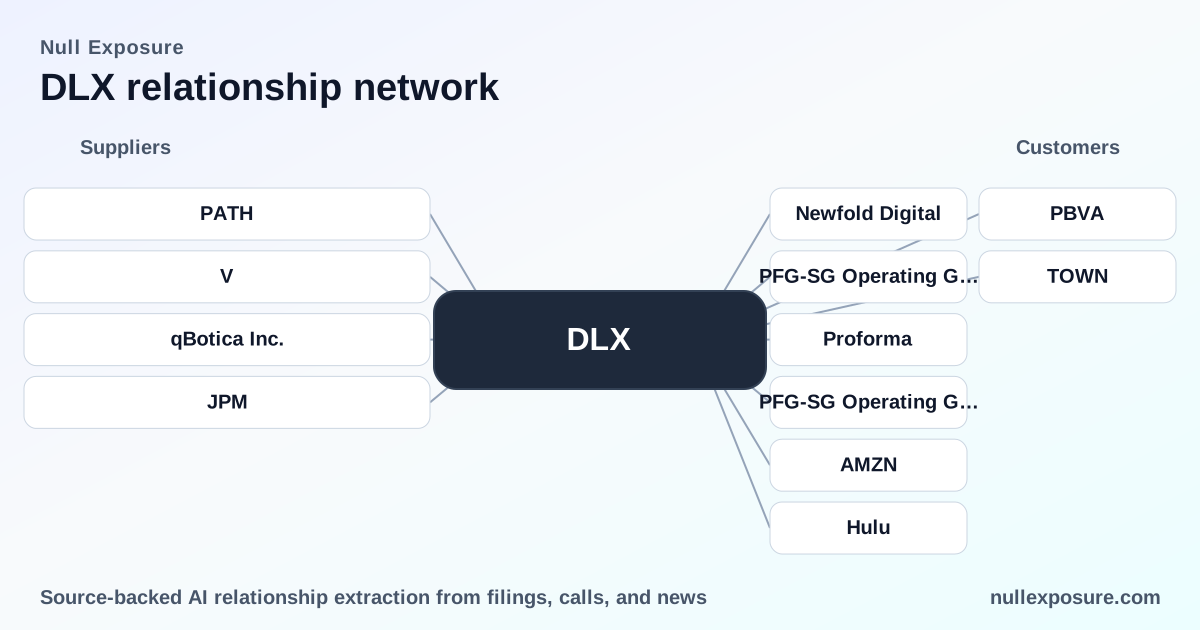
Deluxe Corporation (DLX): supplier relationships that shape payments and print economics
Deluxe monetizes through two principal channels: payments and data services for financial institutions and small businesses, and print/manufacturing of business essentials such as checks and marketing materials. Revenue is driven by recurring payments flows and transaction services (higher-margin, scalable software and payments rails) alongside a more capital- and input-intensive print business that sells manufactured goods. For investors, the company’s supplier relationships indicate a deliberate shift toward platform and payments partnerships while retaining material supply commitments for its manufacturing segment.
Explore more supplier intelligence at https://nullexposure.com/
Why suppliers matter now: shift from manufacturing inputs to payments platforms
Deluxe’s capital-light growth vectors are concentrated in payments, data, and automation. Strategic suppliers for technology and payment rails are therefore disproportionately important to future margin expansion, while manufacturing suppliers remain critical to cash flow stability and customer retention in legacy product lines. The company’s public metrics (FY2025 revenue ~ $2.13B; EBITDA ~$397M) underscore why third-party service continuity and payment integrations are material to valuation and operational risk.
The supplier map: what the public signals reveal
Below I cover every supplier relationship surfaced in the available results and what each means for operators and investors.
UiPath — automation provider advancing operational scale
Deluxe has contracted with UiPath to deploy AI-powered automation across its operations, a move that accelerates back-office efficiency and transaction processing throughput. According to SiliconANGLE coverage (Nov 5, 2024), UiPath’s automation capability is being delivered to Deluxe to augment internal workflows and service delivery. Source: SiliconANGLE, Nov 5, 2024.
Visa — payments rail for instant payouts (dlxFastFunds)
Deluxe announced a collaboration to implement Visa Direct, branded as dlxFastFunds, to enable faster, seamless payments—leveraging Visa’s push-to-card and push-to-account capabilities to reduce settlement friction and improve customer experience. That initiative was disclosed in corporate releases and third-party news coverage during FY2026, including a Jan 8, 2026 news release reported by StockTitan and summarized by MarketScreener. Source: StockTitan/MarketScreener, Jan 2026.
qBotica Inc. — AI partner for bespoke solutions
qBotica is delivering machine learning and AI solutions to Deluxe to augment the company’s automation and analytics stack, supporting product innovation in payments and data services. This engagement was described in the same SiliconANGLE coverage that discussed UiPath’s role, highlighting qBotica’s contribution to new solution development for Deluxe (SiliconANGLE, Nov 5, 2024). Source: SiliconANGLE, Nov 5, 2024.
JPMorgan Chase Bank — asset acquisition in B2B check conveyance
Deluxe acquired certain assets of JPMorgan Chase Bank’s CheckMatch electronic check conveyance business in 2025 to bolster its B2B payments segment and expand market share in electronic check processing. That transaction appears in company disclosures summarized in a TradingView report covering Deluxe’s SEC filings for FY2026. Source: TradingView (SEC filing summary), FY2026.
What the supplier set implies about contracting posture and concentration
The public constraints and excerpts provide clear company-level signals about how Deluxe manages suppliers:
-
Contracting posture: Deluxe uses formal, contractual relationships with third-party service providers for delivery and information technology services, including telecommunications, network server management, and transaction processing. This indicates a deliberate outsourcing posture for non-core infrastructure while retaining control over customer-facing payments and data products through strategic integrations. Evidence: company excerpts referencing third-party provider contracts.
-
Concentration and sourcing: For manufacturing inputs (paper, inks, plastics, packaging, printing plates), Deluxe sources from multiple suppliers. This signals diversified input sourcing in the Print segment, reducing single-supplier concentration risk but leaving exposure to commodity price cycles for paper and plastics. Evidence: excerpt on primary print materials.
-
Criticality and maturity: Third-party IT and transaction processing services are mission-critical to the scalable payments business; partnerships with Visa and automation vendors indicate matured outsourcing relationships that support both product delivery and cost leverage.
These constraints are company-level characteristics and are not attributed to a single supplier unless the excerpt explicitly names one.
Investment implications — opportunity and risk in equal measure
Deluxe’s supplier mix creates a clear risk/reward profile:
-
Upside: Strategic integrations with Visa and automation partners accelerate payment volume monetization and margin expansion, supporting the company’s higher forward P/E and EV/EBITDA multiple compression potential as payments scale. The JPMorgan asset acquisition further consolidates Deluxe’s B2B payments positioning and could expand cross-sell into treasury and account services.
-
Operational risk: The Print segment’s dependence on paper, plastics, and ink keeps Deluxe exposed to raw-material inflation and logistics disruption; these inputs are critical to legacy revenue and cash generation. Additionally, reliance on third-party IT and transaction processors heightens counterparty and operational continuity risks if integrations fail or service levels slip.
Key takeaways:
- Payments partnerships are strategically critical and value-accretive; Visa integration is a high-impact supplier relationship.
- Automation and AI suppliers reduce operating cost and increase throughput, supporting margin improvement.
- Manufacturing inputs remain a structural risk for cost inflation and cyclical margin pressure.
For deeper supplier risk scoring and exposure mapping, visit https://nullexposure.com/ — our platform aggregates disclosures, news, and filings into actionable supplier intelligence.
Operational guidance for operators and procurement teams
Operators should treat these supplier relationships with two priorities:
- Lock in SLAs, dual-sourcing, and contingency plans for third-party transaction processing and telecom services to preserve uptime and settlement reliability.
- Hedge or pass through raw material volatility in the Print segment through contracts or pricing mechanisms that protect gross margins.
Conclusion — what investors should watch next
Deluxe’s trajectory is clear: scale payments and data while managing legacy manufacturing exposure. Monitor execution on the Visa Direct rollout, volume migration metrics into dlxFastFunds, and the realized run-rate benefits from UiPath/qBotica automation projects. Also track commodity cost trajectories for paper and plastics and any supplier consolidation that could increase input concentration risk.
For a vendor-specific diligence package and ongoing monitoring of Deluxe’s supplier ecosystem, see https://nullexposure.com/ — our coverage focuses on supplier contracts, integrations, and operational constraints that move valuation.