Destra Multi‑Alternative Fund (DMA) — supplier relationships, operating posture, and investor implications
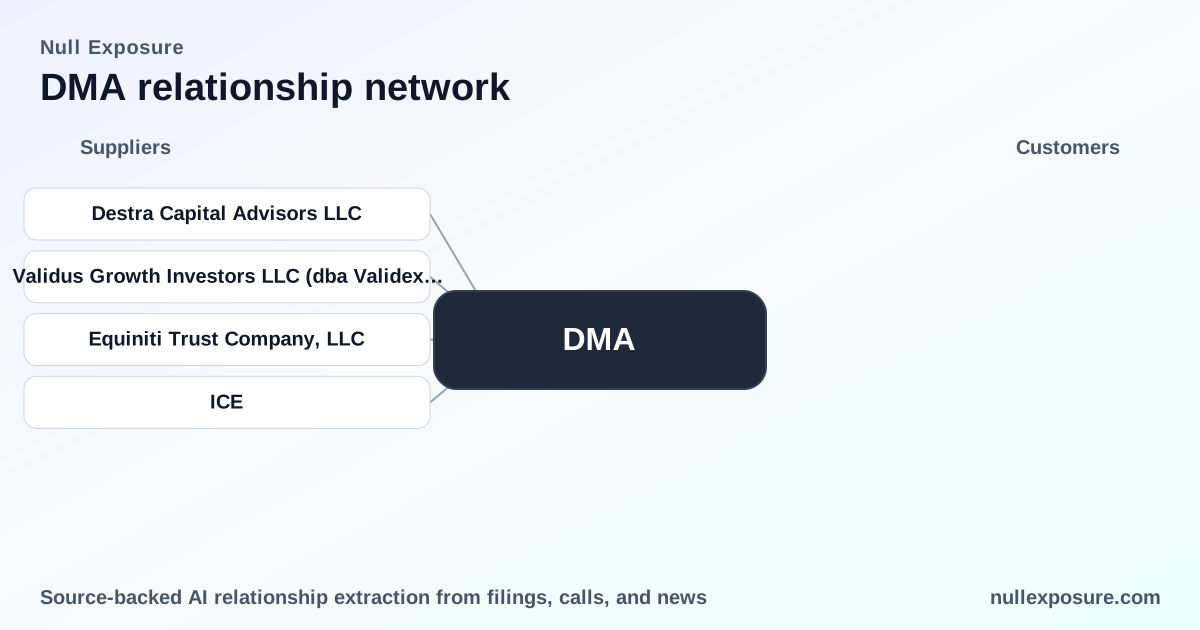
Destra Multi‑Alternative Fund (NYSE: DMA) is a closed‑end fund that outsources the critical functions of portfolio management, sub‑advisory execution, shareholder servicing and listing access to third parties. The fund’s economics and operational reliability are driven by those supplier contracts: management and servicing fees flow to the investment adviser, sub‑advisory fees feed a specialist manager, shareholder reinvestment mechanics are handled by a plan agent, and liquidity is delivered through the NYSE listing. For investors and operators evaluating counterparty risk, the supplier map is compact and concentrated — that concentration is the central governance and operational risk to monitor.
If you want a structured supplier view and monitoring toolkit, start here: https://nullexposure.com/
Who runs the portfolio and how the fee chain is structured
Destra Capital Advisors LLC is the fund’s designated Investment Adviser and Secondary Market Servicing agent, a role that positions it as the primary fee recipient for portfolio supervision and for supporting listed‑shareholder servicing. According to a press release in FY2025 distributed on Yahoo Finance, Destra is explicitly named as the adviser and secondary market servicing agent to the Fund (https://finance.yahoo.com/news/destra-multi-alternative-fund-shareholders-220000508.html). This is a governance focal point: the adviser executes strategy and interacts directly with the board and shareholders.
Validus Growth Investors LLC (doing business as Validex Global Investing) serves as the Investment Sub‑Adviser, which means execution of the fund’s investment strategy can be delegated to a specialist who receives sub‑advisory compensation. Multiple FY2025–FY2026 notices (Yahoo Finance, StockTitan, and FinancialContent distribution) identify Validus/Validex as the sub‑adviser to DMA (for example: https://finance.yahoo.com/news/destra-multi-alternative-fund-shareholders-220000508.html).
Shareholder mechanics and liquidity plumbing
Equiniti Trust Company, LLC is the fund’s plan agent/transfer agent for dividend reinvestment, responsible for handling automatic reinvestment elections and direct‑shareholder processing. A FY2025 distribution announcement on Yahoo Finance specifies that shareholders holding shares directly with the Fund will have declared dividends automatically reinvested by Equiniti unless they elect otherwise (https://finance.yahoo.com/news/increased-distribution-announced-destra-multi-130000493.html).
The fund’s trading and price discovery function is delivered by the New York Stock Exchange, where DMA trades under the ticker DMA; NYSE notices and market disclosures are referenced in FY2025 media announcing board‑approved distributions (see StockTitan reporting of NYSE‑listed DMA distributions, https://www.stocktitan.net/news/DMA/increased-distributions-declared-by-destra-multi-alternative-h4w8jxu49arz.html). The listing is the fundamental liquidity channel for secondary‑market investors.
If you want a consolidated view of supplier exposures for DMA, review the monitoring service at https://nullexposure.com/
Company‑level operating model signals (constraints and posture)
There are no explicit third‑party contractual constraints recorded in the dataset for DMA, so the observable signals must be framed at the company level:
- Contracting posture — Outsourced advisory model. DMA relies on a primary adviser and a named sub‑adviser rather than an in‑house portfolio team, which is typical for closed‑end funds but increases dependence on external managers for performance and compliance.
- Concentration — Small, critical supplier set. The supplier universe evident in public notices is compact (adviser, sub‑adviser, transfer agent, exchange). That concentration creates single points of operational and reputational risk if one supplier changes terms or exits.
- Criticality — High for named parties. Adviser/sub‑adviser decisions directly affect fund performance and distributions; the transfer agent controls reinvestment mechanics that affect shareholder experience; the exchange determines trading liquidity.
- Maturity — Established ongoing relationships. Multiple mentions in FY2025 and FY2026 press activity indicate these relationships are active and operationalized across reporting periods, suggesting established contracts rather than ad‑hoc arrangements.
Relationship‑by‑relationship concise inventory
Destra Capital Advisors LLC — Destra is named as the Investment Adviser and Secondary Market Servicing agent to DMA in FY2025 and again in FY2026 press notices; this gives Destra primary responsibility for portfolio oversight and shareholder servicing communications. Source: Yahoo Finance FY2025 and FinancialContent FY2026 press releases (https://finance.yahoo.com/news/destra-multi-alternative-fund-shareholders-220000508.html; https://markets.financialcontent.com/stocks/article/bizwire-2026-2-19-destra-multi-alternative-fund-announces-board-member-resignation).
Validus Growth Investors LLC (dba Validex Global Investing) — Validus/Validex is listed consistently as the Investment Sub‑Adviser, indicating delegated investment execution and a sub‑advisory fee relationship; disclosures in FY2025–FY2026 public notices confirm this role. Source: Yahoo Finance FY2025 and StockTitan/FinancialContent FY2026 notices (https://finance.yahoo.com/news/destra-multi-alternative-fund-shareholders-220000508.html; https://www.stocktitan.net/news/DMA/destra-multi-alternative-fund-shareholders-approve-proxy-proposal-iy03mtd2azcp.html).
Equiniti Trust Company, LLC — Equiniti is the plan agent that handles dividend reinvestment for shareholders who hold shares directly with the fund, a role called out in FY2025 distribution materials. Source: Yahoo Finance FY2025 distribution announcement (https://finance.yahoo.com/news/increased-distribution-announced-destra-multi-130000493.html).
New York Stock Exchange — DMA is a listed closed‑end fund on the NYSE, with distribution approvals and trading mechanics referenced in FY2025 notices; the exchange provides the market venue that enables secondary liquidity for investors. Source: StockTitan reporting of board approvals and distribution schedules (https://www.stocktitan.net/news/DMA/increased-distributions-declared-by-destra-multi-alternative-h4w8jxu49arz.html).
What investors and operators should watch next
- Supplier concentration is the primary operational risk. With a short supplier list, any adviser or transfer‑agent transition could disrupt distributions, investor communications, or execution. Validate contract term lengths, termination triggers, and transition plans in due diligence.
- Fee and governance alignment between adviser and sub‑adviser matters. Confirm how investment decisions, performance fees (if any), and reporting lines are structured between Destra and Validex to assess incentive alignment.
- Transfer agent mechanics affect shareholder experience and flows. Equiniti’s reinvestment process affects cash flow timing and taxable events for investors — review processing windows and election management.
- Liquidity is exchange‑dependent. Monitor trading spreads and NAV discounts on the NYSE reporting cycle for evidence of market access stress.
If you want to convert this supplier map into a monitoring plan or vendor scorecard, begin your assessment at https://nullexposure.com/
Actionable next steps for a disciplined diligence cycle
- Request the advisory and sub‑advisory agreements to confirm termination rights, fee schedules, and notice periods.
- Obtain the transfer agent service agreement to validate reinvestment processing SLAs and reconciliation flow.
- Track NYSE trading metrics and distribution notices on a weekly cadence to capture liquidity shifts and board decisions.
For a turnkey supplier risk checklist and continuous monitoring, visit https://nullexposure.com/ — it’s the quickest way to operationalize supplier diligence into investment decisions.
Bold takeaway: DMA’s operational risk profile is defined more by supplier concentration and the adviser/sub‑adviser split than by a sprawling vendor footprint; disciplined contractual review and active monitoring of those named suppliers are essential for investors.