DMAA: Sponsor Services, Cost Structure, and What It Means for Investors
Drugs Made In America Acquisition Corp. (DMAA) is a NASDAQ-listed special purpose acquisition company that monetizes through the execution of a business combination rather than operating revenue today; its economics are driven by sponsor-led capital formation, transaction execution, and ultimately the realized value of any target it acquires. For investors evaluating supplier relationships, the immediate commercial relevance is administrative overhead and sponsor alignment—two variables that directly influence SPAC burn rate, governance friction, and timing to deal completion. DMAA’s supplier posture is simple: an ongoing, subscription-style administrative services agreement with its sponsor that creates a predictable, mid-six-figure annual expense.
For a concise commercial diligence checklist and supplier-risk monitoring on similar issuers, visit https://nullexposure.com/.
What DMAA is and how it runs the business
DMAA is a classic SPAC/shell entity listed on NASDAQ with no operating revenue; its balance sheet and runway are the short-term drivers for investor outcomes. The company’s public filings identify it as a shell vehicle focused on pharmaceutical targets that could reshape domestic drug manufacturing. With roughly $351.6 million market capitalization and a sponsor relationship responsible for core administrative functions, the company’s near-term cash trajectory is governed by sponsorship arrangements and trust-account dynamics rather than product-level cash flow.
The supplier relationship you need to know about
Sponsor provides office and admin services — contractual detail and citation
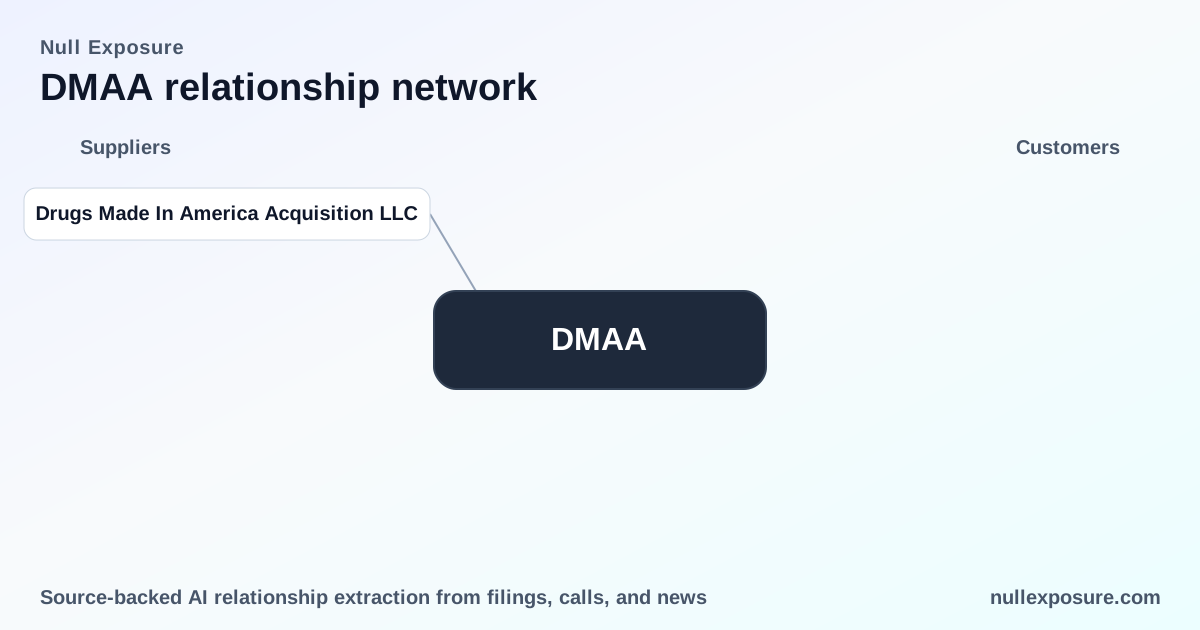
DMAA has an Administrative Services Agreement with its sponsor, Drugs Made In America Acquisition LLC, under which DMAA pays $10,000 per month for office space, administrative and support services. According to the company’s FY2025 filings as reported on TradingView (SEC 10‑Q referenced in March 2026), this payment structure is active and ongoing. (TradingView coverage of DMAA’s SEC 10‑Q, March 2026.)
Plain-English take for the sponsor relationship
Drugs Made In America Acquisition LLC provides DMAA with essential day‑to‑day office and administrative support in exchange for a fixed monthly fee; this is an active, subscription-style commercial relationship and a de facto operational backbone for the SPAC. (TradingView report of company SEC 10‑Q, FY2025, March 2026.)
What the contract signals about DMAA’s operating model
The administrative agreement with the sponsor offers several concise, investable signals about DMAA’s operating posture:
- Contracting posture — subscription and predictable: The $10,000 per month payment is a subscription-style fee that creates a stable, predictable run-rate for a key portion of corporate G&A. The filing language explicitly frames the space and services cost as included in a monthly fee.
- Spend magnitude and runway impact — mid-six-figure annualized: At $10,000 per month, the contract implies approximately $120,000 per year, consistent with the extracted spend-band signal (100k–1M). That expense is modest relative to SPAC trust balances but relevant for post-merger planning and sponsor economics.
- Relationship role and criticality — sponsor as service provider: The sponsor functions simultaneously as sponsor and service provider, a common SPAC structure that reduces third-party procurement but concentrates control. This dynamic is material to governance and potential conflicts of interest because the sponsor supplies essential administrative services.
- Maturity and stage — active, low-complexity vendor relationship: The filing treats the agreement as an active administrative contract rather than a one-off transition arrangement, indicating a stable, operationally mature relationship appropriate for a shell company in the pre-deal phase.
These elements combine into a practical operating model: low complexity, concentrated vendor reliance, and predictable recurring cost that reduces short-term budget uncertainty but raises governance questions about sponsor incentives and related-party economics.
For more on how supplier posture affects SPAC valuation and sponsor alignment, see our deep-dive resources at https://nullexposure.com/.
Risks and upside translated into investor language
- Governance and related-party risk: Sponsor-supplied services concentrate operational control; that increases the importance of transparency in the Administrative Services Agreement and any fee escalators or termination clauses disclosed in SEC filings. The arrangement is customary for SPACs but remains a direct route to potential conflicts of interest.
- Limited financial leverage from this supplier relationship: The $10,000 monthly spend is not transformative to EBITDA or liquidity given DMAA’s trust-account model, but it is a recurring fixed cost that impacts net cash available for transaction-related expenses.
- Operational continuity advantage: Having sponsor-provided office and administrative support reduces friction and cost of coordinating deal processes and investor engagement, which is an operational plus in a tight transaction timeline.
- Concentration signal: Relying on the sponsor for both capital formation and back-office services concentrates counterparty exposure; investors should value transparency on service scope and any incremental fees tied to transaction execution.
Practical investor actions
- Review the Administrative Services Agreement language in the latest 10‑Q/10‑K for termination provisions, fee escalation clauses, and any concentrated-service warranties. The trading‑view reported SEC 10‑Q for FY2025 documents the $10k/month arrangement and should be read in full. (TradingView coverage of the company SEC 10‑Q, March 2026.)
- Monitor any amendments or new supplier relationships that diversify administrative services away from the sponsor as a signal of governance normalization.
- Track cash runway and trust-account balances relative to transaction timelines to assess whether administrative spend becomes material in a compressed deal schedule.
For investor tools and supplier relationship mapping for SPACs and small-cap issuers, visit https://nullexposure.com/.
Final read: what to bookmark
DMAA’s supplier landscape is straightforward and concentrated: an active, subscription-style administrative services agreement with its sponsor at $10,000 per month. That structure delivers operational certainty and cost predictability but concentrates control and related-party exposure—two core items for investors assessing SPAC governance and transaction-risk profiles. For ongoing monitoring of DMAA’s supplier signals and related corporate filings, use the company’s SEC disclosures and curated coverage that highlights sponsor arrangements and contractual run-rates.
Stay informed and structured in your diligence: https://nullexposure.com/ is a practical starting point for tracking supplier relationships and governance signals across small-cap issuers.