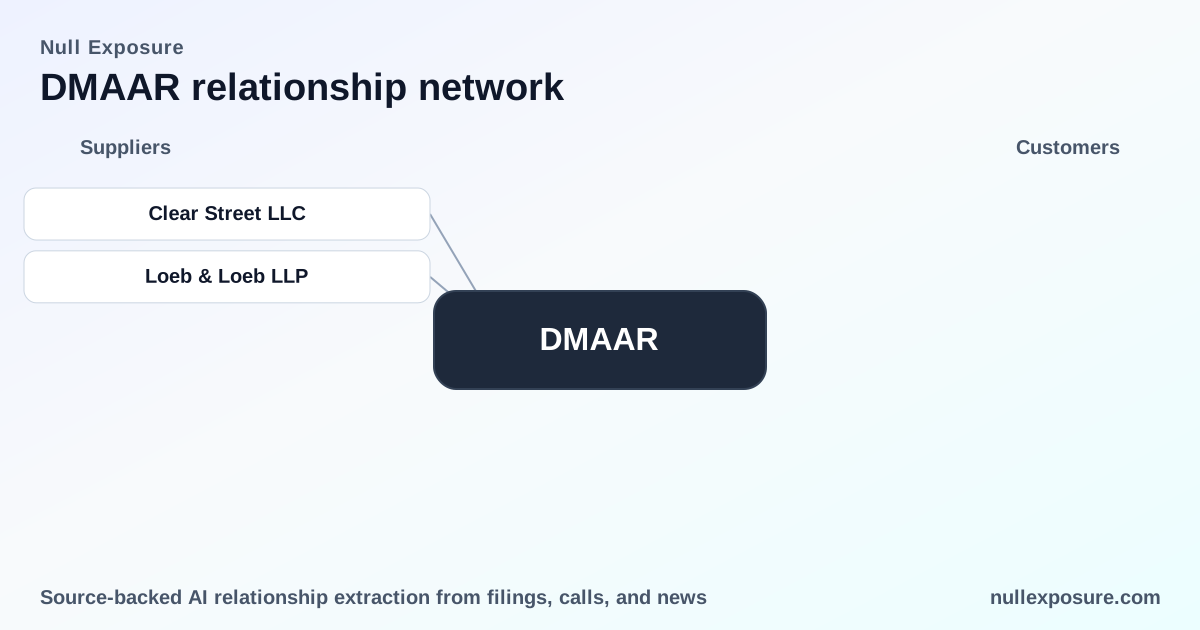
DMAAR supplier relationships: a concise investor guide
Drugs Made In America Acquisition Corp. (DMAAR) is a SPAC formed to merge with U.S.-based pharmaceutical manufacturing or related asset targets; it monetizes by raising IPO capital, issuing representative shares and sponsor economics, and by capturing upside when it completes a business combination. For investors and operators evaluating DMAAR as a counterparty or supplier partner, the company’s model is cash-conservative but sponsor-dependent, with small public market scale and recurring administrative obligations that determine near-term procurement and contracting posture.
Explore supplier exposure and relationship intelligence at https://nullexposure.com/.
How DMAAR operates and funds basic services
DMAAR operates as a typical acquisition vehicle: it holds IPO proceeds in trust while sourcing a target and runs a lightweight corporate engine to preserve capital ahead of a business combination. The company budgets recurring operating payments to its sponsor for core office and administrative services—the filing discloses a $10,000 per month fee payable to its sponsor or an affiliate for office space and administrative support—which establishes a baseline vendor commitment and a predictable monthly cash outflow. The company’s market capitalization and public float are small (market cap reported at $1,020,000 with 20.4 million shares outstanding), which signals constrained internal procurement capacity and elevated reliance on third‑party service providers for legal, underwriting and corporate administration functions.
Who is on the vendor roster and what they do
Below are the supplier and advisor relationships disclosed in public filings and press coverage. Each relationship is summarized in plain English with source context.
Clear Street LLC — the underwriter and representative-share recipient
Clear Street acted as the sole book‑running manager for DMAAR’s IPO and received 230,000 ordinary “representative” shares at the consummation of the offering and exercise of the over‑allotment option, reflecting the standard underwriter economic package for a SPAC IPO. According to a Reuters release republished on TradingView dated February 18, 2025, Clear Street filled the lead underwriting role for the offering. (Reuters/TradingView, Feb 18, 2025)
Loeb & Loeb LLP — corporate legal counsel
Loeb & Loeb served as legal counsel to DMAAR for its initial public offering, providing the corporate and securities law support necessary for the SPAC to list and to structure sponsor agreements and disclosure. This engagement is disclosed in the same Reuters/TradingView coverage of the IPO closing. (Reuters/TradingView, Feb 18, 2025)
Contracting posture, spend profile and operational constraints
DMAAR’s disclosures and filing excerpts provide several company‑level signals about how it contracts and where supplier risk concentrates:
-
Service-provider posture: DMAAR explicitly contracts recurring services with its sponsor and engages external advisors for underwriting and legal work; the constraints data identifies “service_provider” with high confidence and documents the $10,000 monthly administrative fee as part of an administrative services agreement. The same constraints show the company issued representative shares to Clear Street as part of underwriting economics.
Evidence excerpt: “we have agreed to pay our sponsor $10,000 per month for office space, and administrative and support services.” (Company filing disclosure) -
Spend scale: The constraint metadata places vendor spend in a $100k–$1m annual band, which aligns with a modest recurring administrative budget plus transactional professional fees for an IPO-level engagement. This implies DMAAR’s suppliers should expect small but recurring contracts and potential episodic uplifts around a business combination.
-
Geography and operating base: Management lists its principal executive offices in Fort Lauderdale, Florida, and the geography signal is North America. This centralization suggests supplier logistics and vendor selection will favor U.S.-based service providers and counsel. Evidence excerpt: “Our principal executive offices are located at 1 East Broward Boulevard, Suite 700, Fort Lauderdale, FL 33301.”
-
Relationship maturity and criticality: Constraints classify active relationships for administrative services and underwriting. For suppliers, this indicates immediate, operationally critical work (payroll, filings, corporate governance) rather than long‑lead manufacturing contracts; manufacturing relationships would follow only after a completed business combination.
What this means for suppliers and operators evaluating DMAAR
The supplier ecosystem around DMAAR is short, concentrated, and transaction-driven. Key takeaways for vendor evaluation:
- Predictable baseline revenue: The $10,000/month administrative fee creates a predictable baseline contractual revenue stream, but it is modest in absolute terms; suppliers should price accordingly.
- Transaction spikes: Underwriting, legal and other professional services drive one‑time or episodic spend around IPO closure and business combination activities; these engagements will temporarily increase supplier revenue beyond the baseline.
- Sponsor dependence: The company relies heavily on sponsor arrangements for office and administrative needs, which centralizes procurement decisions and can speed contracting decisions but also concentrates counterparty risk. The issuance of representative shares to Clear Street formalizes part of the underwriting economics and aligns the underwriter’s compensation with the transaction outcome.
- Scale constraints: With a reported market capitalization of roughly $1.02 million and a small public float, DMAAR lacks scale to be a major buyer until it completes a business combination and secures target‑level revenues or capital.
If you need a deeper supplier risk profile or wants to map exposure across a broader SPAC universe, start with a focused scan at https://nullexposure.com/.
Tactical implications for investors and procurement teams
For investors assessing DMAAR’s supplier risk and for vendors considering engagement:
- Treat DMAAR as a low‑volume, high‑transaction client pre‑business combination: prioritize flexible, short-term contracts with clear termination and fee provisions.
- Negotiate clarity on billing and sponsor invoicing: because administrative services flow through the sponsor or its affiliate, invoicing chains and payment triggers should be specified to avoid operational delays.
- Monitor underwriting economics: representative shares and any finder fees to underwriters like Clear Street are signals of market placement incentives and route to future liquidity events.
Final assessment and recommended next steps
DMAAR operates a lean supplier model anchored by a small monthly administrative fee and a compact roster of professional advisors. For suppliers, this is an opportunity for small but reliable recurring work plus transactional upside around a business combination; for investors, the key exposure is sponsor concentration and the timing risk inherent in a SPAC’s lifecycle. Detailed counterparty diligence should focus on payment terms with the sponsor, documentation around representative-share arrangements, and the timeline to a business combination.
For a systematic supplier due diligence playbook and comparative exposure across similar SPACs, visit https://nullexposure.com/ to request tailored intelligence and to align your procurement strategy with SPAC-era counterparties.