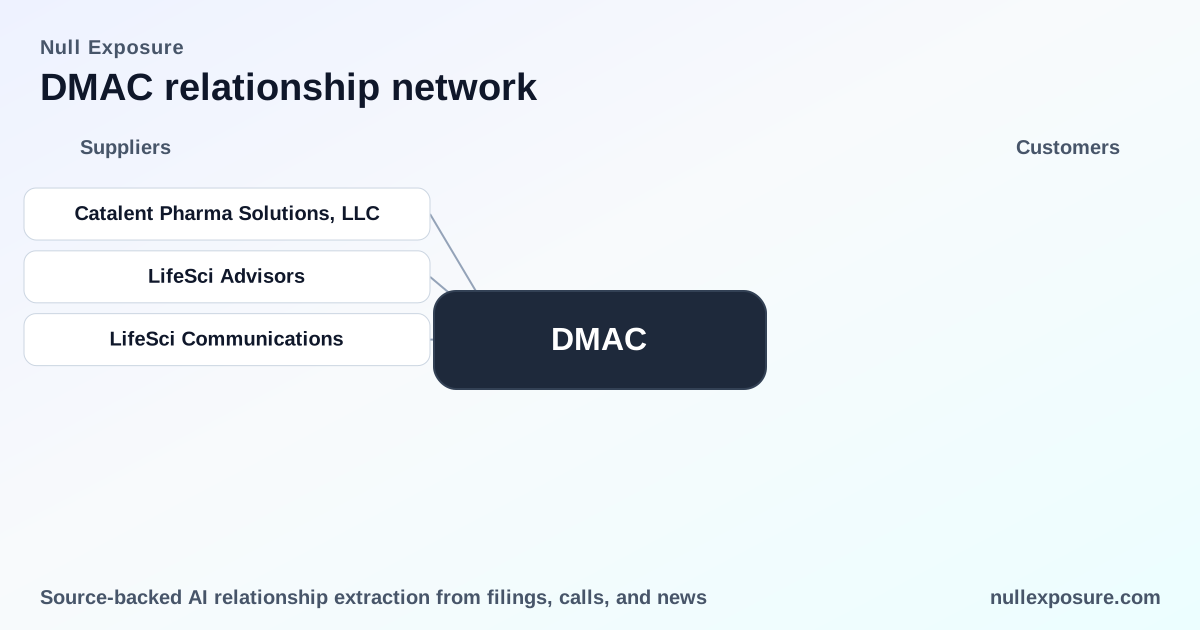
DiaMedica (DMAC) — the supplier map investors need to price execution risk
DiaMedica Therapeutics Inc. is a clinical‑stage biopharmaceutical company that develops recombinant protein therapies (notably DM199) for neurological and kidney indications; it currently monetizes through licensing, clinical collaboration, and eventual product sales upon regulatory approval, with no reported product revenue to date. The company outsources virtually all manufacturing and many clinical services to third parties, creating supplier dynamics that are central to timeline and valuation assumptions.
For a concise, transaction‑level view of supplier risk and counterparty context, see https://nullexposure.com/ — the platform that surfaces these relationships for investor due diligence.
The counterparties: who supplies and who supports DiaMedica
Below are every supplier and service contact captured in public records and press announcements.
Catalent Pharma Solutions, LLC
DiaMedica relies on Catalent, a contract development and manufacturing organization (CDMO), for procuring raw materials and manufacturing the active pharmaceutical ingredient for DM199, and DiaMedica has a license agreement with Catalent for certain gene expression technology while contracting Catalent to manufacture DM199. Catalent functions as DiaMedica’s primary CDMO and a licensor/manufacturer. According to DiaMedica’s Form 10‑K for the year ended December 31, 2024, the company contracts with Catalent for production and has licensed technology to Catalent. (Source: DiaMedica 2024 10‑K)
LifeSci Advisors
LifeSci Advisors is listed as the investor relations contact for DiaMedica in a corporate press release tied to conference participation; the relationship is advisory/communications in nature rather than a supply chain counterparty. A BioSpace press release (March 2026) names Mike Moyer of LifeSci Advisors as investor contact for DiaMedica’s presentation at the 2025 Jefferies Global Healthcare Conference. (Source: BioSpace press release, March 2026)
LifeSci Communications
LifeSci Communications is identified as the media contact in the same BioSpace release, indicating retained public relations support for investor outreach and media relations rather than operational supply. The press release (March 2026) lists Madelin Hawtin of LifeSci Communications as media contact. (Source: BioSpace press release, March 2026)
What the contracting posture reveals about operational risk and leverage
DiaMedica’s public disclosures and filing language convey a clear operating model: outsourced development with largely spot and short‑term contracting. This has direct valuation and execution implications.
- The company explicitly states it does not have long‑term supply agreements with its CDMOs and purchases on an order‑by‑order basis, which indicates a spot contracting posture that increases price and timing variability but reduces fixed contractor commitments. (Company signal from 2024 10‑K)
- Clinical research agreements are cancelable with relatively short notice (60–90 days) and obligations limited to incurred costs, which gives DiaMedica operational flexibility but shifts termination and ramp risk onto ongoing enrollment and manufacturing timelines.
- DiaMedica has executed license arrangements, including a license agreement with Catalent that covers gene expression technology while concurrently contracting Catalent to manufacture DM199; this embeds technology transfer and IP licensing into the manufacturing relationship, making Catalent both a strategic partner and a supplier. (Company signal naming Catalent)
- The company projects global clinical expansion and explicitly references expanding the ReMEDy2 trial internationally, which increases dependency on multi‑jurisdictional supplier networks and logistical complexity.
- Materiality signals are strong: DiaMedica does not own manufacturing facilities and states reliance on third parties for cGMP manufacturing is material to development timelines and future revenue potential. The filing flags the relationship as both material and, to an extent, critical to product development.
- Spend posture: public disclosures indicate outstanding commitments of approximately $19.3 million as of December 31, 2024, with $14.5 million due within 12 months, implying near‑term cash flow exposure to supplier and contract obligations that investors should model explicitly.
Together these signals describe a company that leverages external providers for technological, manufacturing, and communications capabilities while retaining programmatic control; this trade‑off improves capital efficiency today and transfers concentrated operational risk to a small set of third parties.
For easy access to the full relationship profiles and to monitor updates, visit https://nullexposure.com/.
How suppliers change the risk/return profile for investors
Operationally, the supplier posture translates into concrete investor risks and optionality:
- Timing risk is elevated. Spot and short‑term contracts increase the probability of manufacturing delays and cost overruns that compress valuation multiples for a clinical‑stage company.
- Counterparty concentration is meaningful. Catalent’s dual role as licensor and contract manufacturer creates single‑node concentration for DM199 production and IP transfer.
- Regulatory and quality control risks are outsourced. Reliance on external cGMP providers means regulatory enforcement or quality lapses at a supplier can pause development.
- Capital efficiency is improved in the near term, because DiaMedica avoids fixed manufacturing overhead, but the company absorbs asymmetric downside if suppliers fail to deliver.
These are not abstract points — the 2024 filing and the company’s public statements frame these dynamics as central to program execution and financial commitments.
A pragmatic monitoring checklist for operators and investors
- Track Catalent contract status, technology transfer milestones, and any amendments to manufacturing scope or capacity.
- Monitor clinical enrollment metrics for the ReMEDy2 and DM199 programs, and watch for supplier‑related delay announcements.
- Watch for any movement from spot to multi‑year supply arrangements; a shift to longer contracts would materially reduce execution risk.
- Watch cash runway and the near‑term $14.5M of commitments; supplier payments will drive liquidity needs.
- Follow investor and media communications retained through LifeSci Advisors and LifeSci Communications for investor‑facing clarity on timelines and supplier issues.
Bottom line: supplier exposure is a defining valuation driver
DiaMedica operates a lean, outsourced model that is capital efficient but supplier‑dependent. Catalent is the central operational counterparty — both manufacturing partner and technology licensee — and the company’s consistent use of short‑term and spot contracts amplifies execution risk around timing and cost. For investors, supplier diligence is as important as clinical data; monitor Catalent’s performance, the evolution of contract terms, and disclosure of any supply disruptions when underwriting timelines or modeling exit scenarios.
For a tailored supplier risk brief and ongoing monitoring alerts, go to https://nullexposure.com/ — the marketplace for actionable counterparty intelligence.