DMII (Drugs Made In America Acquisition II): underwriting relationships and what they mean for investors
Drugs Made In America Acquisition II Corp. (DMII) is a NASDAQ-listed SPAC that raises capital through public markets with the explicit objective of merging with a pharmaceuticals or biotech company focused on onshoring drug manufacturing. The company monetizes primarily through deal execution: capital raised in its IPO is deployed to fund a business combination, with value creation driven by post-merger equity appreciation, sponsor economics and transaction-related fees. For investors and operators, the critical dependency is transaction execution — access to underwriting, placement and advisory services directly affects the SPAC’s ability to close a sponsor-led deal and deliver returns. Learn more at https://nullexposure.com/.
Why the underwriting relationship matters to a SPAC investor
A SPAC’s lifecycle is short and binary: successful identification and close of a merger, or liquidation and return of trust assets to public shareholders. Underwriting banks and placement agents are the execution engine that convert investor demand into a funded IPO and support secondary market liquidity for the SPAC’s equity. Underwriting partners influence pricing, timing, investor mix, and the credibility of the post-combination capitalization table. For DMII, the named provider in public reporting is therefore a material operational relationship for the near-term path to a transaction.
Who DMII is working with to bring the IPO to market
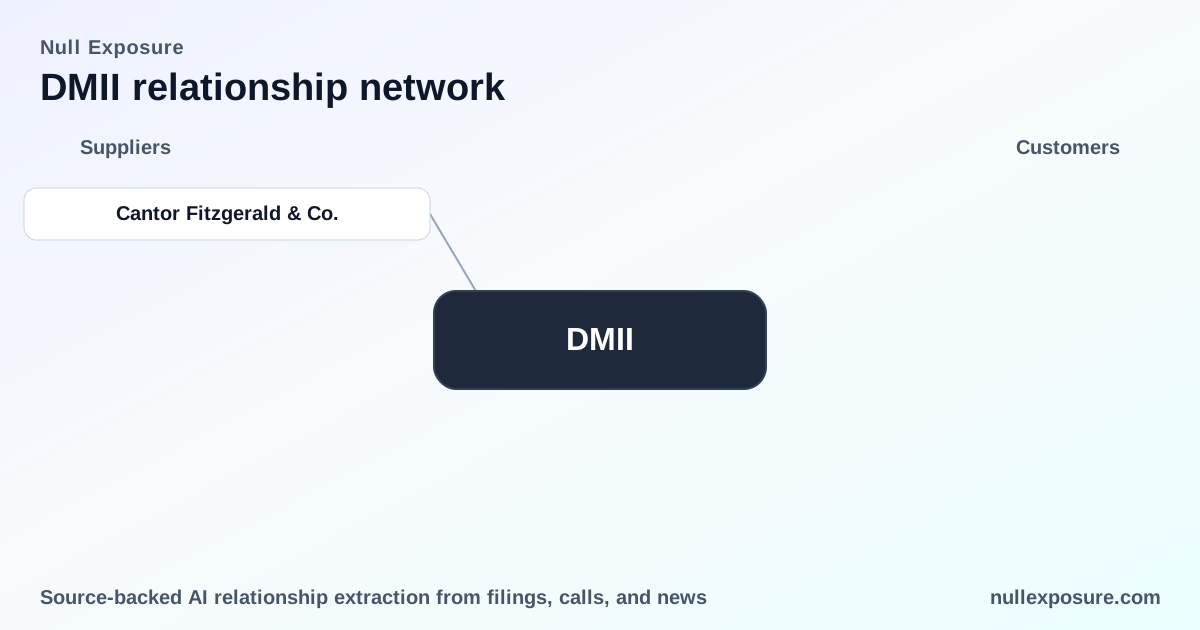
Cantor Fitzgerald & Co. is listed as the sole book‑running manager for DMII’s offering, which was reported as expected to close on September 26, 2025. This establishes Cantor Fitzgerald as the primary underwriting partner responsible for syndication, allocation and pricing for the $500 million offering referenced in coverage. According to an RTTNews report in FY2025, Cantor Fitzgerald & Co. was acting in that sole book‑runner role for the transaction.
What that single relationship signals for investors
- Concentrated execution risk. Running the IPO with a single book‑runner concentrates deal execution and distribution responsibilities in one institution. That centralization accelerates decision-making and consistency of message to investors, but it also creates a single point of failure if the underwriter’s appetite or relationships change.
- Near-term maturity and transactional posture. The relationship is transactional and time‑bound: it exists to execute a capital raise and initial market placement for DMII. This reflects a typical SPAC contracting posture — short-term, outcome-driven engagements rather than long-term supplier contracts.
- Credibility and market access. Cantor Fitzgerald’s role as sole book-runner signals a clear underwriting strategy and direct route to institutional and intermediary investors that Cantor can access, which is material for closing a $500M offering and filling the trust account.
- Criticality to deal success. Execution of the IPO and initial liquidity are prerequisites to pursuing target mergers; therefore this relationship is operationally critical to the company’s business plan.
These are company-level operational characteristics rather than financial forecasts; they describe how DMII structures and relies on supplier relationships in practice.
Where operational constraints show up in the business model
DMII’s model is not a recurring revenue operation; it is a transaction-driven vehicle. Several company-level signals are relevant for diligence:
- Concentration: SPACs inherently concentrate risk in a small set of external providers for capital formation — underwriters, legal counsel and target advisors. DMII’s disclosed relationship with a single book-runner fits that profile.
- Contracting posture: DMII’s supplier posture is short-term and transactional; counterparties are contracted for execution windows tied to IPO closing and deal syndication rather than ongoing service contracts.
- Criticality: Underwriting is critical to capital formation and investor access; losing or replacing a book-runner mid-process would materially delay or impair execution.
- Maturity: As a SPAC, DMII has an accelerated life-cycle and will evolve materially upon completing a business combination; supplier relationships that matter today are primarily those that enable capital formation and the deal pipeline.
Practical implications for portfolio managers and operators
DMII’s corporate snapshot provides useful context for how these supplier dynamics translate into investor risk and opportunity. According to company filings through the latest quarter (2025-09-30), DMII has a market capitalization of approximately $653.13 million, 65,575,000 shares outstanding, and a shareholder base with ~53.96% institutional ownership and ~17.64% insider ownership. These ownership statistics reinforce that underwriting success and the initial investor mix are decisive to post-transaction capital structure and redemption dynamics.
Investors should monitor a few concrete items:
- The underwriting syndicate composition and whether Cantor Fitzgerald remains sole book-runner or brings in co-managers.
- Timing and structural terms of the offering and any forward commitments that reduce redemption risk.
- Sponsor economics and any fee structures that will transfer value upon de-SPAC.
For targeted due diligence, examine continued reporting on deal close timelines and any amendments to underwriting agreements to understand execution risk.
Explore more supplier relationship intelligence and transactional signals at https://nullexposure.com/.
Single-relationship summary (clear and concise)
Cantor Fitzgerald & Co. — Cantor Fitzgerald is acting as sole book-running manager for DMII’s $500 million offering, with the transaction reported as expected to close on September 26, 2025, making it the primary underwriter responsible for syndication and pricing of the IPO (RTTNews, FY2025).
Bottom line and recommended next steps
DMII’s near-term investment thesis is execution-centric: the SPAC’s ability to realize its stated objective of merging with a pharmaceuticals manufacturing target depends directly on underwriting execution and investor placement. The disclosed relationship with Cantor Fitzgerald creates both an explicit path to market and a concentration risk that investors must price into position sizing and event-driven monitoring.
Actionable next steps:
- Track ongoing press releases and filings for any changes to the underwriting syndicate or offering terms.
- Stress-test portfolio exposure to redemption risk if the offering does not reach target capitalization.
- Use underwriting changes as a leading indicator of transaction probability and timing.
For a deeper view of supplier relationships and to integrate these signals into active due diligence workflows, visit https://nullexposure.com/ for more intelligence and market commentary.