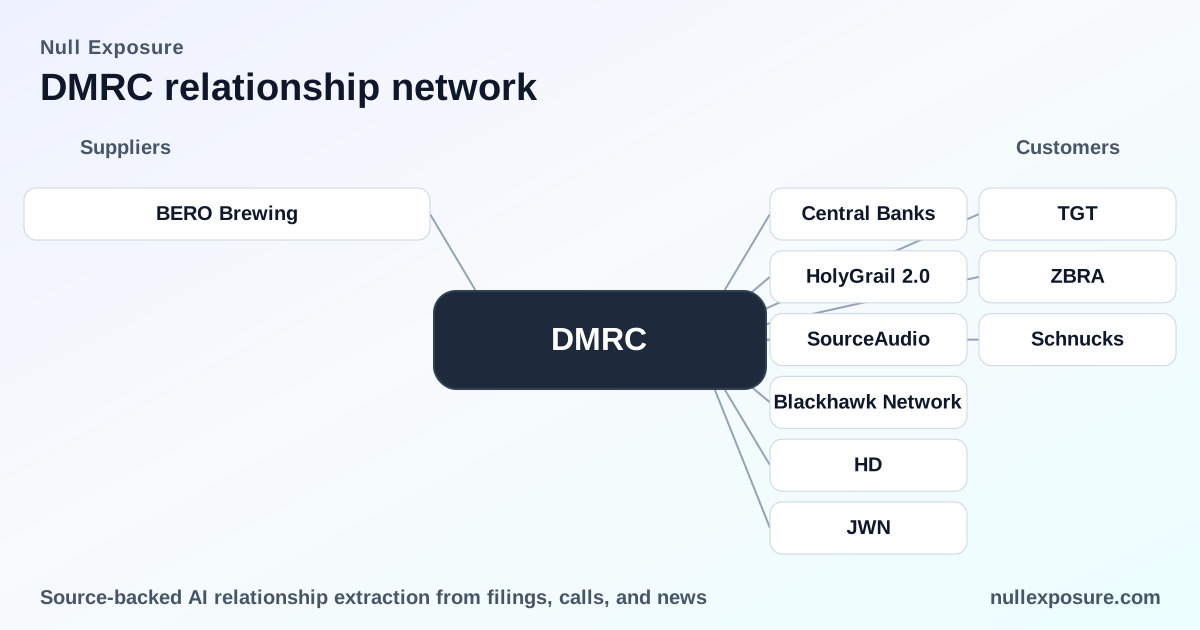
Digimarc sells digital identity and authentication software to commercial and government clients, monetizing through product licensing, services and partnership integrations that embed its watermarking and identification technology into customers’ channels. The company's value proposition is not transaction volume but intellectual property and platform differentiation that generate recurring commercial relationships and selective partner revenue.
Digimarc (DMRC): supplier relationships and what they mean for investors
A compact company with deep tech, modest revenue and concentrated ownership
Digimarc operates in the application software segment, providing automatic identification and digital authentication solutions. Revenue trailing twelve months: $33.9M; gross profit: $25.6M; operating margin (TTM): -48.2%; market capitalization: ~$137M (latest quarter 2025-12-31). The business carries negative net income metrics and elevated insider ownership (29%), while institutions hold roughly 59% of the float—an ownership profile that creates clear governance and capital allocation dynamics for suppliers and partners. Investors should treat Digimarc as a small-cap technology firm that leverages IP-based contracts rather than high-volume SaaS scale.
If you want a deeper supplier-screen or relationship map for small-cap technology vendors like Digimarc, start here: https://nullexposure.com/
Why supplier and partner relationships matter for Digimarc
Digimarc’s commercial motion is partnership-driven: customers integrate watermarking and identity services into physical and digital products, and partners convert that IP into consumer experiences (e.g., authentication, loyalty, anti-counterfeiting). Supplier relationships that enable distribution, brand adoption, or go-to-market integration are therefore strategic because they directly influence revenue growth pathways and channel reach. Given the company’s current scale, each material partner carries outsized influence on product adoption and margin leverage.
The supplier relationships the record shows
Below I cover every relationship returned in the supplier-scope search.
- BERO Brewing — BERO partnered with Digimarc to launch a first-of-its-kind omnichannel customer loyalty program that uses Digimarc’s digital identity and authentication technology to link product experiences with loyalty actions; the announcement was reported in March 2026. A StockTitan news release dated March 9, 2026 described the joint launch and positioned the partnership as a consumer-facing deployment of Digimarc’s identity stack. (Source: StockTitan news release, March 9, 2026 — https://www.stocktitan.net/news/DMRC/bero-brewing-delivers-omnichannel-customer-loyalty-experience-with-wv2z1127wsi0.html)
That single-sourced relationship is commercial and marketing-oriented rather than a traditional supplier-of-record procurement. This is an example of Digimarc’s go-to-market emphasis on brand partnerships and consumer-facing pilots, which scale awareness and create case studies for broader B2B adoption.
If you want an operational supplier risk readout for Digimarc and similar vendors, visit: https://nullexposure.com/
Operating model and contracting posture — what to infer for investors
- Contracting posture: Digimarc operates through contractual integrations with brands and enterprise customers, and through partner co-developments. Contracts are structured to protect IP via licensing terms while enabling partners to build consumer-facing solutions. This posture favors licensing and integration fees over commodity procurement.
- Concentration and criticality: Given Digimarc’s revenue scale, individual partner deployments can be materially important for near-term growth and visibility; however, the current public record shows sparse supplier relationships, indicating low breadth of high-profile channel partners at present.
- Maturity and runway: The technology is mature in its niche (digital watermarking and identity), but commercial maturity is limited by revenue and operating losses. Maturity of product does not equate to scaled commercial distribution, and that gap defines near-term risk and opportunity.
- Supplier risk: From a supplier-management perspective, Digimarc behaves like a small strategic vendor—highly technical, IP-forward, and dependent on a handful of partnerships to expand market reach. Procurement teams contracting with Digimarc should prioritize IP protections, SLAs for integration, and go-to-market cooperation clauses.
No supplier-specific constraints are flagged in the available record; the constraints dataset returned no entries, which is itself an informative company-level signal: there are no documented supplier constraints or contractual red flags surfaced in the reviewed data.
Financial context that shapes supplier dynamics
Digimarc’s negative operating margin (-48%) and net loss profile require careful capital allocation. Partnerships that generate revenue without heavy upfront capex are the most valuable near-term. Institutional holders control a majority of shares, which drives expectations for disciplined growth and clear ROI from strategic relationships. The company’s small revenue base amplifies the impact of every supplier or partner win on the top line.
Risk and opportunity checklist for investors and operators
- Opportunity: Partnerships like BERO Brewing demonstrate an accessible route into consumer markets and loyalty use cases, converting IP into revenue and marketing proof points.
- Risk: Low absolute revenue and negative margins mean the company must convert partnerships to recurring contracts or scale channel distribution quickly to reach profitability.
- Supplier management implication: For counterparties, Digimarc is a strategic, IP-centric vendor that requires careful negotiation around licensing, exclusivity, and long-term support commitments.
Bottom line and next steps
Digimarc’s commercial model is IP-first and partnership-driven, with supplier and partner relationships taking on outsized strategic importance relative to company scale. The current supplier record is light—only the BERO Brewing collaboration is documented in the reviewed data—so investors should prioritize tracking new channel agreements and conversion of pilot partnerships into contractual, revenue-producing programs.
For a full operational and supplier-risk profile across technology vendors, explore additional company cuttings and signals at https://nullexposure.com/
If you need a tailored supplier exposure brief for Digimarc or comparable small-cap tech names, request a custom analysis at https://nullexposure.com/