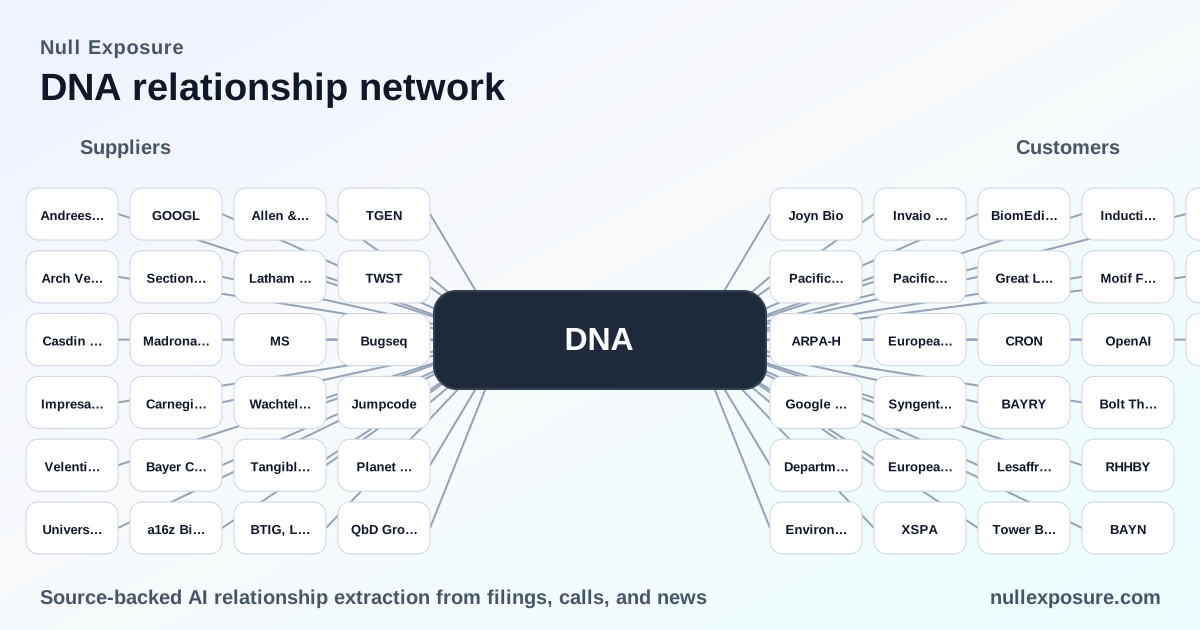
Ginkgo Bioworks (DNA) — supplier and partner map investors need to watch
Ginkgo Bioworks designs and engineers biological systems and monetizes through blended revenue: long-term product and material purchases, multi-year strategic platform agreements, consortium R&D, and M&A into adjacent capabilities. The company functions as a large-scale buyer of critical biological inputs and as a platform integrator for joint development programs, creating predictable spend commitments on suppliers while depending on a web of partners for cloud, analytics, regulatory and manufacturing services. For a concise vendor risk read and contract posture overview, visit https://nullexposure.com/.
High-level investor thesis: how suppliers shape DNA’s risk-reward profile
Ginkgo’s operating model is dual: it purchases essential inputs at scale (synthetic DNA, reagents, contract lab services) and orchestrates collaborative product programs (platform-as-a-service, diagnostics consortia, and acquired capabilities). That structure produces revenue optionality through partnerships and recurring costs through long-term supply commitments, exposing the company to concentration and operational continuity risks that are visible in public filings and press releases.
Key company-level signals drawn from filings and press coverage:
- Long-term contracting posture is evident from multi-year supply agreements and multi-year strategic deals; this locks in predictable spend but limits sourcing flexibility.
- Supplier concentration and criticality are material: Ginkgo acknowledges reliance on a limited number of suppliers and single-source providers for critical inputs.
- Buyer role with committed spend: the company documents multi-year minimum commitments that sit in the mid-to-high single-digit millions annually and aggregate into the tens of millions over contract life.
- Service-provider dependency for biosecurity and public-health offerings indicates reliance on third-party labs and device/regulatory specialists.
- Spend scale signals both heavy future operating leverage and potential fixed-cost pressure; lease and other commitments reported are large.
The rest of this piece covers each partner and supplier relationship found in public sources and explains how those ties influence Ginkgo’s operating and financial exposure.
The supplier and partner ledger (plain-English relationship summaries)
-
Twist Bioscience — Ginkgo entered a four‑year noncancelable supply agreement with Twist for synthetic DNA and related products, obligating the company to spend a minimum of $58 million over the term with defined annual minimums. This is a material long-term buyer commitment documented in Ginkgo’s 2024 Form 10‑K. (Source: Ginkgo 10‑K filing, Dec 31, 2024 — https://www.sec.gov/)
-
Google Cloud (GOOGL / Google) — Ginkgo made Google Cloud its primary cloud provider under a multiyear strategic cloud and AI partnership; the company recorded a $21 million shortfall obligation to the partnership in its 2025 full‑year R&D disclosures, highlighting the financial impact of strategic cloud commitments. (Source: Ginkgo earnings call, Q4 2025 — dna-2025q4-earnings-call)
-
TGen — As part of a consortium under HADEA funding, Ginkgo will work with TGen to integrate existing technologies into a benchtop diagnostics device for respiratory viruses; this is a collaborative R&D role rather than a pure supplier contract. (Source: PR Newswire consortium announcement, Mar 9, 2026 — https://www.prnewswire.com/news-releases/ginkgo-bioworks-partners-with-hadea-in-up-to-24-million-consortium-project-to-deliver-next-generation-agnostic-diagnostics-for-respiratory-viruses-at-the-point-of-care-302381350.html)
-
Jumpcode — Named as a consortium technology partner on the HADEA diagnostics program, Jumpcode will contribute existing technology components to the benchtop device effort. (Source: PR Newswire consortium announcement, Mar 9, 2026 — https://www.prnewswire.com/news-releases/ginkgo-bioworks-partners-with-hadea-in-up-to-24-million-consortium-project-to-deliver-next-generation-agnostic-diagnostics-for-respiratory-viruses-at-the-point-of-care-302381350.html)
-
Bugseq — Identified as another consortium partner for the HADEA diagnostics program, Bugseq is a technology contributor in Ginkgo’s benchtop device development phase. (Source: PR Newswire consortium announcement, Mar 9, 2026 — https://www.prnewswire.com/news-releases/ginkgo-bioworks-partners-with-hadea-in-up-to-24-million-consortium-project-to-deliver-next-generation-agnostic-diagnostics-for-respiratory-viruses-at-the-point-of-care-302381350.html)
-
Planet Innovation — Listed among HADEA consortium partners supplying device engineering and integration expertise for the planned point‑of‑care diagnostics device. (Source: PR Newswire consortium announcement, Mar 9, 2026 — https://www.prnewswire.com/news-releases/ginkgo-bioworks-partners-with-hadea-in-up-to-24-million-consortium-project-to-deliver-next-generation-agnostic-diagnostics-for-respiratory-viruses-at-the-point-of-care-302381350.html)
-
QbD Group — Ginkgo will collaborate with QbD Group to secure EU certification and validation for certain analytes and sample types once clinical trials are complete, indicating outsourced regulatory and validation expertise in go‑to‑market execution. (Source: PR Newswire consortium announcement, Mar 9, 2026 — https://www.prnewswire.com/news-releases/ginkgo-bioworks-partners-with-hadea-in-up-to-24-million-consortium-project-to-deliver-next-generation-agnostic-diagnostics-for-respiratory-viruses-at-the-point-of-care-302381350.html)
-
Twist (TWST) — Regulatory filings and third‑party reports note non‑refundable DNA supply payments to Twist totaling approximately $11 million spanning 2026–27, reinforcing the materiality and cash‑flow timing of the supply commitment. (Source: SEC filing excerpt reposted on StockTitan, 2026 — https://www.stocktitan.net/sec-filings/DNA/page-4.html)
-
Bayer / Bayer CropScience LP — Ginkgo acquired certain Bayer West Sacramento biologics assets; Ginkgo financed the purchase in part through public offering proceeds, indicating inorganic expansion of manufacturing and biologics capabilities. (Source: Sacramento Business Journal reporting on $83M asset sale, 2022 — https://www.bizjournals.com/sacramento/inno/stories/news/2022/07/25/ginkgo-bioworks-bayer-west-sac-83-million.html)
-
UEIC — A news item referencing Finland’s DNA (telecom) selecting UEI’s Android TV remote is present in the data; this item does not relate to Ginkgo’s core biotech supply chain but is included in the collected results. (Source: Broadband TV News, Jun 22, 2022 — https://www.broadbandtvnews.com/2022/06/22/dna-goes-with-universal-android-tv-controller/)
-
Allen & Company LLC — Served as a financial advisor to Ginkgo in connection with its IPO and related transactions, reflecting investment‑banking advisory relationships during capital raises. (Source: PR Newswire IPO announcement, 2021 — https://www.prnewswire.com/news-releases/ginkgo-bioworks-to-begin-trading-today-as-nyse-dna-with-over-1-6-billion-in-proceeds-301379315.html)
-
Morgan Stanley & Co. LLC (MS) — Acted as a financial advisor in Ginkgo’s public listing and capital markets transactions. (Source: PR Newswire IPO announcement, 2021 — https://www.prnewswire.com/news-releases/ginkgo-bioworks-to-begin-trading-today-as-nyse-dna-with-over-1-6-billion-in-proceeds-301379315.html)
-
Latham & Watkins LLP — Legal advisor on Ginkgo’s public offering, reflecting use of top-tier law firms for governance and transaction work. (Source: PR Newswire IPO announcement, 2021 — https://www.prnewswire.com/news-releases/ginkgo-bioworks-to-begin-trading-today-as-nyse-dna-with-over-1-6-billion-in-proceeds-301379315.html)
-
Wachtell, Lipton, Rosen & Katz — Served as legal advisor on certain corporate governance matters around Ginkgo’s listing and governance structure. (Source: PR Newswire IPO announcement, 2021 — https://www.prnewswire.com/news-releases/ginkgo-bioworks-to-begin-trading-today-as-nyse-dna-with-over-1-6-billion-in-proceeds-301379315.html)
-
Tangible Scientific — Identified as a logistics or compound handling partner that orchestrates secure storage, handling and movement of customer compounds with deliveries to local service providers including Ginkgo. (Source: Sahm Capital coverage, Aug 20, 2025 — https://www.sahmcapital.com/news/content/ginkgo-datapoints-tangible-scientific-and-inductive-bio-partner-to-deploy-ai-driven-lab-in-the-loop-workflows-across-the-biopharma-industry-2025-08-20)
-
BTIG, LLC — Named as sole book‑running manager on a public offering filing, indicating capital‑markets advisory engagement. (Source: InvestingNews reporting on proposed offering, 2022 — https://investingnews.com/ginkgo-bioworks-announces-proposed-public-offering-of-class-a-common-stock/)
-
Carnegie Mellon University — Partnered with Ginkgo under ARPA‑H programs for cancer screening research, demonstrating government‑funded academic collaborations. (Source: Sahm Capital summary, Dec 22, 2025 — https://www.sahmcapital.com/news/content/ginkgo-bioworks-dna-shares-rise-on-new-cancer-screening-approach-plans-2025-12-22)
-
University of Pittsburgh — Academic collaborator on the cancer screening initiative, showing reliance on external research institutions for translational science. (Source: Sahm Capital summary, Dec 22, 2025 — https://www.sahmcapital.com/news/content/ginkgo-bioworks-dna-shares-rise-on-new-cancer-screening-approach-plans-2025-12-22)
-
Velentium Medical — Named as a development partner on the cancer screening team, providing device or medical engineering expertise. (Source: Sahm Capital summary, Dec 22, 2025 — https://www.sahmcapital.com/news/content/ginkgo-bioworks-dna-shares-rise-on-new-cancer-screening-approach-plans-2025-12-22)
-
Proof Diagnostics, Patch Biosciences, and associated venture sellers (Arch Venture Partners, Madrona Venture Group, Casdin Capital, Andreessen Horowitz / a16z Bio + Health, Impresa Management, Section 32) — Reporting indicates Ginkgo completed multiple acquisitions of smaller diagnostics and therapeutics companies and assets from venture funds (including Patch and Proof Diagnostics), positioning Ginkgo to internalize capabilities previously supplied by external startups and fund portfolios. (Source: SimplyWallSt acquisitions summary, FY2025 — https://simplywall.st/stocks/us/pharmaceuticals-biotech/nyse-dna/ginkgo-bioworks-holdings/future)
-
Allen & Company / BTIG / Investment banks listed above — In addition to IPO advisory roles, these firms demonstrate the capital markets relationships Ginkgo uses for financing inorganic growth and asset purchases. (Source: PR Newswire / InvestingNews, 2021–2022)
This ledger reflects active supply, cloud, regulatory, academic and capital markets relationships that shape Ginkgo’s operating cost base and strategic pathways.
(If you want a visual map or supplier risk scorecard for these relationships, see more at https://nullexposure.com/.)
What investors should watch next — implications and risk checklist
- Contractual rigidity vs. supply resilience. Long‑term supply commitments (the Twist agreement explicitly obligates multi‑year spend) provide predictable input pricing but reduce short‑term sourcing flexibility if a supplier faces capacity or price shocks.
- Concentration and single‑source risk. Ginkgo’s disclosure of single‑source dependencies is a classic operational vulnerability in bio manufacturing—contingency plans or secondary suppliers materially affect valuation upside.
- Cloud and platform economics. The Google Cloud strategic partnership drives R&D capability and product scale but carries committed‑cost obligations (documented shortfall charges) that compress margin if revenue realization lags.
- Regulatory and go‑to‑market dependencies. Use of specialist firms (QbD Group, Velentium) for certification and device engineering converts technical risk into spend and calendar risk ahead of commercialization.
- M&A as capability buy vs. supplier replacement. Recent acquisitions absorb previously external capabilities, reducing some supplier exposure but increasing integration and cash requirements.
Bottom line
Ginkgo’s supplier network is a mix of long‑term purchased inputs, cloud platform commitments, and collaborative R&D partners; each element drives different cash‑flow and execution risks. For investors, the critical lenses are contractual duration, supplier concentration, and how acquisitions shift supplier‑dependent workflows in‑house. For a tailored supplier risk brief or visual vendor map, visit https://nullexposure.com/.