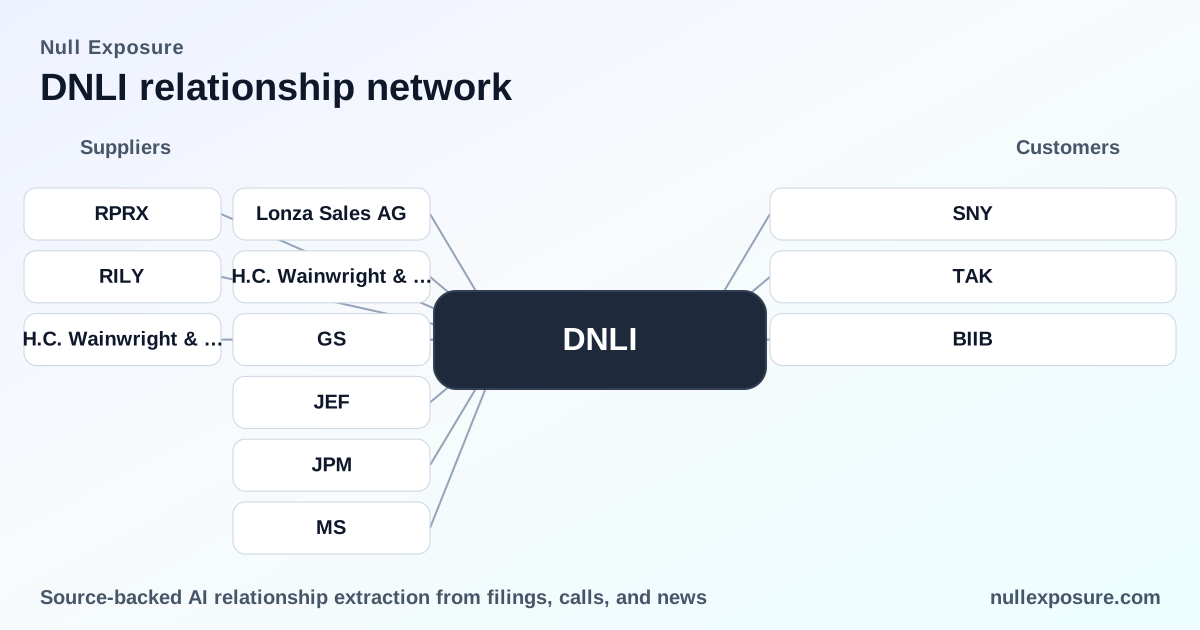
Denali Therapeutics (DNLI) — Supplier relationships that shape development runway and financing flexibility
Denali Therapeutics operates as a clinical-stage biopharma focused on neurodegenerative disease programs; the company monetizes through development milestones, eventual product sales, and non-dilutive or equity financing when development capital is required. Its operating model relies on third-party development and manufacturing partnerships for biologics production and a recurring need for capital markets and alternative financing to fund late-stage development and commercial preparation.
For a concise, searchable feed on supplier and counterparty risk for Denali, visit https://nullexposure.com/ for full coverage and alerts.
Why supplier relationships matter for a clinical-stage biotech investor
Denali has no meaningful product revenue reported in trailing twelve months figures, negative operating metrics, and development programs that require outsourced manufacturing and significant cash to advance. Outsourced manufacturing partners and capital markets counterparties are therefore both operationally critical and strategically decisive—they define run-rate spend, timing to clinic supply, and the company’s ability to monetize assets or access liquidity.
Lonza Sales AG — the long-term CDMO backbone
Denali has an explicit Development and Manufacturing Services Agreement (DMSA) with Lonza Sales AG for biologics development and manufacturing. The DMSA is a multi-year, project-based contract that underpins Denali’s ability to produce antibody and enzyme candidates, and Denali reported non-cancellable purchase commitments under the DMSA totaling approximately $36.7 million as of December 31, 2024. According to Denali’s FY2024 Form 10‑K, the DMSA remains in force and the company executes purchase orders and project plans under that agreement. (Source: Denali Therapeutics FY2024 Form 10‑K, filed 2024-12-31.)
The investment banks that underwrite liquidity events
A cluster of global and specialty investment banks served as arrangers and managers on Denali’s recent equity financing activity. Denali announced a public offering and pre-funded warrants in December 2025 and related reporting through March 2026 shows the following roles:
- Goldman Sachs & Co. LLC — named as a joint book‑running manager for the offering, a primary distribution role for reaching institutional investors (GlobeNewswire press release, Dec 10, 2025).
- J.P. Morgan Securities LLC — served as a joint book‑running manager, supporting syndication and bookbuilding efforts (GlobeNewswire press release, Dec 9–10, 2025).
- Morgan Stanley & Co. LLC — listed as a joint book‑running manager in the offering, participating in placement with institutional accounts (GlobeNewswire press release, Dec 9–10, 2025).
- Jefferies LLC — also a joint book‑running manager, active on the deal execution and investor outreach (GlobeNewswire press release, Dec 9–10, 2025).
- H.C. Wainwright & Co. / H.C. Wainwright & Co., LLC — identified as a co‑manager on the transaction and listed as co‑manager in company announcements, a common role for specialty biotech syndication (GlobeNewswire press release and QuiverQuant coverage, Dec 2025 / Mar 2026).
- B. Riley Securities, Inc. — cited as a co‑manager on the offering, supporting distribution to mid‑market and boutique buy‑side clients (GlobeNewswire press release, Dec 10, 2025).
All of the above banks appear in Denali’s public offering materials and press releases tied to the December 2025 proposed and priced offering (press coverage Dec 9–10, 2025; news aggregation March 2026). (Sources: GlobeNewswire release dated Dec 9–10, 2025; QuiverQuant news item, Mar 9, 2026.)
Royalty Pharma — a hybrid non‑dilutive funding partner
Denali executed a synthetic royalty funding arrangement with Royalty Pharma valued at US$275 million tied to potential future net sales of Denali’s investigational Hunter syndrome therapy, tividenofusp alfa, with $200 million payable at closing and $75 million contingent on European approval by end‑2029. This transaction converts future product economics into near‑term cash while preserving equity dilution control, but increases dependency on future commercial success of a named program. (Source: market coverage summarized on SimplyWall and news summaries, March 2026.)
What these relationships collectively signal about Denali’s operating posture
- Contracting posture and maturity: Denali relies on established, long‑term CDMO agreements (explicitly with Lonza) rather than ad‑hoc manufacturing spot buys, indicating a medium‑to‑high maturity sourcing model appropriate for biologics scale‑up. The DMSA’s project plans and purchase commitments demonstrate committed multi‑year capacity alignment. (Company 10‑K, FY2024.)
- Concentration and criticality: The company identifies third‑party suppliers as critical to operations; loss of a key supplier would materially harm supply continuity. This is a company‑level signal grounded in the 10‑K disclosure about supplier dependence.
- Spend and operational exposure: Non‑cancellable purchase commitments under the Lonza DMSA (~$36.7M at 12/31/2024) place Denali in the $10M–$100M annual spend band with at least one prime CDMO, creating a predictable procurement outlay for investors modeling cash burn. (Company 10‑K, FY2024.)
- Role mix: The company combines manufacturer relationships with third‑party distributor and logistics arrangements to support clinical trial supply chains; Denali explicitly expects to rely on third parties to store and distribute trial drug supplies (company filings).
- Financing approach: Denali blends traditional equity offerings (managed by global banks) with structured royalty funding from Royalty Pharma, preserving runway while balancing dilution. The presence of top-tier book‑runners and specialty co‑managers indicates access to broad capital markets distribution.
Explore a structured supplier risk dashboard and sign up for alerts at https://nullexposure.com/ to track updates on these counterparties and contractual commitments.
Implications for investors and operators
- Operational risk is concentrated but contracted. The Lonza DMSA creates an enforceable production pathway, but reliance on third parties is a single point of failure for clinical supply and early commercial scale. Investors should treat manufacturing continuity as a binary risk that can pivot program timing.
- Financing flexibility reduces short‑term dilution but ties economics. The Royalty Pharma transaction provided immediate non‑dilutive capital but attaches future revenue streams; investors must price contingent payments against probability of approval and commercial uptake.
- Capital markets access is intact. The syndicate of Goldman Sachs, J.P. Morgan, Morgan Stanley, Jefferies, H.C. Wainwright and B. Riley indicates Denali retains robust underwriter relationships and distribution capacity for future equity raises.
Actionable takeaways for decision-makers
- Monitor Lonza relationship milestones and purchase order cadence; changes in committed spend or project delays will directly impact cash burn and trial timelines. (See FY2024 Form 10‑K commitments.)
- Model the Royalty Pharma uplift and contingent tranche only against regulatory milestones and regional approval timing—treat the $75M contingency as conditional through 2029. (Market coverage, March 2026.)
- For equity investors, track book‑runner activity and deal announcements from the listed banks as proxies for access to follow‑on capital and potential repricing events. (GlobeNewswire and related press, Dec 2025–Mar 2026.)
For continuous monitoring and a detailed supplier exposure report, visit https://nullexposure.com/ to subscribe and get real‑time notices.
Denali’s supplier and financing relationships create a clear pathway to sustain development through clinical inflection points; they also concentrate execution risk with a small set of counterparties and introduce future revenue obligations through royalty funding. Investors should weigh the operational security of long‑term manufacturing agreements against the commercial dependency implicit in structured financing.