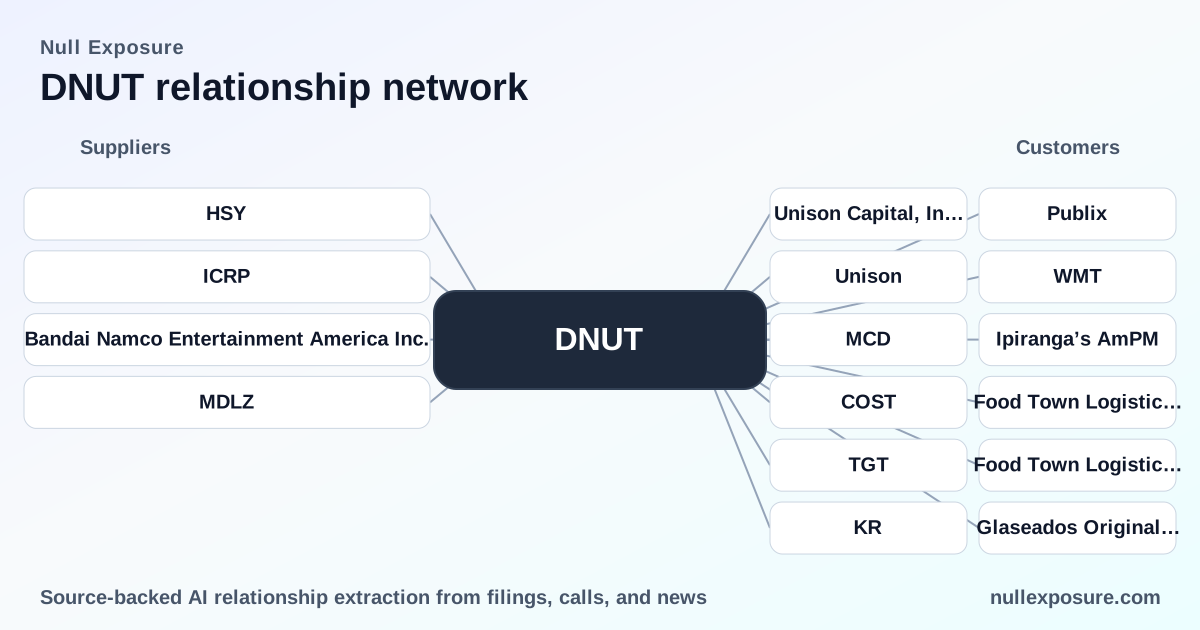
Krispy Kreme (DNUT) — supplier relationships and what they mean for investors
Krispy Kreme operates as a branded retailer and wholesaler of donuts, coffee and complementary packaged drinks and snacks, monetizing through shop sales (company-owned and franchised), wholesale distribution, and product partnerships and licensing. Revenue mixes come from retail sales, franchise royalties, and co-branded product initiatives that extend the brand into grocery and promotion channels. For investors evaluating supplier exposure, the risk profile is driven less by headline marketing collaborations and more by a concentrated ingredients and distribution model that creates operational leverage — and operational fragility — in equal measure. Learn more about supplier risk and relationship mapping at https://nullexposure.com/.
How Krispy Kreme makes money and why suppliers matter
Krispy Kreme monetizes its brand through three linked vectors: shop-level sales (both company-owned and franchise), wholesale/retail packaged product sales, and licensing/co-brand partnerships that drive limited‑time product demand. The company complements core doughnut sales with beverage concentrates and packaged drinks sold through shops, and it periodically releases co-branded collections (e.g., Oreo, Hershey’s) that increase store traffic and wholesale placement. Given this model, ingredient supply, co-manufacturing capacity and distribution rights directly affect product availability, margin stability and promotional cadence, which in turn shapes same-store sales and wholesale revenue.
If you want a structured supplier map and risk scoring for DNUT, visit https://nullexposure.com/ for a deeper analysis.
Supply-chain constraints and contracting posture — what the filings signal
Krispy Kreme’s public disclosures reveal several company-level supply constraints and contractual features that matter for investors:
- Single-vendor dependence for key glaze ingredients is marked as a critical exposure. The company states it relies on a single vendor for essential ingredients used in its glaze flavoring, creating direct vulnerability to shortages, interruptions, or price shocks. This is a material operational risk disclosed in filings (FY2025).
- Co‑manufacturing and backup production relationships exist to manage capacity and continuity. Krispy Kreme has an agreement with an independent food company to manufacture certain doughnut mixes (outside the southeastern U.S.) and to provide backup mix production capability in case its main facility is disrupted.
- Beverage supply is a reseller channel into shops. Keurig Dr Pepper (KDP) sells beverage concentrates and packaged beverages to Krispy Kreme for resale, introducing dependency on an external beverage supplier for incremental beverage revenue.
- Advisory/service arrangements are used for corporate transactions. The company had service agreements with BDT Capital Partners, LLC to provide advisory and valuation services related to acquisitions — a signal of outsourced strategic and valuation expertise.
- Distribution is concentrated via an exclusive partner. An exclusive distribution agreement with BakeMark USA LLC covers distribution of ingredients, packaging and supplies to company-owned and franchised shops in most U.S. regions and Canada (excluding NYC), indicating a centralized distribution posture that simplifies logistics but raises single-point-of-failure risk.
- Purchase commitments are economically meaningful. Forward purchase commitments for ingredients and other contracts total about $98.9 million, placing supplier spend in the $10m–$100m band and implying meaningful bargaining power but also fixed exposure.
Collectively these constraints show a contracting posture that mixes strategic exclusivity (distribution) with concentrated upstream supply (glaze inputs) — a structure that improves unit economics in good times but creates acute operational risk when single sources are disrupted.
Press relationships that matter — every external partner spotted in coverage
Below I walk through each relationship surfaced in the press and what it practically means.
Hershey’s — co‑branded chocolate doughnuts
Krispy Kreme relaunched a Chocomania collection glazed with HERSHEY’S chocolate, a collaboration designed to drive promotional interest and lift store traffic. According to MarketScreener, the product returned as a fan-favorite limited collection in early 2026. (MarketScreener, March 2026).
A separate publicity mention quotes Krispy Kreme’s Chief Brand and Product Officer describing the partnership and product development. This partnership is marketing-led and revenue-accretive on a promotional basis, not a core supply dependency. (Quantisnow, March 2026).
Oreo (Mondelez) — limited-time product collaboration
Krispy Kreme partnered with Oreo for a limited-time doughnut collection, leveraging a packaged-snack brand to create SKU lift and retail visibility. The tie-up was reported by MarketScreener as part of the company’s global product calendar and promotional strategy. (MarketScreener, March 2026).
Such collaborations support short-term same-store-sales uplifts and grocery/wholesale placement, but they do not substitute for the underlying supply and distribution exposures identified in filings.
Bandai Namco Entertainment America — promotional IP partnership
Krispy Kreme announced a collaboration with Bandai Namco Entertainment America celebrating Pac‑Man’s anniversary, producing themed doughnuts and store promotions that included free product events, per USA Today (May 2025). (USA Today, May 2025).
This is a classic brand‑promotion tie intended to drive traffic and PR, reinforcing Krispy Kreme’s model of using limited-time offers to create episodic demand spikes.
ICR — investor relations and media services
Investor relations and media contact lines list ICR as Krispy Kreme’s IR and media provider, indicating outsourced communications support for earnings, investor outreach, and public filings. The connection was cited in a company release about refranchising (reported on StockTitan in March 2026). (StockTitan/press release, March 2026).
Outsourcing IR functions is a standard corporate practice; for investors it signals that KRISPY KREME is using specialized external firms for messaging around transactions and capital markets activity.
What these relationships and constraints mean for investors
- Operational concentration is the primary supply risk. The single-vendor dependence for a key glaze ingredient creates high criticality; even with purchase commitments approaching $100m, a supply interruption would quickly hit product availability and margins.
- Distribution exclusivity is a double-edged sword. The BakeMark exclusive distributorship centralizes logistics and likely lowers unit distribution costs, but it also creates a concentration risk where disruption could cascade across company and franchise shops.
- Marketing partnerships are positive for top-line volatility but not for structural supply risk. Collaborations with Hershey’s, Oreo, and Bandai Namco are valuable for promotional lift; however, they do not mitigate the underlying ingredient and distribution concentration issues.
- Outsourced manufacturing and advisory relationships increase operational resilience in some areas. Co-manufacturing agreements and external advisory services provide redundancy where used, but investors should confirm geographic and capacity depth of backup producers during diligence.
- Financial signal: operating leverage with margin pressure. The company’s latest public figures show meaningful revenue ($1.52bn TTM) but negative EPS and negative net margins, indicating promotional and operational investments are pressuring profitability; supplier and distribution stability are therefore directly material to a path to sustainable margins.
If you are layering supplier risk into an investment thesis or vendor due diligence, get a granular view of the exclusive distribution terms and the single‑vendor contract for glaze ingredients. For detailed supplier scoring and scenario analysis, see the full toolkit at https://nullexposure.com/.
Bottom line — actionable conclusions for investors
Krispy Kreme’s value hinges on brand-driven traffic and co-brand promotions but is materially exposed to concentrated ingredient supply and a centralized distribution model. Promotional partnerships with Hershey’s, Oreo and Bandai Namco are important revenue drivers, yet the company’s filings flag single-supplier criticality and near‑nine‑figure purchase commitments that make supplier continuity a top investment risk. For a deeper supplier-level exposure report and remediation scenario planning, start your assessment at https://nullexposure.com/.
Key takeaway: prioritize due diligence on ingredient vendor contracts, exclusive distribution covenants, and the geographic coverage of co-manufacturing backups before assuming upside from promotional partnerships.