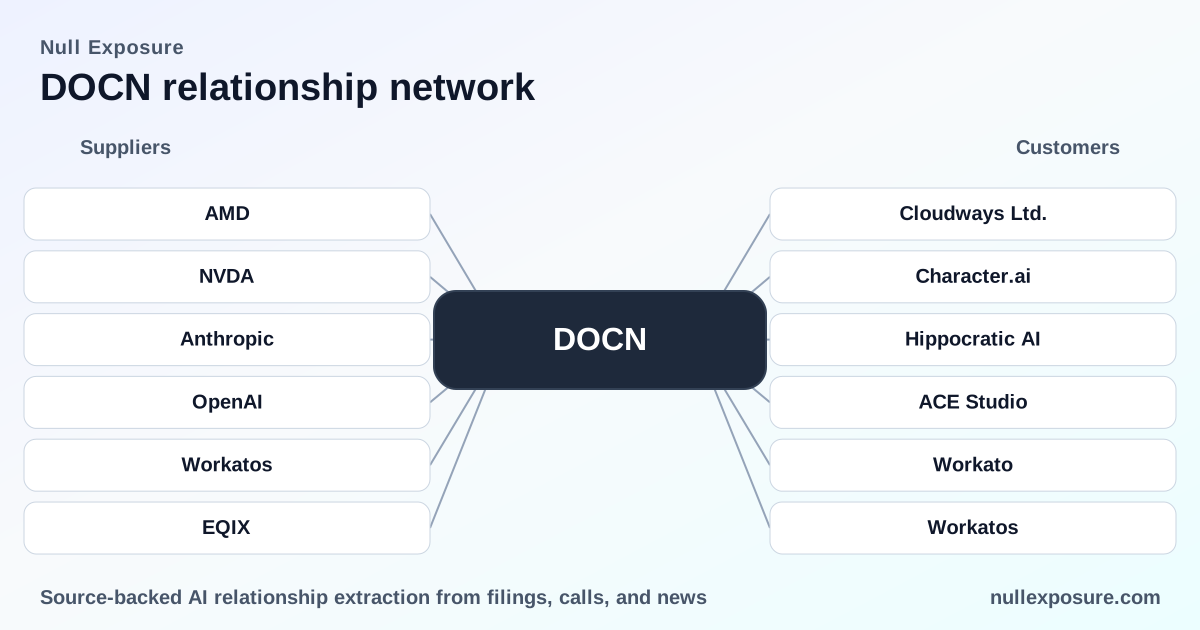
DigitalOcean Holdings (DOCN): Supplier map and what it means for investors
DigitalOcean monetizes a developer- and SMB-focused cloud platform by selling compute, storage, managed services and now specialized AI inference capacity on a usage basis. The company packages GPU-accelerated “Droplets,” the Gradient AI platform, and inference services that convert third-party models and hardware partnerships into recurring, consumption-based revenue. For investors, the key lever is how DigitalOcean converts supplier relationships—GPU OEMs, model vendors and colocation partners—into scalable, margin-accretive product lines. Explore more on the company and supplier exposures at https://nullexposure.com/.
The strategic role of suppliers in DigitalOcean’s growth story
DigitalOcean’s recent product cadence centers on delivering inference-optimized infrastructure to small and mid-market customers that otherwise lack scale. That strategy is built on three supplier-driven realities:
- Hardware dependence and concentration. To deliver competitive inference performance, DigitalOcean sources GPUs from leading chipmakers; those relationships directly determine product performance and pricing.
- Revenue model: usage and product bundling. GPU Droplets and Gradient services are billed on a consumption basis and bundled with third-party LLM access, turning supplier capacity into recurring revenue.
- Operational posture and control. The company’s public disclosures treat DigitalOcean as the principal for services sold to customers, implying integration and control over supplier-delivered components (see constraints discussion below).
These dynamics create asymmetric upside—if DigitalOcean secures favorable terms and capacity for the right GPU SKUs, it captures both utilization-driven revenue and higher-margin platform fees. Investors looking for deeper supplier intelligence can start here: https://nullexposure.com/.
Company-level constraints and operating signals
DigitalOcean’s SEC disclosure makes two strategic signals explicit. First, management concludes it acts as principal for services provided to customers, which signals direct control over pricing, customer relationships and revenue recognition for integrated offerings. Second, the company disclosed a transition services agreement with Gaditek tied to its Cloudways acquisition; fees under that agreement were disclosed for recent years. According to the company filing, fees paid to Gaditek were approximately $355, $792 and $300 for the years ended December 31, 2024, 2023 and 2022, respectively—this highlights the presence of transitional supplier arrangements after M&A and the operational work required to integrate acquisitions.
These are company-level characteristics: principal contracting posture supports higher gross take rates but requires active supplier and integration management; transitional agreements indicate ongoing post-acquisition supplier dependencies.
Supplier map: what each relationship supplies and why it matters
Below I cover each supplier relationship referenced in recent reporting and news, with concise takeaways and source citations.
AMD — GPU supplier for inference-optimized Droplets
DigitalOcean rolled out GPU Droplets powered by AMD Instinct MI350X (and announced upcoming MI355X deployments), positioning AMD hardware as a cornerstone of its Agentic Inference Cloud and Gradient offering. According to multiple press releases in March 2026, DigitalOcean’s AMD-based Droplets doubled production inference throughput for Character.ai while cutting cost per token materially. (Source: StockTitan press release and Bitget coverage, Mar 2026 — https://www.stocktitan.net/news/DOCN/digital-ocean-elevates-its-agentic-inference-cloud-with-gpu-droplets-c90ozp0iwlvr.html; https://www.bitget.com/amp/news/detail/12560605208458)
NVIDIA — strategic supplier for high-performance AI chips
DigitalOcean also deploys NVIDIA GPUs (H100 and Blackwell B300 cited) in specialized Droplets for production AI, integrating NVIDIA’s accelerated platform into inference services to support enterprise-grade workloads. Management highlighted these capabilities in its product launches and filings describing Gradient AI GPUs from both NVIDIA and AMD. (Source: TradingView summary of the company’s SEC filings and FinancialContent coverage, 2025–2026 — https://www.tradingview.com/news/tradingview:390139bef4159:0-digitalocean-holdings-inc-sec-10-k-report/; https://markets.financialcontent.com/stocks/article/finterra-2026-1-27-the-mid-cap-renaissance-a-deep-dive-into-digitaloceans-specialized-cloud-strategy)
Anthropic — model access partner for Gradient customers
DigitalOcean offers ready-made LLM access within its Gradient platform, including models from Anthropic, enabling SMB customers to deploy sophisticated AI features without licensing models directly. This supplier relationship is framed as a platform capability that shortens time-to-market for customer applications. (Source: Finviz market write-up referencing product positioning, Mar 2026 — https://finviz.com/news/278613/1-glorious-growth-stock-down-56-to-buy-hand-over-fist-in-january-according-to-wall-street)
OpenAI — third-party model provisioning inside Gradient
OpenAI models are listed among the third-party LLMs that DigitalOcean makes available through Gradient, letting customers use established foundation models as part of their inference stacks. This integration converts model vendors into indirect suppliers of value for end customers. (Source: The Globe and Mail and Finviz coverage of Gradient platform capabilities, 2025–2026 — https://www.theglobeandmail.com/investing/markets/markets-news/motley/233028/prediction-digitalocean-stock-is-going-to-soar-after-feb-24/; https://finviz.com/news/278613/1-glorious-growth-stock-down-56-to-buy-hand-over-fist-in-january-according-to-wall-street)
Workato(s) — enterprise integration customer using DigitalOcean inference
DigitalOcean powers Workato’s agentic enterprise products with production-scale AI running on its inference platform, illustrating how the company converts supplier-sourced hardware and software into customer-facing, industry-specific solutions. This is an example of a strategic customer that validates the platform’s enterprise capability. (Source: StockTitan coverage, Mar 2026 — https://www.stocktitan.net/news/DOCN/digital-ocean-powers-workato-s-agentic-enterprise-with-production-ykdcc6p5ofcz.html)
Equinix — colocation and data-center footprint partner
DigitalOcean’s geographic footprint includes colocation relationships such as early deployments in Equinix facilities; colocation partners enable global reach and the latency/performance characteristics required for inference services. (Source: DatacenterDynamics historical reporting and market commentary — https://www.datacenterdynamics.com/en/news/small-cloud-company-digitalocean-raises-775m-ipo-shares-drop-open/)
Gaditek — transition services partner post-Cloudways acquisition
The company’s SEC filing discloses a transition services agreement with Gaditek related to the Cloudways acquisition, with fees billed primarily on a usage basis; disclosed payments were approximately $355, $792 and $300 for 2024, 2023 and 2022, respectively. This is an explicit post-acquisition supplier dependency that required management attention. (Source: Company SEC filing as cited in the 10-K disclosure, reported in the constraints excerpt)
What investors should watch next
- Supply risk vs. product monetization. GPU availability and commercial terms from AMD and NVIDIA will directly influence DigitalOcean’s unit economics and go-to-market pricing.
- Platform integration and principal posture. Treating DigitalOcean as the principal for services creates higher revenue capture but requires tight supplier governance and operational maturity. That governance will determine margin expansion as AI workloads scale.
- Customer validation and sticky use cases. Deployments for customers like Workato and Character.ai provide evidence the platform can host production AI; watch usage growth, cost per token metrics, and cross-sell into existing SMB accounts.
For deeper supplier and counterparty analysis, visit https://nullexposure.com/ to access structured supplier intelligence and filings.
DigitalOcean has converted raw supplier capability—GPUs, LLM access and colocation—into a packaged product set that targets an underserved SMB segment for production AI. If the company sustains favorable supplier access and manages integration risk, the inference business is a lever for durable revenue growth; if supply or pricing turns, the model’s margin sensitivity will be exposed. For investors and operators evaluating DOCN supplier relationships, the next earnings cycle and supplier announcements will be decisive—track GPU rollouts, partner contracts, and the company’s usage metrics closely. More supplier-focused intelligence and filing summaries are available at https://nullexposure.com/.