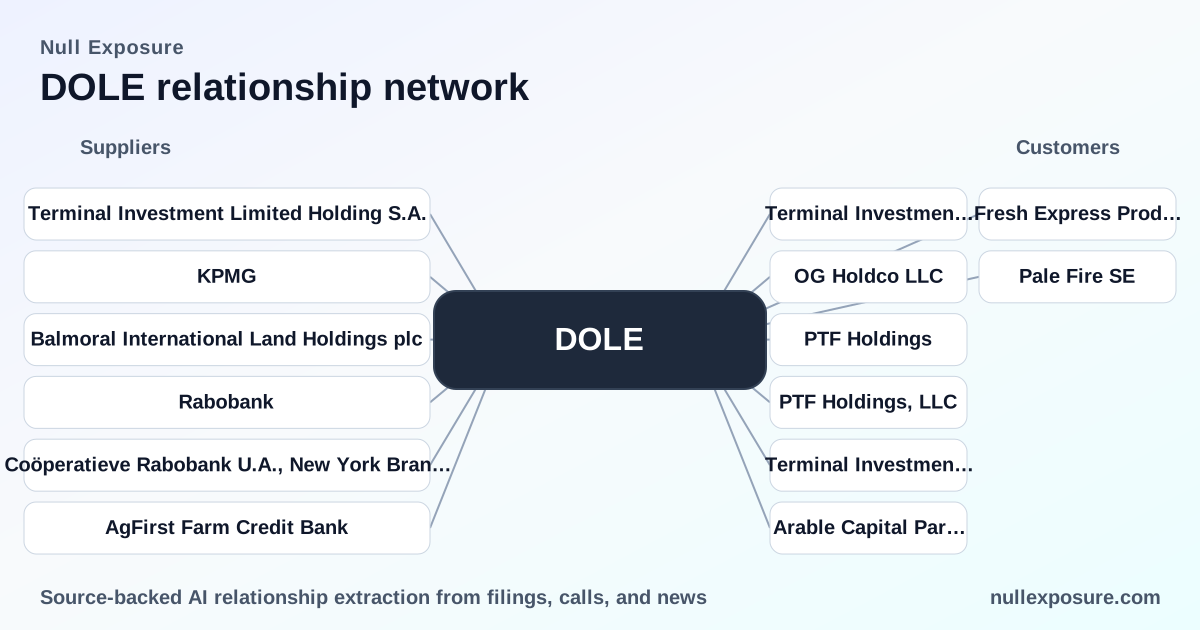
Dole PLC (DOLE) — Supplier relationships that shape operating risk and near-term cashflow
Dole PLC operates as a global supplier of fresh fruits and vegetables, monetizing through vertical control of production, packing and distribution across more than 70 countries and through branded and private-label sales to retailers and foodservice customers. Revenue is generated from crop sales and packaged produce, while value is preserved through logistics assets, long-term customer contracts and financing arrangements that smooth working capital in a seasonally exposed business. For investors and operators assessing supplier and counterparty exposures, the company’s recent port transaction and its updated financing package are the most material developments for cashflow and operating continuity. Learn more about the commercial and counterparty map at https://nullexposure.com/.
How Dole’s commercial footprint turns into cashflow
Dole’s business model ties agricultural production to global distribution: harvests convert into boxed/packaged product, which flows through company-controlled packing and port facilities into retail and wholesale channels. The company’s profitability is driven by scale in commodities (bananas, pineapples, salads), distribution efficiency and the ability to access trade finance and syndicated credit to fund seasonal working capital. Key financials to keep on the dashboard: trailing revenue near $8.97 billion, EBITDA around $338 million, and an EV/EBITDA multiple of about 6.8 — signaling a capital-intensive business with modest operating margins but meaningful asset backing.
For a deeper counterparty map and supplier-risk scoring, visit https://nullexposure.com/.
What the Guayaquil port sale signals about capital allocation
Dole announced an agreement to sell its Guayaquil, Ecuador port properties to Terminal Investment Limited Holding S.A. for net cash proceeds of approximately $75 million after adjustments, with regulatory approvals and a closing expected in 2026. Critically, Dole will continue to use the facility under an arm’s length terminal services agreement, converting a fixed asset into cash while preserving operational continuity at the port. This is a classic monetization trade: unlock balance-sheet liquidity without immediate operational disruption. The transaction is documented in the company’s filings and covered in shipping trade press in March 2026 (Form 6-K and ShippingTelegraph).
Financing posture and lenders: gearing, covenants and maturity
Dole restructured its core credit arrangements in May 2025, amending and extending facilities with Rabobank and related agents, with a revised end date to May 7, 2028. The May 1, 2025 Amended and Restated Credit Agreement lists Coöperatieve Rabobank U.A., New York Branch as administrative and collateral agent, and identifies AgFirst Farm Credit Bank as farm credit administrative agent. These financing relationships indicate a sponsored, syndicated approach to working-capital and asset-backed financing, central to Dole’s ability to fund seasonal inventory and capitalize harvest cycles. The presence of farm credit capacity and a major international bank as agent improves access to agricultural receivables financing but also concentrates negotiating leverage among a few lenders.
Supplier and partner relationships: who Dole works with
Below are every relationship captured in the recent reporting with plain-English summaries and source context.
-
Terminal Investment Limited Holding S.A. — Dole has signed agreements to sell 100% of membership interests in its Guayaquil, Ecuador port properties and operations, with expected net proceeds of about $75.0 million and a plan to continue using the terminal under a services agreement through completion; closing is subject to Ecuadorian regulatory approvals and expected in 2026. According to Dole’s Form 6‑K disclosure (filed March 2026) and ShippingTelegraph coverage (March 2026), the sale converts an operational property into liquidity while preserving terminal access.
-
KPMG — KPMG served as Dole’s principal accountant for the fiscal years ended December 31, 2025 and December 31, 2024, anchoring the company’s external audit and reporting processes. This auditor relationship is stated in Dole’s annual filing (Form 10‑K, filed 2026).
-
Balmoral International Land Holdings plc — Two Dole subsidiaries currently lease a number of properties from Balmoral for their normal trading activities, indicating a landlord-tenant relationship for certain operational sites. This leasing arrangement is disclosed in Dole’s Form 10‑K (filed 2026).
-
Rabobank — In May 2025 Dole amended and extended a credit arrangement with Rabobank that includes recourse provisions and a maturity revised to May 7, 2028; this reflects Rabobank’s role as a key lender in Dole’s syndicated financing. The amendment and its terms are summarized in Dole’s Form 10‑K (filed 2026).
-
Coöperatieve Rabobank U.A., New York Branch — This branch acts as administrative agent and collateral agent under Dole’s Amended and Restated Credit Agreement dated May 1, 2025, formalizing agent responsibilities in the syndicate structure. The credit agreement is referenced in Dole’s Form 10‑K (filed 2026).
-
AgFirst Farm Credit Bank — AgFirst is named as the farm credit administrative agent in the May 1, 2025 amended credit agreement, providing a channel for farm credit facilities that align with Dole’s agricultural receivables and seasonal needs. The role is described in Dole’s Form 10‑K (filed 2026).
Company-level constraints and operating character
The public disclosures include no explicit external constraint list, but several company-level signals define Dole’s operating posture:
-
Contracting posture: Dole uses a mix of owned and leased assets and executes arm’s-length service agreements post-disposal (the Guayaquil sale is an example), showing an operational preference for monetizing non-core property while retaining service continuity.
-
Counterparty concentration: Financing is concentrated in a small set of institutional lenders and farm-credit agents, which improves efficiency but creates negotiation concentration risk around covenant resets and refinancing windows.
-
Criticality of assets: Port and logistics facilities are critical to export flow; monetizing these assets transfers ownership risk but preserves service access only if the buyer relationship holds under commercial terms.
-
Maturity profile: The amended credit package through 2028 establishes a medium-term financing runway, but investors should watch refinancing risk and covenant compliance through that window.
What investors should watch next
- Cash conversion from the Guayaquil sale and the timing of regulatory approvals — proceeds will materially add liquidity and reduce balance-sheet leverage if realized in 2026.
- Covenant language and leverage metrics under the Rabobank-led facility as the company moves through seasonal peaks and troughs; the May 2025 amendment sets the framework through 2028.
- Lease and landlord arrangements for operational sites that could affect fixed-cost flexibility as Dole optimizes its footprint.
For a practical counterparty and supplier risk brief tailored to institutional investors, see our research hub at https://nullexposure.com/.
Dole’s model converts perishable agricultural production into global retail supply through a tightly coupled logistics and financing stack. The recent port sale and the May 2025 financing amendments are the immediate events that reframe liquidity, creditor relationships and operational resilience. For active investors and operators, monitoring cash realization from asset monetizations and lender covenant dynamics will be decisive for the next 12–24 months.
Explore more supplier relationship intelligence and supplier-operational risk tools at https://nullexposure.com/.