Dover Corporation (DOV) — Supplier Relationship Review for Investors
Dover Corporation is an industrial conglomerate that monetizes through the sale of specialized machinery, aftermarket parts and services, and targeted recurring revenue in niche industrial end-markets; the company combines product sales, consumables, and service contracts to generate steady cash flow and above-average operating margins for the sector. Dover runs a diversified manufacturing and distribution footprint and funds strategic capital allocation via active capital markets activity, including share repurchases and offerings. For investors and operators evaluating supplier and counterparty relationships, the crucial distinction is that the relationships documented here are financial counterparties and capital markets partners, not single-source production suppliers — a structural signal for lower supplier concentration risk but meaningful dependence on banking markets for capital programs. For a concise sourcing and relationship map, see the NullExposure hub: NullExposure homepage.
What the relationship footprint reveals in plain terms
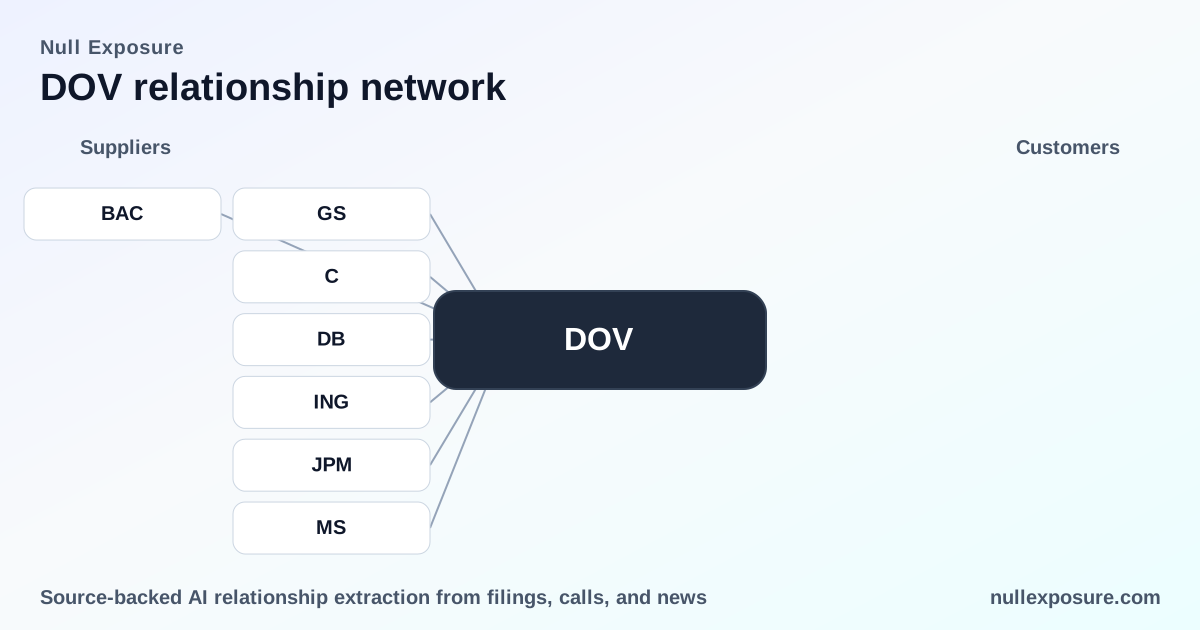
Dover’s listed relationships in the recent filings are predominantly underwriters, brokers, and a bank counterparty for an accelerated share repurchase. These partnerships reflect the company’s capital markets activity — equity offerings and repurchase execution — rather than core production dependencies. From an operating-model perspective, Dover combines index-based, longer-term raw-material contracts with a broad supplier base, which results in low single-supplier criticality at the consolidated level. According to Dover’s filings, the company maintains longer-term index-based contracts on raw materials and components and centrally manages risk to minimize exposure, and it explicitly states that the loss of any single supplier is generally immaterial to consolidated operating profits (company filing language disclosed in FY2026). This is a company-level signal for low supplier concentration and moderate contractual maturity.
If you are modeling counterparty concentration or credit exposure, include both the capital markets counterparties below and the procurement posture described in the filings. For access to an organized relationship view, visit NullExposure homepage.
The roll call — every relationship surfaced in recent filings
- Goldman Sachs & Co. LLC acted as an underwriter in a multi-bank syndicate for a securities offering disclosed in FY2026, indicating Goldman’s role as a capital markets partner on Dover’s issuance activity (source: FY2026 filing hosted on StockTitan, March 2026 — https://www.stocktitan.net/sec-filings/DOV/page-4.html).
- Citigroup Global Markets Limited was also part of the underwriting syndicate for the same offering, supporting distribution and placement capacity in European markets (source: FY2026 filing on StockTitan, March 2026 — https://www.stocktitan.net/sec-filings/DOV/page-4.html).
- Deutsche Bank AG, London Branch participated in the underwriting syndicate, supplying London-based distribution and underwriting capabilities for the offering (source: FY2026 filing on StockTitan, March 2026 — https://www.stocktitan.net/sec-filings/DOV/page-4.html).
- ING Bank N.V. appears as a syndicate member on the underwritten offering, reflecting participation from continental European banking partners (source: FY2026 filing on StockTitan, March 2026 — https://www.stocktitan.net/sec-filings/DOV/page-4.html).
- Merrill Lynch International was listed among the syndicate underwriters, providing additional distribution and placement support for Dover’s capital markets transaction (source: FY2026 filing on StockTitan, March 2026 — https://www.stocktitan.net/sec-filings/DOV/page-4.html).
- JPMorgan Chase Bank, N.A. executed an accelerated share repurchase (ASR) program with Dover to facilitate a $500 million reduction in common shares outstanding, indicating JPMorgan’s role as the repurchase execution counterparty (source: FY2026 filing on StockTitan, March 2026 — https://www.stocktitan.net/sec-filings/DOV/page-4.html).
- Morgan Stanley Smith Barney LLC is named as a broker for insider/executive share dispositions in the filings, registering addresses and broker information for share sales disclosed by company insiders (source: FY2026 filing posted on StockTitan, March 2026 — https://www.stocktitan.net/sec-filings/DOV/144-dover-corp-sec-filing-e2a6862aed66.html).
How these relationships affect the operational and financial profile
- Capital markets access is a clear operational lever. The presence of major global underwriters and an ASR with JPMorgan signals that Dover executes active capital allocation strategies, using underwritten offerings and repurchase programs to manage share count and capital structure. This lowers the risk of liquidity shortfalls when management opts for market transactions to fund buybacks or M&A.
- Supplier-side risk remains low at the consolidated level. Dover’s procurement posture—explicitly citing longer-term, index-based contracts for some raw materials and a broad supplier base—creates a contracting posture that is mature and centrally managed, and the company’s own language categorizes loss of any single supplier as generally immaterial to consolidated profits. That reduces single-point-of-failure concerns for large-scale manufacturing continuity.
- Concentration of financial counterparties is moderate but strategic. Using top-tier banks for underwriting and ASR execution ensures execution quality but creates operational reliance on capital markets corridors; monitor execution costs and access during market stress.
For a structured counterparty map and further supplier intelligence, visit NullExposure homepage.
Key risk factors to model
- Commodity index exposure: long-term, index-based raw-material contracts can shift margin volatility from spot purchases to index-linked pricing; model commodity curves accordingly.
- Execution risk on capital programs: underwritten offerings and ASRs compress liquidity windows; simulate scenarios where market dislocation raises underwriting spreads or impairs ASR completion.
- Counterparty credit and settlement: reliance on a handful of global banks for issuance and repurchase execution concentrates settlement and operational risk; include counterparty limits in treasury stress tests.
Investment implications and recommended monitoring checklist
- Track issuance cadence and underwriting fees to measure the cost of capital and the frequency of accessing public markets. Underwriters listed in FY2026 signal active capital markets usage—adjust leverage and free cash flow assumptions accordingly.
- Incorporate the company-level procurement signals into working-capital and margin stress tests: longer-term index contracts and broad supplier availability reduce downside from supplier disruption, but increase sensitivity to index moves.
- Monitor repurchase programs for impact on share count and leverage; the $500 million ASR executed with JPMorgan is a material capital allocation event and changes per-share metrics and capital structure dynamics (source: FY2026 filing on StockTitan, March 2026).
Bottom line and what operators should watch next
Dover’s public filings show a network of high-quality financial counterparties used primarily for underwriting and share-repurchase execution, while procurement policies emphasize longer-term indexed contracts and a diversified supplier base that limit single-supplier criticality. For investors and operators, the commercially relevant takeaways are: low consolidated supplier concentration risk, active use of capital markets to manage capital structure, and exposure to index-linked commodity pricing. If you want a consolidated, searchable view of these relationships and how they intersect with procurement signals, research tools at NullExposure homepage provide direct access to the underlying filing references and relationship mappings.
For diligence follow-ups, prioritize counterparty exposure limits, the timeline and terms of index-based contracts, and any subsequent underwriting activity that could signal additional capital needs or strategic transactions.