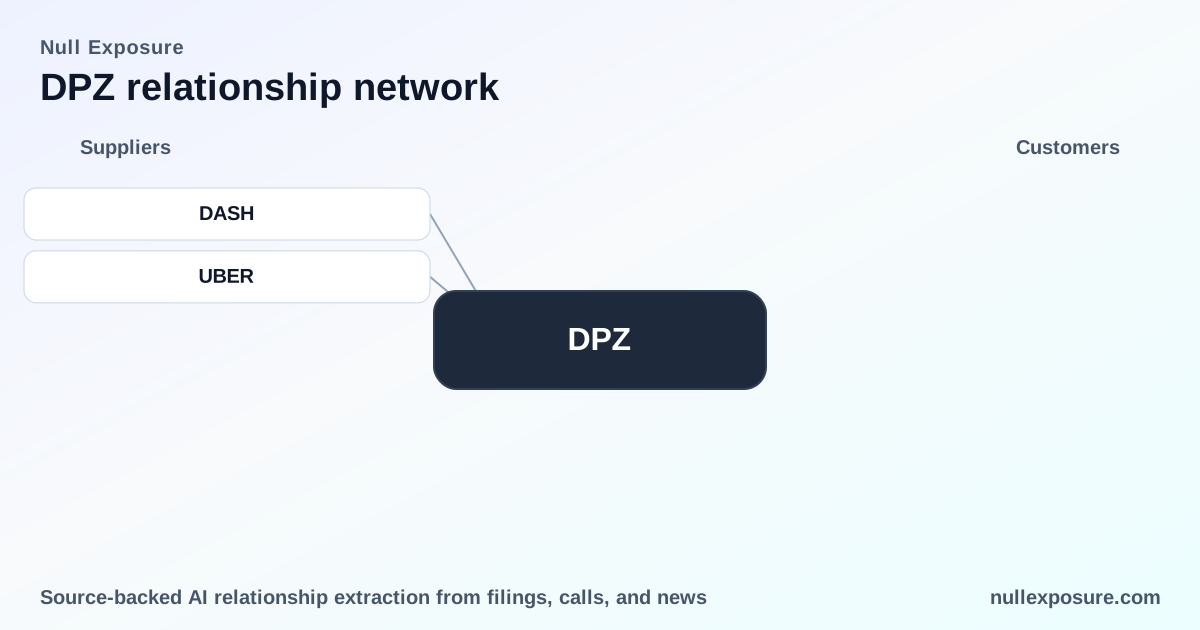
Domino’s (DPZ) supplier relationships: what investors need to know
Domino’s monetizes a global pizza delivery and carryout business through a predominantly franchised model, proprietary digital ordering, and a tightly controlled supply chain that sells back certain ingredients and services to franchisees. The company earns recurring royalties and supply-chain markups while leveraging technology and third‑party delivery aggregators to increase order volume and unit economics. Investors should view Domino’s as a tech-enabled franchisor with concentrated supplier exposures and long-dated commercial commitments that materially affect margins and operational continuity. For further supplier-level analysis, visit https://nullexposure.com/.
Quick take — investment thesis in one paragraph
Domino’s generates cash through franchise fees, company-owned stores and a supply-and-logistics model that captures recurring margin on key inputs; margins scale with digital penetration and delivery reach. Key risk vectors are supplier concentration for major food inputs, long-term commercial commitments, and the company’s reliance on delivery aggregators to expand reach without materially increasing fixed costs. With a market cap north of $13 billion and a consistent operating margin profile, the company’s economics reward stable unit-level performance but are sensitive to commodity and partner dynamics.
What the relationships tell us (each relationship in the results)
Domino’s references two external delivery aggregators repeatedly across its FY2026 commentary and SEC reporting. Below are concise, source-linked summaries for each.
-
DoorDash — Domino’s reported that its rollout on DoorDash progressed through 2025 and should drive continued aggregator growth in 2026; management highlighted DoorDash as a channel that was not fully rolled out until mid‑2025. Source: Benzinga transcript of Domino’s Q4 FY2025 earnings call, March 2026.
-
Uber — Management acknowledged under‑penetration on Uber relative to the overall delivery market, noting Domino’s represents about one out of every three deliveries on platforms where it is active and that Uber remains an underweight channel. Source: Benzinga transcript of Domino’s Q4 FY2025 earnings call, March 2026.
-
DoorDash and Uber (SEC/10‑K summary) — In its public filings and investor summaries, Domino’s frames aggregator partnerships with DoorDash and Uber as deliberate extensions of its technology and market reach strategy. Source: TradingView summary of Domino’s SEC 10‑K, March 2026.
Why these partners matter for returns and operations
Domino’s strategy is to drive incremental orders without building proportional fixed-cost capacity. Aggregators such as DoorDash and Uber provide that incremental demand channel — they are distribution multipliers rather than ownership changes. That means revenue lift can be high‑return if incremental orders avoid significant additional promotional spend or cannibalization.
However, aggregators also compress per‑order economics via delivery fees and promotional mechanics. For investors, the key questions are: (1) how much net new demand aggregators deliver versus cannibalization of Domino’s owned delivery, and (2) whether platform commission structures and placement priorities evolve against Domino’s interests. Management’s disclosure that DoorDash was only fully rolled out in mid‑2025 implies recent gains in penetration and a near‑term growth runway for aggregator-driven volume.
Constraints and what they signal about Domino’s operating model
Domino’s corporate disclosures provide several company-level constraints that shape supplier risk and contract posture:
-
Long-term contracting posture. The company discloses multi-year supply and beverage contracts and leases with terms extending multiple years (examples include a five‑year cheese supply commitment and an exclusive Coca‑Cola agreement through 2030). These arrangements indicate a preference for long-term certainty in input availability and price mechanisms that smooth cost volatility.
-
High concentration on a small set of critical inputs. Management explicitly states cheese is its largest food cost and that the U.S. pizza cheese purchases are sourced from a single supplier; price to franchisees is formula-based on commodity benchmarks. Concentration on essential inputs creates outsized operational leverage to supplier disruptions and commodity price moves.
-
Buyer role with price‑sensitive exposures. Domino’s is a buyer for meat and cheese contracts and is exposed to commodity volatility; the company passes some price changes through to franchisees but also carries margin consequences at the corporate and supply‑chain level.
-
Active contracts with near-term expirations for certain inputs. Some meat topping contracts expire at the end of 2025 and other leases commence in 2025 with long terms; this indicates a mix of mature and renewing relationships that require active contract management.
Taken together, these constraints describe a company that locks supply certainty with long-term contracts while accepting concentration risk on critical commodities — a tradeoff that stabilizes supply but concentrates supplier dependency.
Operational implications for franchisees and operators
Franchise economics hinge on predictable ingredient pricing and reliable delivery channels. Long‑dated supplier agreements and supply‑chain leases reduce short‑term volatility but limit flexibility if market prices shift in favor of alternative sourcing. Aggregator partnerships expand demand reach but introduce variable unit economics and platform dependence. Operators should model both the upside of incremental aggregator orders and the downside of concentrated input cost shocks.
Portfolio risk/reward framing
For investors, Domino’s is a growth‑adjacent consumer play: steady same‑store dynamics, high digital penetration, and recurring supply revenues support robust margins, but concentrated commodity exposures and dependency on aggregator economics compress optionality. The stock’s forward-looking multiples reflect this mix — stable cash generation with embedded operational risks that are contractually and geographically concentrated.
If you want ongoing supplier-level monitoring and deeper counterparty analysis, see our platform for curated supplier intelligence at https://nullexposure.com/.
Final takeaways and next steps
- DoorDash and Uber are core distribution partners that materially affect order volume; DoorDash rollout accelerated in 2025 and is expected to contribute growth in 2026. (Benzinga, TradingView — March 2026)
- Supply-side risks are concentrated and contractual: cheese sourcing and certain meat contracts are pivotal inputs governed by multi-year arrangements. (Company December 2024 disclosures)
- Investors should balance the yield from Domino’s franchised model and supply-markup economics against supplier concentration and aggregator fee pressure.
For a more granular read on counterparty exposures and contract timelines, visit https://nullexposure.com/ and request the DPZ supplier briefing.