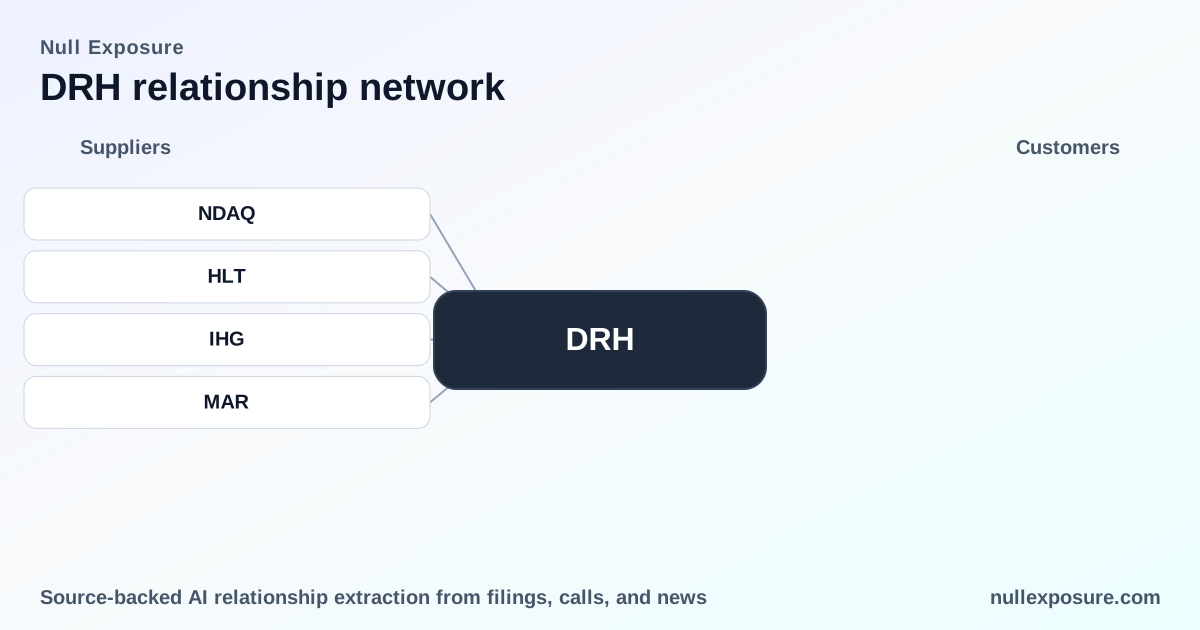
DiamondRock Hospitality (DRH): Supplier Relationships, Contracting Posture, and Investment Implications
DiamondRock Hospitality is a self-advising REIT that owns a geographically diversified portfolio of hotels and monetizes through property-level cash flow, management and franchise fee arrangements, and REIT-level capital allocation (dividends, asset sales, and refinancing). The company captures revenue both directly from owned hotels and indirectly via usage‑based contractual streams (management and franchise royalties tied to gross revenues), and benefits from long-duration brand and management contracts that stabilize cash flow while leaving operations in the hands of third‑party operators. For deeper supplier intelligence and relationship mapping visit the Null Exposure homepage: https://nullexposure.com/.
How DiamondRock’s operating model converts to predictable cash flow
DiamondRock operates as a capital owner and outsources hotel operations to third parties under two principal commercial models: franchise (license) agreements and hotel management agreements. The firm receives the residual economics of hotel ownership — room revenue net of operator fees and royalties — while paying usage‑based fees to brand franchisors and managers that scale with occupancy and ADR. Company filings and recent coverage for FY2026 make several operating characteristics explicit:
- Contracting posture and duration: A meaningful portion of the portfolio is bound by long‑term franchise and management contracts (some franchise terms extend up to 26 years; certain management contracts include renewals stretching to ~34 years), which creates durable, lender‑friendly cash flow profiles.
- Fee design (criticality): Management and franchise compensation is largely percentage‑based on gross revenues — base management fees typically 0.5%–3.5% of gross hotel revenues, and franchise royalties generally 3.5%–7% of gross room sales (plus small food & beverage percentages where applicable). That alignment preserves operating leverage for the owner but links DRH’s fees directly to market demand cycles.
- Counterparty concentration and scale: More than 60% of hotels operate under brands owned by global lodging companies (Marriott, Hilton, IHG), signaling high‑quality, very large enterprise counterparties that materially influence distribution, reservation systems, and corporate sales channels.
- Spend and economics: Annual management fees and franchise fees are non‑trivial on a company basis — in FY2024 DRH reported roughly $27.1 million of total management fees and $39.7 million of franchise fees — placing vendor spend and partner payments in a mid‑range band (tens of millions annually).
- Relationship stage and role: All hotels are actively managed by third parties (either independent operators or brand operators), so these supplier relationships are operationally critical and active across the portfolio.
These corporate signals frame how supplier relationships create cash‑flow stability while exposing the REIT to brand contract terms and usage‑sensitivity. For a full vendor relationship map and supplier intelligence, see https://nullexposure.com/.
What the public sources say about DRH’s counterparties
Below are the supplier relationships surfaced in publicly indexed coverage and the plain‑English implications for investors.
Nasdaq (NDAQ)
DiamondRock disclosed plans to move to the Nasdaq Global Select Market and received recent analyst attention following a dividend increase and a Deutsche Bank upgrade in FY2026; listing strategy and positive analyst momentum are being referenced in market commentary. See the Sahm Capital write‑up and SimplyWall coverage discussing the upgrade, dividend raise and listed‑market move in early 2026 (FY2026) — https://www.sahmcapital.com/news/content/a-look-at-diamondrock-hospitality-drh-valuation-after-upgrade-dividend-hike-and-planned-nasdaq-move-2026-01-16 and https://simplywall.st/stocks/us/real-estate/nasdaq-drh/diamondrock-hospitality/news/a-look-at-diamondrock-hospitality-drh-valuation-after-upgrad.
Hilton (HLT)
DRH reports that a material portion of its portfolio operates under global brands; roughly 40% of hotels are independent and the remainder affiliates with brands including Hilton, implying that Hilton functions as a large enterprise franchisor/operator for part of the estate and contributes to distribution and loyalty demand. This classification is drawn from TradingView’s summary of DRH’s 10‑K disclosures (March 2026) — https://www.tradingview.com/news/tradingview:90c23336cd516:0-diamondrock-hospitality-co-sec-10-k-report/.
IHG (IHG)
InterContinental Hotels Group is named among the major brand partners supporting DRH’s franchised footprint, representing a strategic distribution and royalty relationship that ties franchise royalty streams to room revenue and F&B sales where applicable, according to TradingView’s recap of DRH’s 10‑K (FY2026) — https://www.tradingview.com/news/tradingview:90c23336cd516:0-diamondrock-hospitality-co-sec-10-k-report/.
Marriott (MAR)
Marriott is explicitly identified as a core franchisor for many of DRH’s properties; Marriott, with Hilton and IHG, collectively account for more than 60% of brand‑operated hotels, intensifying the importance of brand licensing and loyalty channels to DRH’s revenue profile (TradingView coverage of DRH’s FY2026 10‑K). Source: https://www.tradingview.com/news/tradingview:90c23336cd516:0-diamondrock-hospitality-co-sec-10-k-report/.
Why these relationships matter to investors
- Revenue alignment and cyclicality: Because management and franchise fees are usage‑based, DRH’s operating cash flow scales with recovery in room demand and ADR, creating cyclical upside in expanding travel markets and downside sensitivity in downturns.
- Durability via long contracts: Long‑term franchise and management tenors reduce turnover risk and support financing flexibility, but long terms also lock in legacy fee schedules and covenant exposures.
- Counterparty quality reduces distribution risk: Relationships with very large global brands (Marriott, Hilton, IHG) materially enhance distribution and corporate sales, reducing demand volatility for branded assets relative to independents.
- Concentration and bargaining dynamics: With ~60% of hotels under global brands, DRH carries concentration risk that can influence renegotiation leverage and franchise fee pass‑throughs; however, these brand relationships also deliver occupancy and ADR premiums that justify royalty costs.
- Spend profile: Annual management and franchise fees in the tens of millions indicate meaningful ongoing payments that are material to operating margins but predictable in scale because they are contractually defined and usage‑linked.
For investors conducting diligence, prioritize analysis of renewal windows for the handful of non‑terminable contracts, the schedule of franchise expirations, and the sensitivity of DRH’s distributable cash flow to occupancy and ADR movements. More detailed supplier analytics and contract‑level signals are available at Null Exposure: https://nullexposure.com/.
Bottom line and next steps
DiamondRock’s supplier map is dominated by long‑dated, usage‑based contracts with very large hotel brands and third‑party managers, offering durable cash flows with embedded cyclical exposure to travel demand. Key investment levers are ADR/occupancy recovery, franchise cost pass‑through, and the timing of contract renewals. For portfolio managers and operator diligence teams seeking a structured supplier risk view, start with contract expiration timelines and fee escalation mechanics.
Explore full supplier intelligence and contract signal analysis at Null Exposure: https://nullexposure.com/.