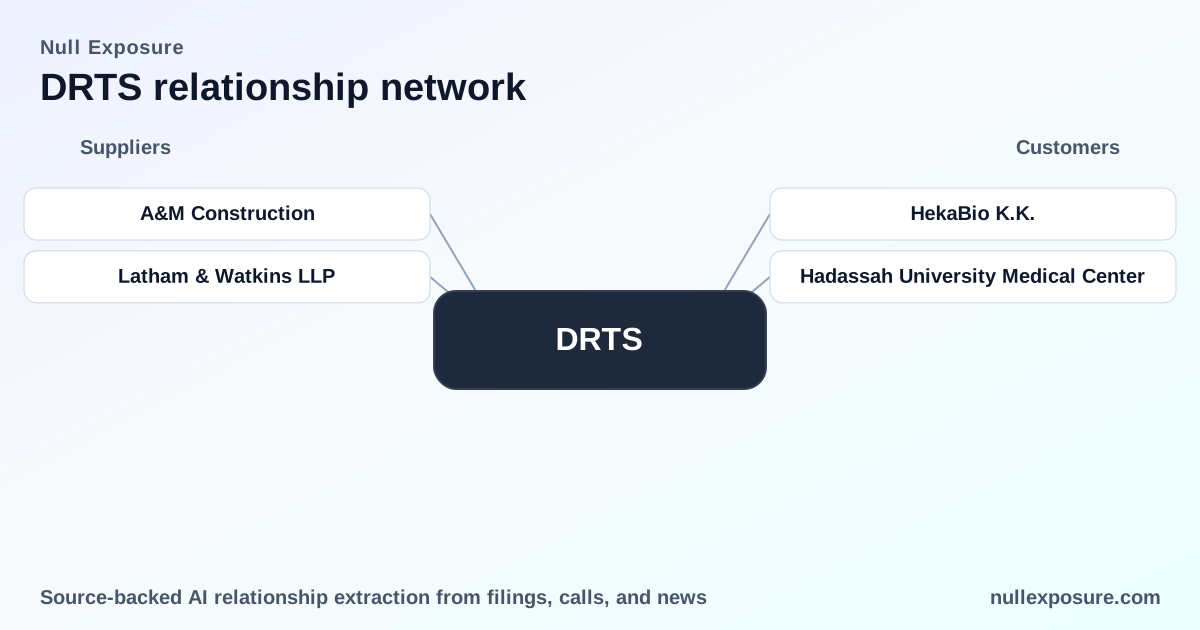
Alpha Tau Medical (DRTS): Supplier relationships that matter as the company pushes to commercial readiness
Alpha Tau Medical is a clinical-stage oncology company commercializing Alpha DaRT, an alpha-emitting radiation therapy for solid tumors. The firm currently monetizes by advancing clinical programs and building internal manufacturing capacity to support product rollouts; until product sales commence revenue stays at zero and the company operates as a development-stage biotech with heavy operational and regulatory capital needs. Investors should treat supplier and advisor ties as strategic levers: construction partners convert regulatory approvals into physical capacity, and legal/capital markets advisors convert development milestones into public market access. Learn more at https://nullexposure.com/.
Why the supplier roster is a central investment signal
Alpha Tau’s operating model is shifting from R&D to commercial readiness, which elevates supplier relationships from tactical contractors to strategic enablers of revenue generation. The company reported RevenueTTM = 0 and negative EBITDA, while securing a radioactive materials license for its New Hampshire manufacturing facility in 2025, a clear operational inflection point that places construction and compliance partners at the center of execution risk.
Key company-level signals:
- Verticalization of manufacturing is underway: licensing and facility build-out signal the company is moving to own critical production capability rather than outsourcing at scale.
- Capital intensity and regulatory dependency are high: a licensed facility for radioactive materials requires long lead times, specialized contractors, and sustained regulatory oversight.
- Ownership and liquidity profile concentrates control: insiders hold roughly 31.7%, while institutions hold about 3.3%, indicating limited institutional scrutiny and potential execution concentrated in management hands.
- Commercial maturity is early: no reported revenues and negative profitability metrics underline a classic clinical-stage risk-reward profile where supplier performance directly determines the timing of revenue realization.
These operational characteristics shape contracting posture (long-term, compliance-heavy contracts), concentration (few high-impact suppliers), and criticality (single licensed facility materially affects go-to-market timing).
Strategic supplier and advisor roster on the public record
Alpha Tau’s disclosed supplier and advisor relationships in the public domain are concise but strategically important. Below are the relationships reflected in filings and press coverage with plain-English summaries and source citations.
A&M Construction — build partner for New Hampshire manufacturing
Alpha Tau publicly credited A&M Construction for executing the build of its New Hampshire manufacturing facility connected to the company’s receipt of a radioactive materials license, positioning A&M as a primary construction and engineering partner for the company’s first commercial production site. According to the company press release on GlobeNewswire (October 21, 2025), management thanked A&M Construction and regulatory officials for supporting the licensing and facility construction effort. (GlobeNewswire, Oct 21, 2025; SAHM Capital repost, Oct 21, 2025.)
Latham & Watkins LLP — legal advisor for capital markets transaction
Latham & Watkins LLP served as Alpha Tau’s legal counsel in the company’s deSPAC transaction, reflecting engagement of top-tier capital markets and M&A counsel to navigate the transition to a listed public company. Latham & Watkins’ advisory role in the completed transaction is documented on the firm’s website and PR from March 2022 that details the deal team and transaction coverage. (Latham & Watkins press release, Mar 2022.)
What these relationships signal about execution risk and timing
The two relationships in the public record offer a tightly focused view of Alpha Tau’s immediate operational priorities.
- Construction/operations risk is front-and-center. The A&M Construction engagement and the granted radioactive materials license convert regulatory success into a tangible production asset; on-time completion and quality of the build will directly control the company’s ability to begin commercial manufacturing and monetization. The presence of a named construction partner reduces the uncertainty of who is executing the build but concentrates execution risk in that contractor and the single facility.
- Capital markets sophistication is established. Retaining Latham & Watkins for the deSPAC highlights a deliberate approach to legal and capital markets structuring; this is a corporate governance and liquidity strength for a small-cap clinical-stage enterprise seeking public funding windows.
- Supplier concentration is evident. Public disclosures list a small set of high-impact partners rather than a broad supply chain; this is a double-edged signal—less vendor management overhead but higher single-point-of-failure risk for manufacturing ramp and regulatory compliance.
If you track Alpha Tau for investment or supplier due diligence, prioritize verification of construction milestones, licensing scope and limits, and the company’s contingency plans for alternate manufacturing capacity.
For deeper supplier and risk mapping, visit https://nullexposure.com/ and explore our supplier intelligence coverage.
Practical implications for investors and operators
Investors should evaluate progress and risk across three operational vectors:
- Execution milestones: track construction completion dates, equipment qualification, and validation steps tied to the New Hampshire license.
- Regulatory and safety scope: confirm license terms and any constraints on throughput, material handling, or geographic limitations that would affect capacity scaling.
- Contingency and diversification: require clarity on backup manufacturing plans or third-party manufacturing agreements if the owned facility experiences delays.
Key takeaways:
- A licensed in-house manufacturing facility materially accelerates the path to revenue but concentrates operational risk.
- Top-tier legal counsel for the deSPAC transaction reduces transaction execution risk and supports future capital raises.
- Insider ownership concentration and low institutional ownership increase the importance of supplier performance as a driver of valuation inflection.
Visit https://nullexposure.com/ for supplier-oriented due diligence tools and ongoing monitoring of Alpha Tau’s execution milestones.
Investment view and next diligence steps
Alpha Tau is transitioning from clinical-stage development to commercial execution; the public relationships reported—A&M Construction for facility build-out and Latham & Watkins for legal advisory—fit that trajectory. Investors should treat announced supplier partners as leading indicators of commercialization timing and source selection, and structure diligence around measurable construction and regulatory milestones rather than speculative timelines.
Actionable next steps for investors:
- Validate A&M Construction’s project timeline, milestones, and any acceptance criteria linked to the radioactive materials license.
- Review the license text and any regulatory conditions that could restrict production volumes or facility operations.
- Monitor cash runway and planned capital raises given negative EBITDA and zero reported revenue.
For structured supply-chain intelligence and ongoing tracking of Alpha Tau’s supplier disclosures, see our coverage at https://nullexposure.com/.