Bright Minds Biosciences (DRUG): A supplier-side read for investors and operators
Bright Minds Biosciences is a clinical-stage biotech developing oral and non-hallucinogenic CNS therapies and monetizes through equity financing, milestone/licensing potential and eventual product commercialization or strategic partnerships. The company currently has no product revenue, relies on outsourced clinical research and analysis providers for early‑stage trials, and funds operations through public offerings and ATM programs—most recently a large U.S. offering that materially reset its cash runway. For dealmakers and supplier managers, the commercial and financing relationships are the critical levers that determine execution risk and optionality.
If you want detailed supplier and capital‑markets signals for operational diligence, explore the full coverage at https://nullexposure.com/.
How Bright Minds runs and funds a drug development engine
Bright Minds is a classic capital‑intensive biotech: no revenue, negative earnings, high development spend, and a dependence on public market funding and external services. Management advances lead candidates through early human testing via contract research organizations and third‑party measurement platforms, then uses underwriters to access institutional capital when milestones support an offering. The company’s January 2026 upsized U.S. public offering ($175.05M gross proceeds) and the accompanying termination of its ATM program signal an explicit shift from continuous at‑the‑market financing to a one‑time, institutional raise—changing counterparty exposure and concentration patterns for suppliers and advisors.
For access to a curated map of these counterparties and what they mean for counterparty risk, see https://nullexposure.com/.
Capital structure and funding posture you need to price into supplier contracts
- High concentration on public underwritings as the primary near‑term liquidity path, with institutional book‑runners leading placement activity.
- Outsourced operational model for trials and biomarker work rather than in‑house infrastructure, creating single‑point dependencies on CROs and measurement vendors.
- Corporate maturity is early stage: clinical proof points drive step changes in valuation and funding cadence, so supplier contracts should include staged payments and performance triggers.
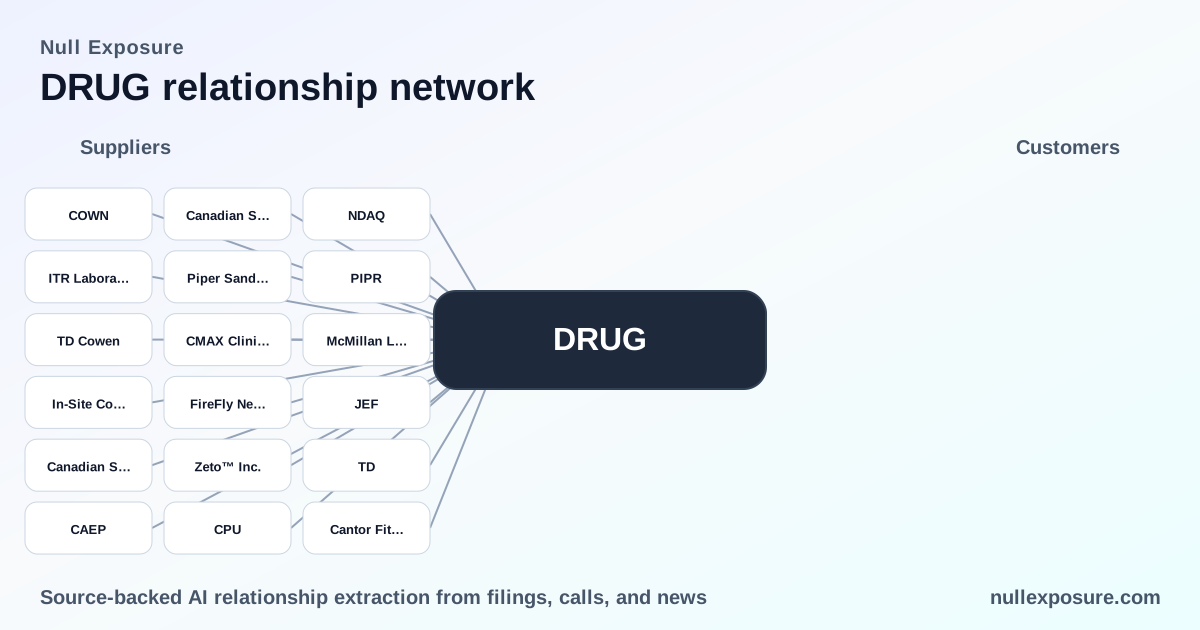
Relationships that matter — who does what for Bright Minds
Below is a concise, relationship‑by‑relationship briefing drawn from the company’s filings and press releases. Each entry is a plain‑English summary with a source reference.
-
The Nasdaq Stock Market LLC / The NASDAQ Capital Market — Bright Minds’ common shares were approved for listing on Nasdaq and have traded on the Nasdaq Capital Market since 2021, a key venue for liquidity and institutional access. This listing approval is documented in company news releases and exchange notices (GlobeNewswire and Psychedelic Alpha, 2021 / 2026).
-
Canadian Stock Exchange / Canadian Securities Exchange (CSE) — Bright Minds has maintained a dual listing on the Canadian exchange under the symbol DRUG, preserving Canadian market access while trading on Nasdaq; the dual‑listing status was stated in listing announcements (Psychedelic Alpha; GlobeNewswire, 2021 / 2026).
-
Jefferies / Jefferies LLC — Served as a joint book‑running manager on the January 2026 public offering and is repeatedly named across the company’s offering communications as a lead underwriter. The role and book‑running status are described in GlobeNewswire releases and Form 6‑K filings (GlobeNewswire Jan 2026; Form 6‑K, Jan 7, 2026).
-
Piper Sandler & Co. — A named underwriter and co‑manager on the January 2026 offering; Piper Sandler is also one of the agents on the terminated ATM program, indicating both execution and distribution roles with the company (Form 6‑K; GlobeNewswire Jan 2026).
-
TD Cowen / TD Securities (USA) LLC — TD Cowen and TD Securities are identified as part of the underwriting syndicate and joint book‑running managers for the upsized offering; their inclusion signals institutional distribution capacity used in the January 2026 financing (GlobeNewswire Jan 2026; Form 6‑K).
-
Cantor Fitzgerald & Co. / Cantor — Listed among the underwriters and joint book‑runners for the offering and as an agent on the earlier ATM, Cantor’s repeated appearance marks it as a distribution and capital markets partner (Form 6‑K; GlobeNewswire Jan 2026).
-
McMillan LLP — Provided the legal opinion on the legality of the issuance and sale of the common shares, a standard counsel role documented in the company’s Form 6‑K (Form 6‑K, Jan 7, 2026).
-
Computershare Investor Services Inc. — Acts as the company’s transfer agent for share consolidations and certificate processing, a routine but operationally critical role for shareholder recordkeeping (GlobeNewswire press release, 2023).
-
CMAX Clinical Research — The Phase 1 first‑in‑human trial for the lead compound BMB‑101 was conducted at CMAX in Adelaide, Australia, making it the primary clinical site for initial safety, PK and qEEG work (Psychedelic Alpha; Dravet Syndrome News, FY2023).
-
FireFly Neuroscience — Provided the advanced EEG analysis platform used to analyze qEEG data from Bright Minds’ Phase 1 study, supplying a specialized biomarker analytics service (Psychedelic Alpha, FY2023).
-
Zeto™ Inc. — Supplied the FDA‑approved 19‑electrode EEG headset used during trial EEG recordings, representing a critical equipment supplier for neurophysiological end points (Psychedelic Alpha, FY2023).
-
ITR Laboratories Canada — Performed preclinical safety and toxicology studies for the oral therapy, acting as contract research support in preclinical stages and contributing to regulatory toxicology dossiers (Dravet Syndrome News, FY2022).
-
In‑Site Communications, Inc. — Identified as an investor relations contact in prior corporate communications, performing IR and external communications duties to the market (StockTitan news release referencing In‑Site Communications, FY2021).
Each of the above relationships is referenced in the company’s press releases and Form 6‑K filings between 2021 and 2026; underwriter roles and the $175.05M offering are explicitly documented in January 2026 materials (Form 6‑K and GlobeNewswire).
What those supplier ties tell an operator about risk and negotiation posture
Bright Minds’ partner set demonstrates a twofold operating reality: clinical execution is outsourced to specialized vendors, and balance‑sheet replenishment is outsourced to institutional underwriters. For supplier managers and procurement:
- Negotiate milestone‑linked payments with CROs and analytics vendors given the binary nature of trial progression and sponsor funding cadence.
- Include termination and repricing clauses tied to capital raises; the company’s move to terminate its ATM program and execute a large underwritten offering signals preference for discrete financing events rather than continuous dilution.
- Model counterparty concentration: a small group of book‑runners handled the 2026 raise, increasing execution risk if those banks re‑price or shift coverage.
A deeper supplier risk map and counterparty scoring is available at https://nullexposure.com/.
Final take: what investors and suppliers should price in
Bright Minds is a development‑stage biotech with no product revenue and acute reliance on equity markets and outsourced trial services. The January 2026 upsized offering and the termination of the ATM are material corporate actions that change the company’s counterparty profile and near‑term liquidity dynamics. For investors, the financing event reduced immediate cash risk; for suppliers, it increases the need for contract structures that align payments to milestones and preserve optionality.
For commercial diligence, underwriting history, and a relationship‑level vendor scorecard tailored to Bright Minds, visit https://nullexposure.com/.
Bold takeaway: value for operators comes from structuring contracts to reflect capital cadence and single‑site or single‑vendor dependencies—this is where supplier negotiation unlocks optionality for both parties.