DSACW: A short thesis on a SPAC whose value depends on capital-market relationships
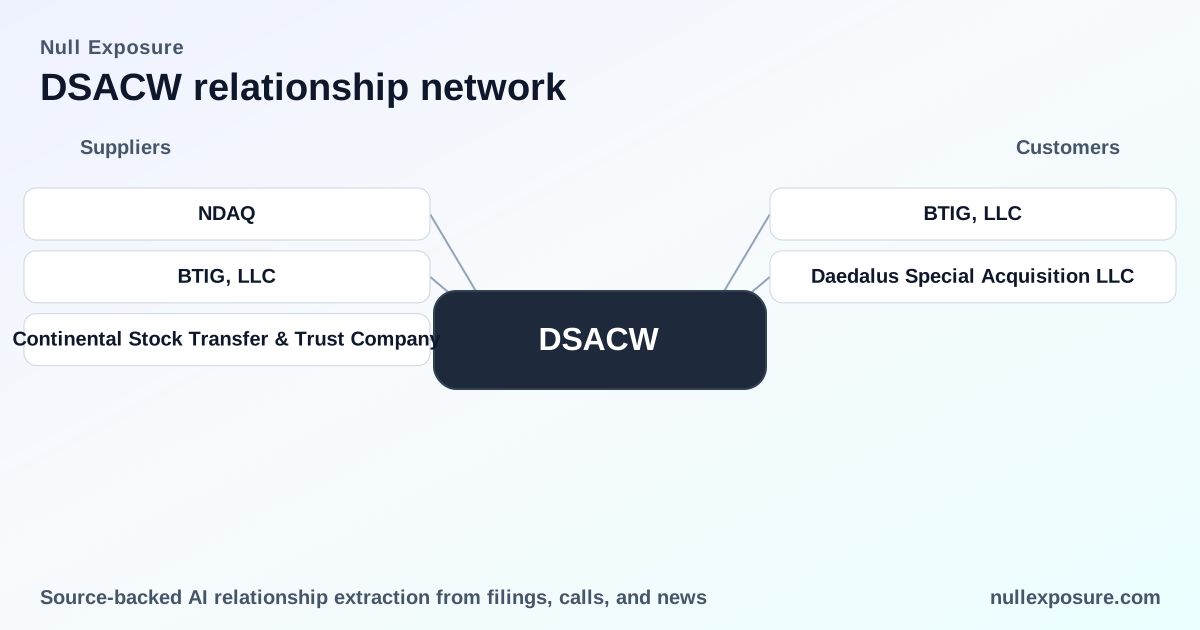
Duddell Street Acquisition Corp (DSACW) is a special-purpose acquisition company that generates shareholder value through capital markets activity rather than operating revenue: it raises capital via units, shares and warrants, lists those securities on Nasdaq, and monetizes by completing a business combination with a target in technology or consumer sectors—or returning capital if a deal is not completed. For investors and supplier managers, the relevant risk and opportunity set is therefore concentrated around listing venues, transfer agents, and underwriters that enable capital formation and post-issuance administration. If you evaluate counterparty exposures for SPACs, DSACW’s supplier relationships are the key operational dependencies to monitor. Visit https://nullexposure.com/ for a broader supplier-risk view of capital markets counterparties.
Why supplier relationships matter for a SPAC operator
A SPAC is inherently a financial engineering vehicle. With no operating revenue reported and a mission to source a target merger, DSACW’s performance is conditional on its ability to execute financings, maintain its Nasdaq listing, and manage shareholder recordkeeping. Counterparties that handle listings, bookrunning, and transfer agency are operationally critical: they control execution windows, settlement, securities separations and communications with brokers and investors. For investors and risk managers, the commercial terms, capacity and continuity of these suppliers determine how quickly a SPAC can close a transaction and how costly that execution will be.
For hands-on due diligence, Null Exposure keeps a running view of the firms that enable public SPAC activity; if you want curated supplier intelligence and relationship scoring, start here: https://nullexposure.com/.
Counterparty map: what DSACW works with now
Below I cover each relationship found in public coverage. Each item includes a plain-English summary and the source context cited by the reporting.
Nasdaq Stock Market LLC — listing noted in SEC-related coverage (FY2025)
Nasdaq is the exchange where DSACW’s units, Class A shares and warrants are listed, which is the essential marketplace for secondary trading and liquidity for DSAC securities. According to an Investing.com article citing SEC filings (reported March 9, 2026), the company’s Class A shares (DSAC), units (DSACU) and warrants (DSACW) are listed on The Nasdaq Stock Market LLC.
BTIG, LLC — book-running manager role described in press materials (FY2026)
BTIG is described in press materials as the sole book-running manager and therefore the underwriter responsible for coordinating the offering and over-allotment mechanics that can influence deal pricing and syndicate distribution. A StockTitan report (March 9, 2026) noted BTIG’s role in press releases covering the offering and registration-statement effectiveness.
Continental Stock Transfer & Trust Company — transfer agent required for separations (FY2026)
Continental Stock Transfer & Trust Company is the transfer agent charged with handling security separations and recordkeeping, a function that directly affects investors’ ability to exercise warrants or convert units into shares. StockTitan coverage (March 9, 2026) explicitly instructs holders and brokers to contact Continental to effect separations, highlighting its operational importance.
The Nasdaq Stock Market LLC — listing referenced again in press-release coverage (FY2026)
Press coverage reiterates Nasdaq’s role as the listing venue for DSAC’s securities—units, Class A shares and warrants—which underscores that the exchange relationship is both contractual and practical for trading and compliance. StockTitan’s March 9, 2026 item restated that DSACU, DSAC and DSACW are listed on The Nasdaq Stock Market LLC.
How DSACW’s supplier posture shapes risk and execution
DSACW’s model produces a compact set of supplier constraints that drive execution risk:
-
Contracting posture: As a SPAC, DSACW maintains short-term, transaction-oriented contracts with underwriters, transfer agents and the exchange; these are purposeful, high-touch engagements timed to offerings and de-SPAC activity rather than long-term operational vendor programs. Expect negotiation leverage to reside with the market-facing providers who control listing and distribution windows.
-
Concentration: The relationship roster is narrow and concentrated—exchange, bookrunner, transfer agent—so single-counterparty disruptions have outsized impact on ability to complete financings or manage separations. This concentration is a company-level signal of dependency rather than a risk tied to any one excerpt.
-
Criticality: The listed counterparties are mission-critical. If the transfer agent’s processes are delayed, warrant conversions or separations can stall; if the underwriter cannot syndicate, deal pricing and access to capital suffer; if exchange requirements change, listing continuity is at risk. These functions are core to a SPAC’s lifecycle.
-
Maturity: DSACW reports no operating revenue and behaves like an early-stage financial sponsor: its maturity is defined by deal cadence and capital-event outcomes rather than by product-market fit. This is a company-level characteristic rather than a supplier-specific constraint.
No additional supplier constraints were reported in the sources reviewed; public coverage focuses on routine listing, underwriting and transfer-agent arrangements.
Investment implications and operational risks
-
Liquidity and valuation depend on Nasdaq listing health. The exchange relationship is the gateway to secondary trading; any compliance or listing-event issues would materially affect liquidity for DSAC securities.
-
Execution fees and timing are determined by underwriter capacity. BTIG’s role as sole bookrunner concentrates market execution risk; underwriter posture influences pricing and the ability to exercise an over-allotment option.
-
Operational frictions in transfer agency can impose investor relations costs. Continental’s handling of separations is a small but consequential operational dependency that affects investor experience and settlement timing.
For a supplier-focused investor, the priority checklist is straightforward: confirm contractual terms (fees, timelines, SLAs) with Nasdaq, BTIG and Continental; monitor press releases and registration-statement updates for underwriting options or changes; and validate transfer-agent workflows for separations and investor communications.
If you want a structured supplier-risk scorecard and continuous monitoring, explore our analysis platform at https://nullexposure.com/.
Bottom line: a SPAC driven by market plumbing, not sales
Duddell Street Acquisition Corp is a capital-markets vehicle whose success hinges on the reliability and commercial terms of a small set of counterparties—not on product revenue. For investors and operators, that means due diligence is primarily about contract certainty, counterparty capacity and operational continuity with the exchange, underwriter and transfer agent. Monitor filings and press coverage for changes to those relationships; they are the levers that will ultimately determine whether DSACW converts sponsor capital into an accretive merger or returns capital to investors.