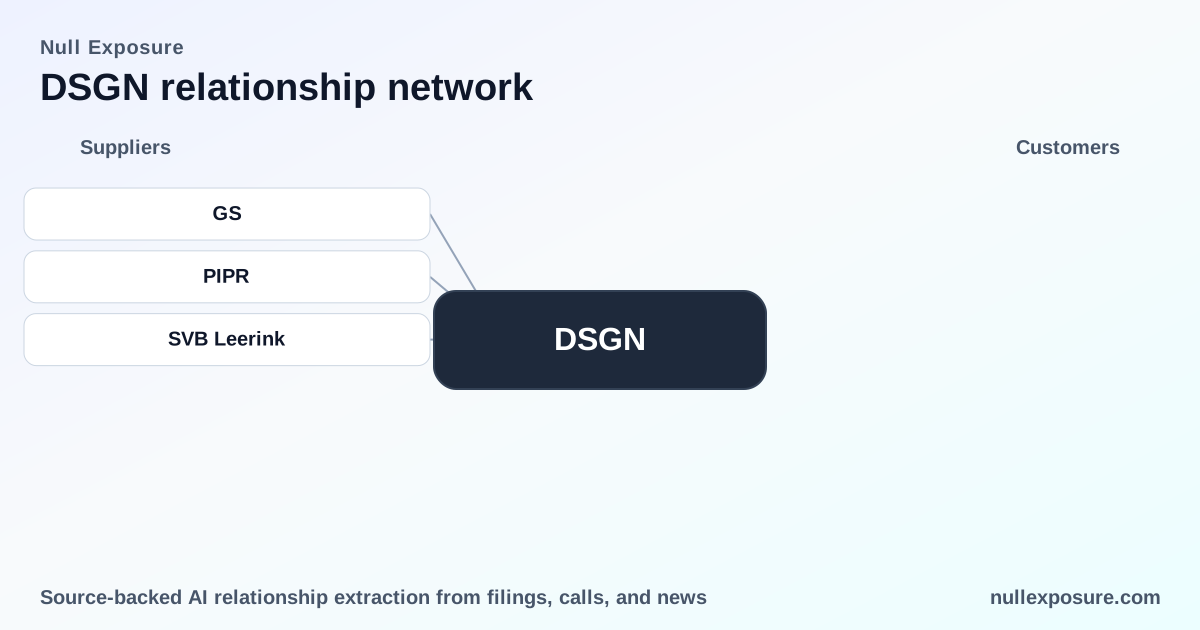
DSGN supplier relationships: capital partners and outsourced dependencies that shape commercialization risk
Design Therapeutics (DSGN) develops therapies for degenerative disorders caused by nucleotide repeat expansions and currently monetizes via licensing of intellectual property and by raising capital to fund R&D and clinical programs. The company operates as an early‑stage biotech with virtually no product revenues today, outsources manufacturing and many R&D functions, and supplements cash needs through public offerings managed by investment banks. For investors and operators, the combination of IP licensing, concentrated contract manufacturing, and capital markets activity defines both the upside pathway and the primary operational risks.
Explore supplier intelligence and relationship overlays at https://nullexposure.com/.
Banks named to lead a FY2026 offering — what was reported
A March 2026 market report aggregated by StockTitan lists three investment banks as managers on a Design Therapeutics offering: Goldman Sachs, SVB Leerink, and Piper Sandler. This placement signals an active capital‑markets push to replenish cash for clinical and manufacturing programs.
Goldman Sachs: a leading global underwriter positioned to provide distribution and pricing muscle for equity placements; the bank is named among the managers for the offering reported March 9, 2026 (StockTitan).
Source: StockTitan news aggregation, March 9, 2026 — https://www.stocktitan.net/news/DSGN/page-6.html
Piper Sandler: a healthcare‑focused investment bank that often leads mid‑market biotech deals and investor targeting; listed as a manager for the same offering (StockTitan, March 9, 2026).
Source: StockTitan news aggregation, March 9, 2026 — https://www.stocktitan.net/news/DSGN/page-6.html
SVB Leerink: the boutique research and investment bank specializing in life sciences, also named as a manager for the financing reported on March 9, 2026 (StockTitan).
Source: StockTitan news aggregation, March 9, 2026 — https://www.stocktitan.net/news/DSGN/page-6.html
Key takeaway: the named syndicate blends bulge‑bracket and specialist firms, suggesting the company is targeting both institutional depth and life‑science investor focus to restore runway.
Contracting posture and dependency signals from company disclosures
Design Therapeutics’ public filings and disclosures present a consistent operating model: heavy reliance on third parties for IP, manufacturing, and services, combined with a modest portfolio of long‑term contractual commitments.
- Licensing posture: The company has executed multiple license arrangements that grant it exclusive or sublicensable rights to patents and technology — most notably a February 2019 exclusive license with the Wisconsin Alumni Research Foundation (WARF) and an additional license in May 2024 for other patents and technology. These agreements position Design as a licensee with rights to develop and commercialize specific assets, rather than as a sole originator of platform IP. According to the company’s filings, the licenses are royalty‑bearing and sublicensable (Company filings, 2019 and 2024).
- Lease and term commitments: Design entered a long‑term lease that commenced in September 2021 for 72 months with an optional three‑year extension; the filings exclude the extension from right‑of‑use accounting because renewal was not reasonably certain. The weighted‑average remaining lease term was about 2.7 years as of December 31, 2024 (Company filings, FY2024).
- Manufacturing and sourcing concentration: The company explicitly states it has no internal manufacturing facilities and relies on third‑party manufacturers and suppliers for raw materials and GeneTAC molecule production, with single‑source suppliers expected for the foreseeable future — a material operational concentration that raises supply continuity and scaling risks (Company filings, FY2024).
- Service provider usage: Design uses third‑party contract research organizations, contract manufacturing organizations, hosting and application providers, and specialist consultants for cybersecurity and regulatory support. The company lists multiple consulting and service agreements in filings going back to 2017 through 2021, signaling an outsourced operating model (Company filings, 2017–2021).
- Materiality signals: Patent legal fees under the WARF license were described as immaterial for the years ended December 31, 2024 and 2023, while the single‑source manufacturing reliance is described in the filings as a material operational risk that could delay development or commercialization if disrupted (Company filings, FY2023–FY2024).
Operating model characteristics: Design runs a capital‑intensive, outsourced biotech model: contracting posture is predominantly licensee and service‑driven; concentration is high in manufacturing; criticality of suppliers is elevated for timing and quality; and relationship maturity is mixed — established licensing and leases exist, but manufacturing scaling remains nascent and single‑sourced.
How those signals translate into investment and operational priorities
From an investor and operator perspective, these points matter in practical terms:
- Funding dependence: The March 2026 underwriting syndicate demonstrates active capital raising — investors should watch prospectus terms, dilution size, and use of proceeds to assess how long the company can fund outsourced manufacturing and trials (StockTitan, March 9, 2026).
- Supply chain risk: Single‑source manufacturing and reliance on CROs/CMOs are the most immediate operational vulnerabilities; any supplier delay could push clinical milestones and materially affect valuation given near‑zero current revenues (company revenue TTM $33k, FY2025 filings).
- IP access vs. control: Licensing gives Design freedom to develop, but also creates royalty obligations and, in some cases, loss of prosecution control; investors should prioritize clarity on patent prosecution rights and sublicense economics disclosed in license agreements.
- Contract maturity and flexibility: The existing lease through 2027 provides physical stability but limited long‑term flexibility; licensing terms from 2019 and 2024 create a multi‑year IP runway that supports R&D but not guaranteed commercialization scale without manufacturing diversification.
If you want a supplier‑level readout that tracks these dependencies alongside capital markets activity, see detailed relationship coverage at https://nullexposure.com/.
Practical recommendations for diligence and operations
For investors evaluating DSGN, and for operators managing execution, prioritize the following actions:
- Conduct targeted diligence on CMO agreements to confirm single‑source status, capacity commitments, quality metrics, and exit/backup plans.
- Review license economics and control provisions to determine royalty burdens, milestone caps, and prosecution rights that impact future margins.
- Monitor filings tied to the March 2026 offering for proceeds allocation to manufacturing scale or backup supplier development.
- Stress‑test cash runway scenarios against realistic supplier delay assumptions given current revenue and negative EBITDA.
For full supplier monitoring and to integrate these signals into investment workflows, visit https://nullexposure.com/.
Bottom line
Design Therapeutics is an early‑stage biotech whose value trajectory depends on successfully converting licensed IP into clinical milestones while managing concentrated supplier risk and securing recurring capital. The March 2026 underwriting syndicate highlights near‑term funding activity; company disclosures underline that manufacturing and service relationships are central to delivery risk. Investors should treat supplier concentration and license economics as first‑order variables when sizing risk and upside.