DSS Inc: A supplier profile for investors evaluating partner risk and capital links
DSS Inc. manufactures and sells packaging and security-printing products and funds operations through product revenue, occasional capital raises and debt financing tied to equipment investments. The company reports roughly $22.0m in trailing revenue with negative EBITDA and heavy insider ownership, and it leverages underwritten equity offerings and targeted financing for capital expenditures to sustain operations and strategic upgrades.
If you evaluate supplier relationships and counterparty risk, start with the capital-market and service providers that enable DSS’s liquidity and corporate actions. For a concise view of counterparties and what they signal about DSS’s operating posture, see NullExposure homepage for more supplier intelligence.
Why the partner network matters for an investor
DSS is capital-constrained and asset-intensive: revenue is modest while capital spending on printing presses and security equipment drives long-term financing needs. That reality makes underwriting, legal counsel, transfer agents and regional distributors more than incidental vendors — they are operational levers that affect liquidity, governance and market access. The company’s choice of a single underwriter on recent offerings, a named corporate counsel, and a transfer agent for corporate actions tells an investor how DSS manages capital events and shareholder mechanics. The historically low institutional ownership and high insider stake also shape counterparty dynamics and negotiating posture.
Learn more about how supplier relationships influence small-cap public companies at NullExposure.
A concise counterparty map you can act on
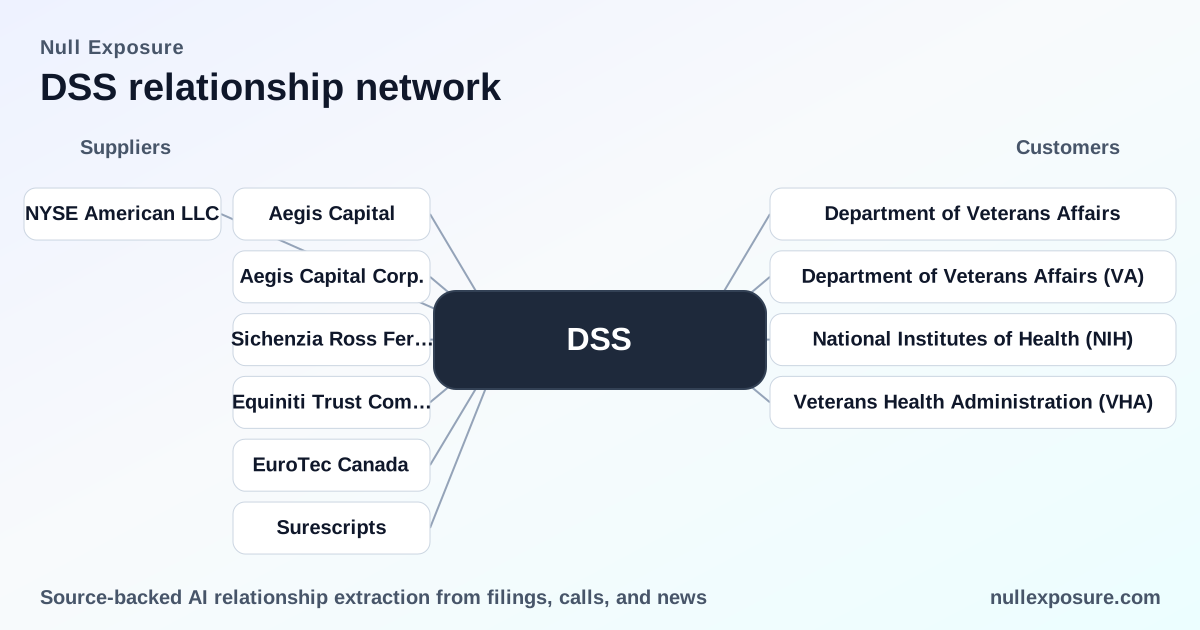
Below are every counterparty mentioned in the collected results, with plain-English summaries and source notes you can follow.
Aegis Capital Corp.
Aegis Capital served as sole book-running manager on a firm-commitment underwritten public offering that DSS launched and later closed for about $1.0 million in early 2026, signaling that DSS uses equity underwrites to replenish liquidity. According to a GlobeNewswire release in February 2026 and subsequent press coverage, Aegis ran the offering as sole book-runner and executed the closing in March 2026. (GlobeNewswire, Feb–Mar 2026)
Sichenzia Ross Ference Carmel LLP
Sichenzia Ross Ference Carmel acted as outside counsel to DSS for the same underwritten offering, providing legal counsel associated with the filing and closing. Public notices around the offering list Sichenzia as company counsel in February–March 2026. (GlobeNewswire / Futunn, Feb–Mar 2026)
Equiniti Trust Company, LLC
Equiniti Trust functioned as transfer agent and exchange agent for a reverse stock split, handling certificates and exchange logistics for record holders, a routine but material corporate-administration role during restructuring events. This role was described in a corporate notice on Yahoo Finance referencing the reverse split activity (FY2023). (Yahoo Finance, 2023)
EuroTec Canada
EuroTec Canada operates as a regional sales and service representative for DSS’s MicroVib II vibration-analysis products, appointed to cover Canada and provide after-sales support — an example of DSS’ distributor/representative model for specialized product lines. That appointment appeared in a Vertical Magazine release referencing EuroTec as DSS’s Canadian representative (2018). (Verticalmag.com, 2018)
Surescripts
Surescripts partnered with DSS in a healthcare data-sharing pilot as a Government Trust Anchor Bundle HISP for Direct Messaging, demonstrating that DSS has engaged in technology and interoperability partnerships outside its core packaging business, likely tied to document security and certified messaging use cases. This relationship was reported in industry coverage of e-health pilots (2018). (HitConsultant.net, 2018)
NYSE American LLC
DSS’s common stock trades on the NYSE American exchange under the ticker “DSS”, a structural visibility and liquidity channel that affects access to capital and investor base; this listing status was noted in mid-February 2026 distribution of the company’s offering materials. (ManilaTimes / GlobeNewswire, Feb 2026)
What these relationships say about DSS’s operating model
-
Contracting posture — transactional and episodic, with firm-commitment equity placement: The consistent references to Aegis acting as the sole book-running manager on a firm-commitment basis indicate DSS turns to full-service underwriters for discrete capital events rather than continuous lines of financing. (GlobeNewswire, Feb 2026)
-
Concentration and negotiating leverage — high insider ownership reduces institutional pressure: Company filings show insiders control a large majority of shares (about 66%), while institutional ownership is minimal. That ownership mix grants management relatively high control over strategic decisions and counterparty selection. (Company filings / market data)
-
Criticality of relationships — underwriter, counsel and transfer agent are operationally relevant: Underwriter and counsel directly enable liquidity events; the transfer agent executes shareholder mechanics on corporate restructurings. Those counterparties are material to DSS’s ability to execute recapitalizations and corporate actions. (GlobeNewswire; Yahoo Finance)
-
Maturity and longevity — mixed: product-channel relationships are multi-year while capital relationships are event-driven: Distributor and technology partnerships (EuroTec, Surescripts) date back to 2018, signaling durable product channels, while underwriting, counsel and transfer-agent engagements are tied to specific capital and corporate events in 2026 and 2023 respectively. (Verticalmag.com 2018; GlobeNewswire / Yahoo Finance 2023–2026)
-
Company-level financing constraint: The dataset includes a company-level signal of long-term financing for capital equipment — a master loan and security agreement referenced outstanding long-term debt associated with a Heidelberg printing press and a stated interest rate around 4.63% as of December 31, 2024 — reinforcing that DSS’s business model requires periodic equipment financing and contributes to leverage and fixed-cost pressure. This is a company-level signal rather than a counterparty-specific obligation. (Company financial disclosures, FY2024)
Practical takeaways for investors and operators
-
Capital access is the operational fulcrum: DSS uses underwritten equity offerings and targeted equipment loans to manage capacity and liquidity; underwriting and counsel partners are therefore high-impact vendors. (GlobeNewswire, Feb 2026; internal filings)
-
Operational resilience is twofold: a small but enduring distribution footprint (e.g., EuroTec in Canada) and episodic market financings. Assess both service continuity for products and the strength of capital providers when modeling downside scenarios. (Verticalmag.com, 2018; GlobeNewswire, 2026)
-
Governance and shareholder mechanics matter: high insider ownership and active transfer-agent involvement in corporate actions mean changes in capitalization are managed with limited institutional friction, but also with limited third-party monitoring. (Market data; Yahoo Finance)
If you want a tailored supplier-risk brief or a counterparty concentration heat map for DSS and comparable small-cap packaging suppliers, start here: NullExposure.
In summary, DSS operates a capital-intensive, product-focused business where underwriters, counsel and transfer agents are essential enablers of liquidity and corporate action, and where durable distributor and technology partners sustain niche product lines. For investors that prioritize counterparty risk and capital durability, those relationships are the primary places to look. For deeper supplier and counterparty analysis for DSS or similar names, visit NullExposure.