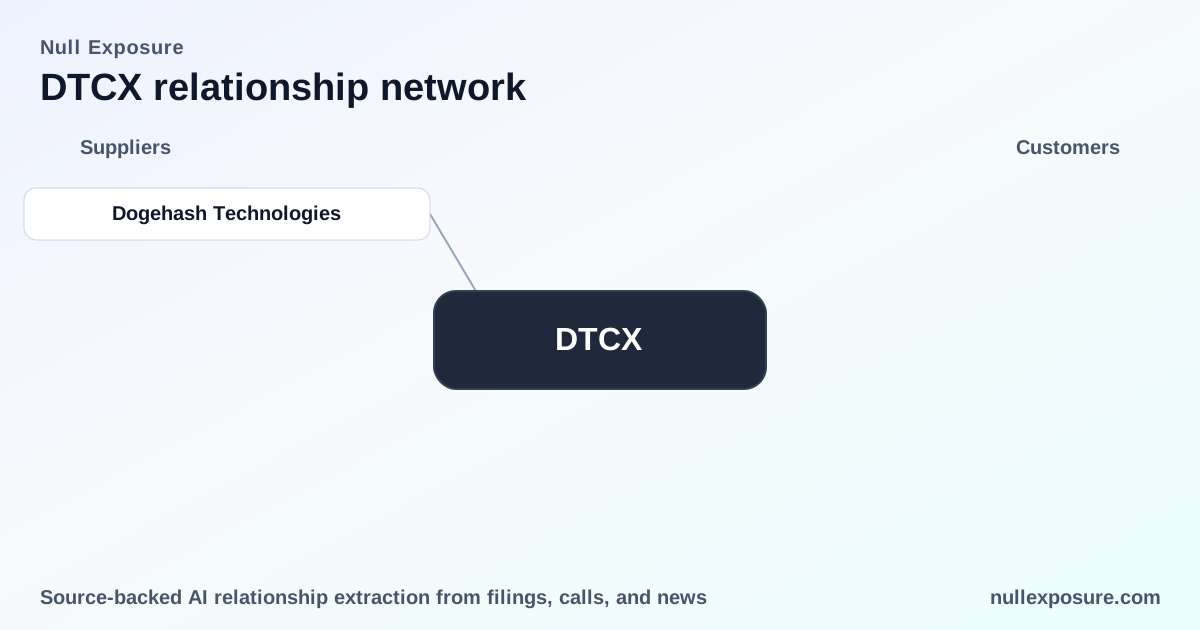
Datacentrex (DTCX): Supplier profile and what the vendor network reveals for investors
Datacentrex is an industrial-scale blockchain infrastructure operator that monetizes by operating and selling crypto-mining output and related services focused on Dogecoin and Litecoin. The company captures revenue through mined coin sales and ancillary service arrangements while relying on externally provided data-center capacity, custodial services for mined assets, and third-party development and content supply chains. Investors should view DTCX as an asset-light miner with operational exposure concentrated in third-party infrastructure and service relationships rather than owned real estate.
For a concise vendor-risk briefing and further supplier mapping, visit https://nullexposure.com/.
How Datacentrex actually runs the business and where suppliers fit
Datacentrex scales mining capacity by leveraging external hosting, specialized service providers, and custodial partners to convert hash power into saleable crypto inventory. The company does not carry heavy property leases; instead it relies on short-term facility arrangements and third-party operations—a posture that reduces long-term fixed-cost leverage but increases operational dependency on suppliers. This supplier-centric model explains why counterparty quality, bandwidth and power arrangements, and custody relationships are the critical operational levers for value realization.
- Monetization: sale of mined Dogecoin/Litecoin and service income tied to infrastructure uptime and hosted capacity.
- Cost base: operating primarily via rented facilities and purchased services rather than owned capital real estate.
- Operational dependency: third-party servers, bandwidth, outsourced development, and custodians are strategic counterparties.
If you want deeper supplier-level intelligence and ongoing tracking of partner events, explore our profiles at https://nullexposure.com/.
Key supplier relationship on record: Dogehash Technologies
Dogehash Technologies — According to a Bitget news release on March 9, 2026, Thumzup completed a full acquisition of Dogehash Technologies, a company that operated Dogecoin and Litecoin mining infrastructure. This transaction indicates consolidation activity in the small/mid-tier mining supplier market and signals potential reconfiguration of capacity that could affect downstream buyers or service partners. (Source: Bitget news, March 9, 2026.)
What the constraint signals tell investors about the operating model
The collected constraint excerpts read like a mosaic of disclosures and indicate several consistent operating characteristics that matter to investors evaluating supplier risk:
-
Short-term contracting posture. The company explicitly states it rents offices on a month-to-month basis. That indicates low fixed real-estate commitments and high flexibility, but also greater exposure to sudden cost shifts or availability issues in local markets because there is no long-term lease lock-in.
-
Usage-based economics and customer deposit flows. Disclosures referencing client deposits and the mechanics of transferring fees upon user actions indicate revenue recognition and cash flow that are usage-dependent. This implies a business model that levers variable, transactional revenue rather than stable recurring contracts—revenue volatility is intrinsic.
-
Heavy reliance on individual counterparties within a partner platform (Thumzup). The company’s language about incentivizing ordinary people to act as content creators signals a supply base that includes large numbers of individuals rather than institutional suppliers, creating high-volume, low-ticket counterparty risk and compliance complexity.
-
APAC operational exposure. The company discloses outsourcing of development resources in Pakistan, which is an explicit geographic concentration in APAC for engineering support. That is a dual-edged signal: lower development cost but heightened geopolitical and continuity risk.
-
Service-provider dependency for core infrastructure. Statements about dependence on third parties for servers, bandwidth, and content transmission identify critical vendor dependencies—infrastructure providers are functionally central to operations and therefore are single points of operational impact.
-
Active custody relationships for crypto holdings. The company reports that substantially all of its bitcoin is held in institutional-grade custody accounts, signaling mature custodial arrangements and an active relationship stage with regulated custodians, which is a positive control element for asset security.
These constraints should be read as portfolio-level signals: Datacentrex operates as a nimble, supplier-dependent miner with variable revenue and concentrated operational exposures in infrastructure and APAC development. The company’s contracting posture reduces fixed overhead but requires best-in-class supplier governance.
Risk and concentration implications for investors and operators
-
Counterparty concentration risk is operational rather than equity-based. The business is not capital-intensive in owned facilities but is dependent on a limited set of service roles—bandwidth, hosting, custodial services—making service-provider failure more acute than a landlord dispute.
-
Revenue volatility is baked into the model. Usage-based client flows and deposits mean mining yield converted to cash drives top-line variability; investors should underwrite scenarios for lower realized coin prices and reduced throughput.
-
Geopolitical and continuity risk in APAC. Outsourced development and offshore engineering create an attack surface for continuity problems that can cascade into slower firmware/security updates or downtime.
-
Governance and compliance load increases with individual counterparties. Reliance on many individual creators (as described in Thumzup disclosures) increases KYC/AML and reputational oversight costs for partners and clients.
Tactical takeaways for supplier diligence
- Prioritize service-level evidence: uptime SLAs, redundancy of bandwidth and hosting, and custodial arrangements. Custodial relationships are a strong operational control—verify institutional-grade custody agreements and proof of assets.
- Stress-test the APAC development pipeline for continuity: contracts, backup vendors, and geographic diversification.
- Model revenue scenarios around usage-based flows to capture realistic downside and liquidity needs.
For a tactical supplier risk scorecard and continuous monitoring platform, visit https://nullexposure.com/.
Bottom line
Datacentrex’s supplier footprint is unmistakably oriented toward outsourced infrastructure, usage-based revenues, and active custodial partnerships. That configuration delivers operating flexibility and lower fixed cost, but it transfers many core risks to third-party suppliers—particularly hosting, bandwidth, and offshore development. Investors should price DTCX by the strength of its supplier governance, the resilience of custodial arrangements, and the company’s ability to convert mined output into stable cash flows under stress.
For a deeper vendor-by-vendor breakdown and to track evolving supplier events for DTCX and peers, see our research hub at https://nullexposure.com/.