Precision BioSciences (DTIL) — supplier relationships and what they mean for investors
Precision BioSciences is a genome-editing therapeutics developer that monetizes through clinical-stage product development, partnering and licensing arrangements, milestone and royalty payments, and capital markets activity to fund operations. The company outsources significant elements of manufacturing and clinical support to third parties while retaining development and commercialization responsibilities for certain partnered assets, creating a hybrid model where operational execution is concentrated in external vendors and commercial upside is retained through licenses and milestone structures. For a deeper look at supplier exposures and partnership implications, visit https://nullexposure.com/.
Why supplier and partner mapping matters to returns
Precision’s model is outsourced and partnership-driven: it relies on contract manufacturers, clinical vendors and technology partners to run trials and deliver drug product, while pursuing asymmetric upside through licensed programs and milestone payments. That structure produces three investment characteristics investors should track closely: operational leverage to third parties, milestone-driven revenue volatility, and capital markets dependence for funding. The firm’s public filings show short-term, cancelable vendor contracts and outsourced spend in the $1–10M band, signaling manageable but recurrent supplier costs rather than long-term captive commitments.
Explore a full supplier dossier at https://nullexposure.com/ if you want raw relationship documents and timeline views.
Quick read on supplier constraints and what they signal
- Contracting posture: The company discloses agreements that are cancelable with less than one year’s notice, which makes vendor relationships flexible but increases operational execution risk if a supplier exits on short notice.
- Materiality: The company states that cancellation of these agreements is not expected to have a material effect on its financial condition, implying that no single supplier contract is critical to solvency.
- Roles and maturity: Filings identify Precision’s reliance on CMOs and CROs for manufacturing and clinical services, indicating mature, market-standard outsourcing rather than bespoke in-house manufacturing scale-up.
- Spend profile: The reported outsourced R&D and CMO line items situate recurring vendor spend in the $1–10M band, consistent with phase‑appropriate clinical development costs rather than large-scale commercial supply contracts.
These elements together describe a company that is operationally dependent on third-party execution but not structurally bound to any single supplier — a profile that supports nimble program changes but requires ongoing vendor management.
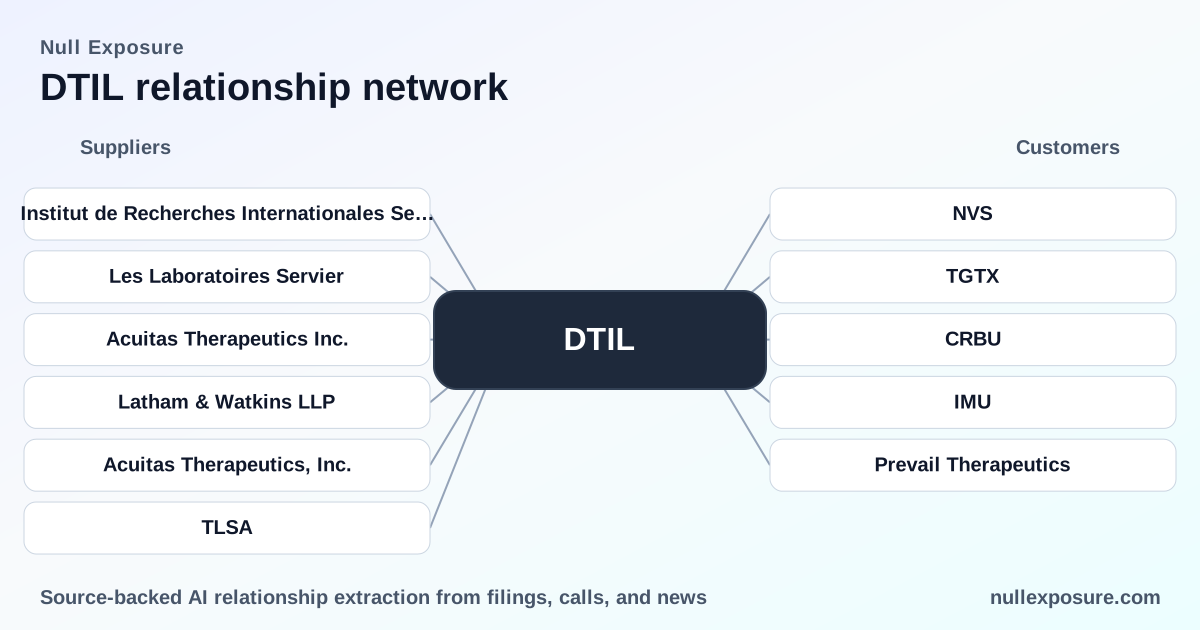
Relationship rollcall — the counterparties you should know
Precision’s public record and industry press show a compact set of external relationships that shape near-term execution and upside.
Institut de Recherches Internationales Servier
Precision disclosed in its FY2024 Form 10‑K that it waived earned but unpaid milestone payments linked to the termination of a development and commercial license agreement with Les Laboratoires Servier and Institut de Recherches Internationales Servier, indicating a concluded commercial relationship and forfeited near-term milestone receipts. According to the company’s FY2024 10‑K filing, the waiver was documented as part of termination settlements.
Les Laboratoires Servier
The same FY2024 10‑K confirms that Les Laboratoires Servier was the counterparty to the terminated development and commercial license agreement, and the termination included waiving milestone payments that Precision had previously earned. This filing provides the clearest example of milestone revenue volatility in Precision’s partner portfolio (FY2024 10‑K).
Acuitas Therapeutics, Inc.
Precision has publicly acknowledged that lipid nanoparticle (LNP) technology for PBGENE‑HBV was provided by Acuitas, which positions Acuitas as a key materials/technology supplier for that program; multiple press releases in FY2025 (BioSpace, PharmiWeb) reference Acuitas’ role in PBGENE‑HBV presentations and safety/efficacy updates. See company press releases and industry coverage on BioSpace and PharmiWeb in FY2025 describing Acuitas’ LNP provision for PBGENE‑HBV.
Latham & Watkins LLP
Latham & Watkins acted as legal counsel to Precision on a public equity offering, with a corporate team leading execution of the transaction; this relationship underscores the company’s ability to access capital markets and engage top-tier counsel for financing activities. The firm’s representation was reported by Latham & Watkins on their site regarding a transaction in November 2025.
Tiziana Life Sciences plc (TLSA)
Precision executed a licensing arrangement with Tiziana whereby Precision assumed responsibility for development, commercialization and associated costs for Foralumab, while Tiziana stood to receive upfront payments, milestones and royalties — a structure that places development burden and upside capture on Precision’s balance sheet. RTTNews reported the licensing terms and responsibilities as of 2021.
What these relationships mean for valuation and risk
Precision’s supplier and partner map delivers a consistent investment narrative: outsourced execution with retained program-level upside and milestone risk. Key implications:
- Revenue volatility from milestones: The Servier termination and associated waiver in the FY2024 10‑K demonstrates that milestone revenue is not guaranteed and can be lost through contract termination, which directly impacts near-term cash expectations. Investors should model downside scenarios where key milestones are canceled or renegotiated.
- Execution reliance on CMOs/CROs and specialty service providers: Multiple filings identify CMOs/CROs and suppliers (including technology vendors such as Acuitas) as necessary for trial material production and delivery; operational continuity depends on maintaining these vendor relationships under short-term contracts.
- Manageable supplier concentration and spend: The company’s own disclosure that the cancelable agreements are not expected to be material, plus spend band indications in the $1–10M range, suggests no single supplier dominates capex or opex, but the aggregate vendor pool remains central to program timelines.
- Financing pathways are operational: Use of law firms like Latham & Watkins for offerings signals active capital markets access, which is critical for bridging R&D spend in a model where commercialization is years away for many programs.
Investor checklist (short):
- Confirm the pipeline milestones driving near-term revenue and their counterparty status.
- Stress-test cash runway assuming loss of one or more milestone payments.
- Monitor vendor contract renewal terms and any shift from short-term to longer-term supply agreements.
- Track press from specialized suppliers (e.g., Acuitas) for material or tech changes that could affect PBGENE programs.
For a structured supplier risk scorecard and historical counterpart documentation, see the full coverage at https://nullexposure.com/.
Bottom line and next steps
Precision BioSciences runs a classic outsourced R&D playbook: it externalizes manufacturing and delivery while internalizing program risk and commercialization upside. That posture supports capital efficiency today but creates sensitivity to milestone outcomes and vendor continuity. The Servier milestone waiver is the clearest recent example of how partner dynamics translate directly into financial outcomes.
If you are evaluating DTIL as an investment or counterparty, review the partner-term specifics and milestone triggers and compare them to your return assumptions. For a complete supplier intelligence package and time‑series relationship tracking, go to https://nullexposure.com/.