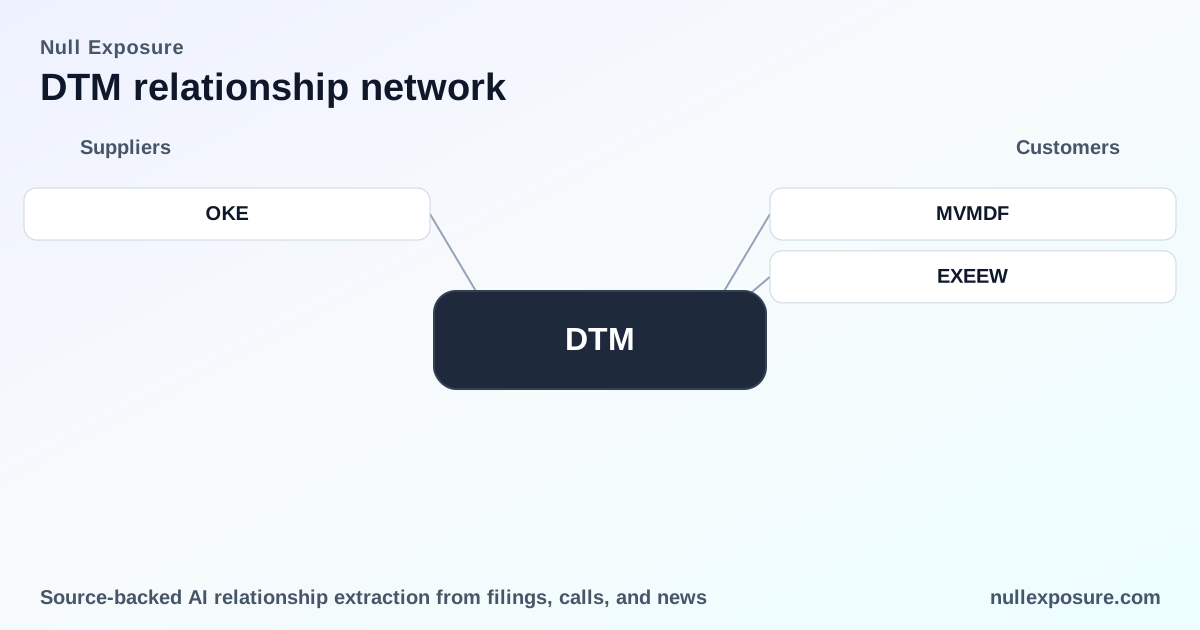
DT Midstream Inc (DTM): Supplier relationships and what the ONEOK acquisition signals for investors
DT Midstream operates and monetizes a portfolio of natural gas transmission, storage and processing assets by owning fee-bearing infrastructure that collects throughput-based revenues, regulated pipeline tariffs and long-term contracts tied to energy flows. The company generates cash through stable take-or-pay style contracts and tariffed interstate pipeline receipts, and it amplifies scale and market access via targeted asset acquisitions. DTM’s strategy is asset-led growth with predictable cash flows and incremental upside from network integration.
For a concise view of DT Midstream’s positioning and supplier ties, visit https://nullexposure.com/.
Quick financial and strategic context for investors
DTM is a mid-cap energy infrastructure company with a market capitalization near $13.94 billion and reported trailing EBITDA of $872 million. The company’s margins are strong (operating margin ~49%) and investor appetite is reflected in a forward P/E of ~26 and a 52-week trading range between $80.95 and $142.75. These metrics frame DT Midstream as a cash-generative, regulated midstream operator that deploys capital into complementary pipelines and storage that reinforce tariffed revenues and customer stickiness.
One explicit supplier/transaction relationship: ONEOK
- DT Midstream closed the Midwest Pipeline Acquisition from ONEOK on December 31, 2024 for a purchase price of $1.2 billion, subject to customary purchase-price adjustments. This transaction transferred three FERC-regulated natural gas transmission pipelines to DT Midstream, expanding the company’s transport footprint in the Midwest. According to DT Midstream’s FY2024 Form 10‑K, the deal closed at year-end 2024 and is recorded as a material acquisition that increases regulated pipeline capacity and revenue base. (DT Midstream FY2024 Form 10‑K, December 31, 2024)
This relationship—an asset purchase from ONEOK—functions as both a supplier/transaction counterpart and a strategic inorganic growth lever for DT Midstream: the transfer of assets creates new supplier-to-owner dynamics where ONEOK was the prior operator and seller, and DTM assumes ongoing operational and customer responsibilities tied to those pipelines.
What the ONEOK acquisition says about DT Midstream’s operating model
- Contracting posture: acquisitive and asset-driven. The purchase of FERC-regulated pipelines from ONEOK demonstrates that DT Midstream secures growth by buying operating assets rather than relying primarily on greenfield construction or short-term contracts. This posture produces immediate scale and tariff income streams.
- Concentration and counterparty profile: moderate concentration with large counterparties. The company’s growth through sizable asset purchases implies counterparties and sellers that are major industry players; DT Midstream’s exposure therefore concentrates around a small number of large, regulated transactions rather than many dispersed, transactional vendors.
- Criticality: high operational criticality. Ownership of interstate, FERC-regulated transmission lines confers system-critical responsibilities—pipeline uptime, regulatory compliance and safety protocols directly influence revenue continuity.
- Maturity: mid-to-late infrastructure lifecycle. Acquiring established pipeline assets transfers existing customer bases and tariff structures, signaling a preference for mature, de-risked cash flows over early-stage development risk.
These are company-level operating signals drawn from public filings and the nature of the ONEOK transaction; they are not assigned to any supplier beyond what the filing explicitly states.
Strategic implications for investors and partners
The ONEOK acquisition shifts DT Midstream’s scale and route density in the Midwest, strengthening its tariff base and the predictability of distributable cash flow. Investors should view this transaction as a liquidity-accretive, regulatory-style expansion rather than a speculative growth move. For counterparties and operators, the deal increases the strategic importance of DT Midstream as a gatekeeper for Midwest gas flows and raises the bar for operational excellence and regulatory compliance.
Explore a concise supplier-impact review at https://nullexposure.com/ to see how this transaction integrates into DT Midstream’s broader supplier matrix.
Operational and commercial risk considerations
- Regulatory risk is non-trivial: FERC-regulated assets are subject to tariff reviews and compliance obligations that directly influence revenue scalability and margin stability.
- Integration risk follows any acquisition: consolidating operational systems, safety programs and customer contracts requires disciplined execution to preserve cash flow continuity.
- Counterparty dependence increases after targeted acquisitions: a concentrated set of major sellers and customers elevates the impact of any single counterparty dispute or volume shock.
These risks are balanced by the company’s high operating margins and recurring revenue profile, but they require active oversight from investors and counterparties during the integration window.
Practical takeaways for operators evaluating DTM as a supplier/customer
- Expect rigorous regulatory compliance and a conservative, integration-focused playbook when DTM assumes acquired assets.
- Commercial relationships will lean toward long-term, contract-backed commitments; DT Midstream values stable throughput and tariff certainty over transactional exposure.
- Asset ownership confers direct operational accountability—third-party operators and service providers should align service-level commitments with the elevated uptime and safety expectations of a regulated pipeline owner.
Closing assessment and action steps
DT Midstream’s acquisition from ONEOK is a clear signal of an acquisition-first growth strategy that privileges regulated, tariffed cash flows. For investors, the transaction enhances revenue visibility and scale; for counterparties and operators, it raises operational and contractual expectations. Monitor integration milestones and FERC-related filings closely as the primary drivers of near-term upside or risk realization.
For a deeper set of supplier-focused analyses and relationship tracking on energy infrastructure companies, visit https://nullexposure.com/ for curated research and timely updates.