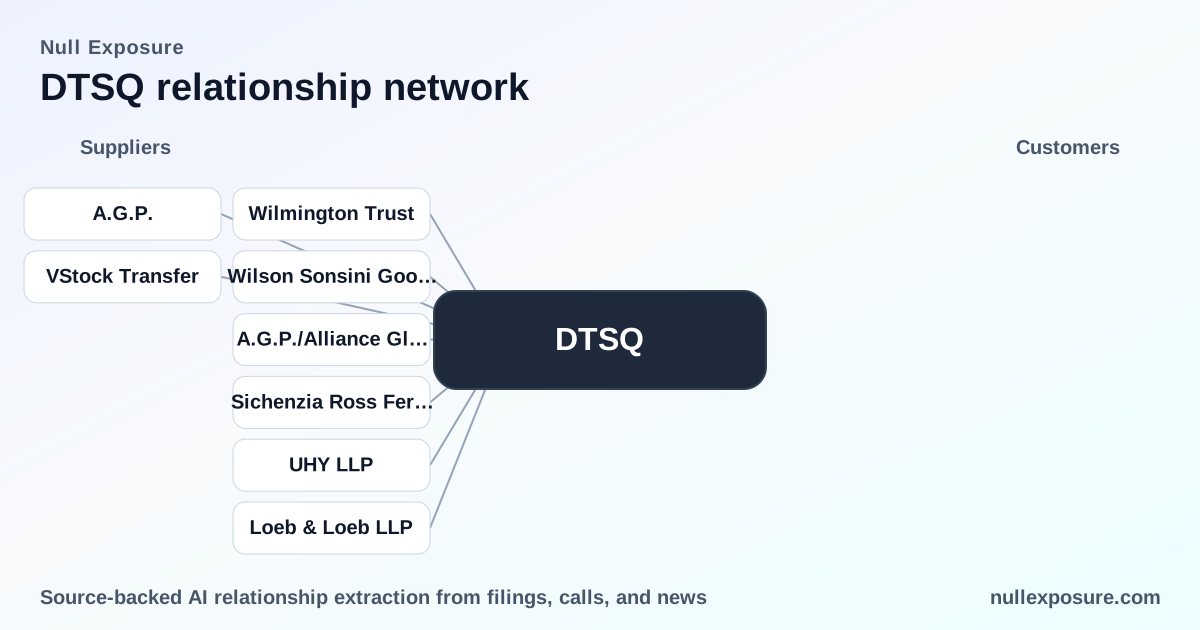
DTSQ — supplier map and commercial implications for investors
DT Cloud Star Acquisition Corporation is a SPAC (a shell company listed on NASDAQ) that raises capital through an IPO trust and seeks an initial business combination; it generates value for public investors by deploying its trust proceeds into a merger or other combination and through sponsor economics (including fees, reimbursements and post‑combination equity upside) rather than operating revenue. The company’s supplier relationships are dominated by short‑term, service‑oriented contracts (legal, underwriting, trustee, audit, transfer agent and sponsor administrative services) whose function is to support the SPAC lifecycle rather than ongoing operations. For a practical supplier risk readout, investors should focus on contracting posture, concentration of governance, spend cadence and which service partners control critical mechanisms such as the trust account and shareholder redemptions. Learn more on the homepage: https://nullexposure.com/
How DTSQ’s external network maps to investor priorities
DT Cloud Star’s suppliers are classical SPAC vendors: trustee custody, underwriting, legal counsel, auditor and transfer agent, plus sponsor‑affiliated admin services. These relationships are transactional and time‑bounded—their value is concentrated around the IPO, trust custody and the eventual business combination. Key operating signals:
- Contracting posture: short‑term and spot — recurring monthly administrative payments to a sponsor affiliate and one‑off underwriting commissions indicate a blend of predictable short‑term spend and large, discrete payments around capital markets events.
- Critical links: trustee and transfer agent — custody of the trust account and mechanics for redemption are core to liquidity for public shareholders; Wilmington Trust and VStock Transfer fill those roles.
- Service maturity and cost scale — most engagements live in the services segment at sub‑$1m annual run‑rate for admin items, while the trust account represents tens of millions in custody ($69m of proceeds referenced).
- Governance concentration — insider ownership is high (reporting shows 87.28% insiders), which amplifies the importance of legal and underwriting partners during deal execution.
If you are evaluating counterparty concentration or operational resiliency for a potential investment or vendor negotiation, our research tools show how these relationships are structured and where execution risk clusters. Explore supplier intelligence on the homepage: https://nullexposure.com/
Detailed supplier list — one‑line takes for each relationship
Wilmington Trust — acting as trustee for the IPO trust account, Wilmington Trust holds the net IPO proceeds ($69 million referenced), making it the primary custodian for shareholder funds and a critical control point for cash distributions. According to company filings referenced in SPACInsider coverage (March 9, 2026), Wilmington Trust is the trustee for the trust account.
Wilson Sonsini Goodrich & Rosati LLP — serves as issuer’s counsel on the IPO and SPAC formation, providing securities and listing counsel critical to transaction documentation and regulatory filings. SPACInsider reported on March 9, 2026 that Wilson Sonsini served as Issuer’s Counsel.
Sichenzia Ross Ference Carmel LLP — retained as underwriter’s counsel, handling legal work on behalf of the underwriter and placement process rather than the issuer. SPACInsider’s March 9, 2026 coverage lists Sichenzia Ross Ference Carmel LLP as Underwriter’s Counsel.
A.G.P./Alliance Global Partners — acted as the sole book‑running manager on the offering, taking primary responsibility for distribution, pricing and bookbuilding for the IPO. SPACInsider (March 9, 2026) notes A.G.P./Alliance Global Partners as the sole book‑running manager.
A.G.P. — Renaissance Capital independently documented A.G.P. as the sole bookrunner on the deal, confirming the same underwriting posture from an IPO‑market watcher. Renaissance Capital’s IPO center reported the SPAC filing and A.G.P. role on March 9, 2026.
UHY LLP — contracted as the company’s auditor, providing the financial statement audit that underpins the offering and ongoing SEC filings. SPACInsider (March 9, 2026) identifies UHY LLP as the auditor for DT Cloud Star.
Loeb & Loeb LLP — engaged as legal advisor to DT Cloud Star in connection with a proposed business combination disclosed in February 2026, positioning Loeb & Loeb as the lead adviser on transaction negotiation and documentation for the target deal. GlobeNewswire and Manilatimes coverage of the proposed combination (Feb 4, 2026) name Loeb & Loeb LLP as DT Cloud Star’s legal advisor.
VStock Transfer — functions as the transfer agent and handles redemption request mechanics; press reporting notes that redemption requests can be withdrawn by contacting VStock Transfer, giving it an operational role in shareholder elections at the meeting. TradingView coverage (March 2026) of the reconvened annual meeting references VStock Transfer in this role.
What the constraints tell you about DTSQ’s operating model
The constraint signals in filings and press coverage frame a clear operating profile for DTSQ:
- Contracting posture: dominated by short‑term service agreements and one‑off spot payments. The company discloses a recurring $10,000 per month fee to a sponsor affiliate for office, utilities and admin services (15‑month horizon referenced), and a single underwriting commission of 1.5% (a spot cost of roughly $1,035,000). These terms indicate a lean, contingent operating cost base tied to the SPAC lifecycle rather than long‑term vendor lock‑in.
- Relationship role and stage: external service providers in active engagements. Audit, trustee, counsel and transfer agent roles are active today and necessary to execute the IPO and process redemptions; filings report these services as current and budgeted (e.g., $50,000 of admin costs recognized in the year ended Dec 31, 2024).
- Spend profile: small recurring administrative spend with a large custody exposure. Recurring spend sits in the sub‑$100k to $100k–$1m band (admin fees and audit/legal retainer activity), while the trust custody represents $10m–$100m scale in balance sheet exposure (the $69m referenced).
- Geography: US‑centric operations. Principal executive office and registered vendor relationships are US‑based, consistent with a NASDAQ SPAC domiciled and operating under US securities rules.
- Concentration and governance: high insider ownership and modest institutional participation shift decision‑making toward sponsor and insiders; legal and underwriting partners therefore carry elevated influence during deal execution.
Note: Wilmington Trust is explicitly named in trust account excerpts and therefore is a confirmed custodian for the $69m trust proceeds in filings; other constraints (for example, $10k monthly sponsor admin fees) are company‑level signals and not attributed to a single external vendor in the constraint excerpts.
Investment and operational takeaways
- Operational risk is concentrated but transparent. The principal operational dependency is custody and transfer mechanics—Wilmington Trust and VStock Transfer are the gates to liquidity for public shareholders. Legal and underwriting relationships determine deal structure and costs at the point of combination.
- Expenditure profile supports limited vendor negotiating leverage. With mostly short‑term, service‑level contracts and a small recurring spend base, the sponsor controls the vendor ecosystem; investors should therefore evaluate sponsor alignment and governance controls more than vendor price competitiveness.
- Event risk dominates: the commercial value of these suppliers materializes at combination or liquidation events, so counterparty reliability during those windows is the decisive factor for investor outcomes.
For a deeper supplier risk assessment or to see how DTSQ’s vendor map compares across SPACs, start here: https://nullexposure.com/
Concluding recommendation: focus due diligence on trustee custody terms, transfer‑agent redemption mechanics, and the legal/underwriting fee schedule for the combination transaction, because those elements directly determine cash access, shareholder outcomes and deal economics. For further supplier intelligence and transaction overlays, visit our analysis hub: https://nullexposure.com/