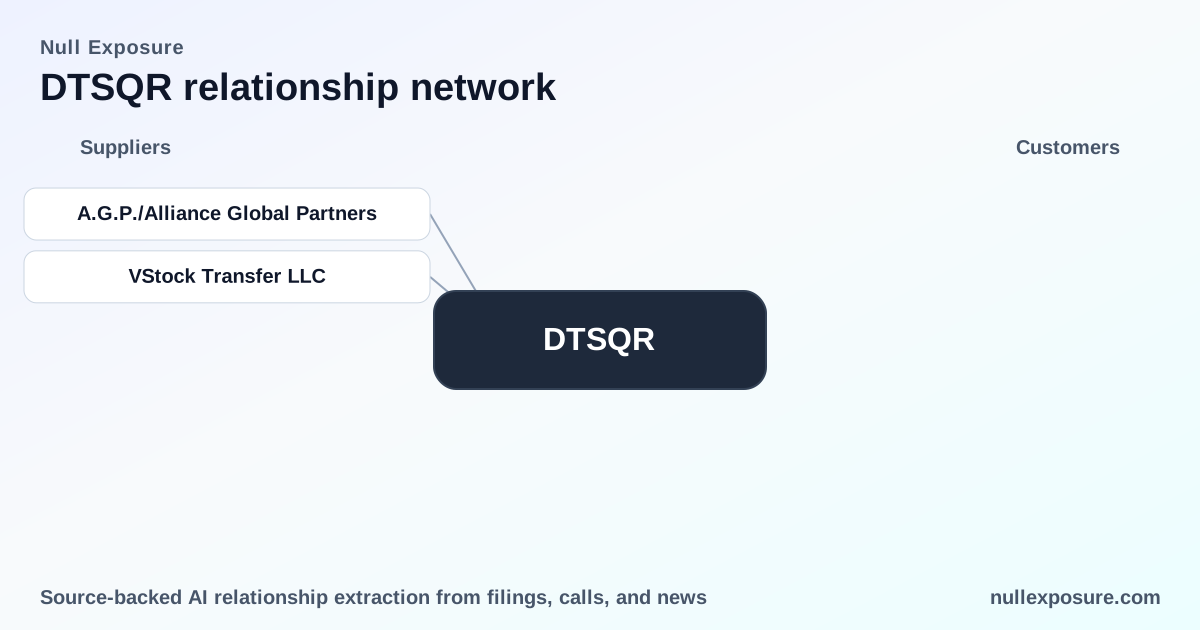
DTSQR (DT Cloud Star Acquisition Corporation Right): supplier relationships and what they reveal to investors
DT Cloud Star Acquisition Corporation Right is a SPAC-related security tied to DT Cloud Star Acquisition Corporation’s unit structure; it does not generate operating revenue and monetizes value through completion of an initial business combination and sponsor-related financial mechanics (working-capital loans and administrative fee arrangements). Investors should treat DTSQR as a pre-combination instrument whose economics are tightly coupled to sponsor support, capital structure mechanics, and corporate administrative arrangements. Explore detailed supplier and counterparty mapping at https://nullexposure.com/.
Quick profile: what DTSQR is and how value flows
DT Cloud Star Acquisition Corporation issues units that can be separated into shares and rights; the “Right” ticker DTSQR reflects those split components. The company reports zero operating revenue and no EBITDA — its short-term economic model is driven by sponsor financing (a short-term unsecured promissory note) and routine payments to sponsor-affiliate service providers for office and administrative support. Key balance signals: book value is negative (-0.083) and float is small (3,335,300), while public trading history is minimal (52-week range roughly $0.0919–$0.28). These metrics reinforce that value is contingent on a business combination or sponsor actions rather than ongoing commercial operations.
Counterparties and service providers: the relationships on record
Below are every named relationship surfaced in the disclosure set and public reporting.
A.G.P./Alliance Global Partners
A.G.P./Alliance Global Partners served as the sole book-runner and representative of the underwriters for the company’s unit offering, effectively running the public placement that created the units from which DTSQR is derived (reported March 2026). This places A.G.P. in the capital markets execution role for the SPAC’s initial distribution (see the Yahoo Finance notice: https://finance.yahoo.com/news/dt-cloud-star-acquisition-corporation-124500460.html).
VStock Transfer LLC
VStock Transfer LLC is identified as DT Cloud Star’s transfer agent responsible for facilitating the separation of Units into Shares and Rights; holders are instructed to coordinate with brokers and VStock to effect that split (reported March 2026). As transfer agent, VStock handles the operational mechanics of converting paper/units into tradable components (see the Yahoo Finance notice: https://finance.yahoo.com/news/dt-cloud-star-acquisition-corporation-124500460.html).
What contractual excerpts and constraints reveal about the operating model
The company disclosures and filing excerpts surface consistent, company-level signals about how DT Cloud Star structures its near-term relationships and cash flows:
-
Short-term financing posture: The company issued an unsecured promissory note to its sponsor on October 28, 2024, allowing borrowings up to $300,000; the note is non-interest-bearing and payable on consummation of a business combination or convertible into private units at $10 per unit. This is a short-duration, sponsor-backed liquidity mechanism that directly ties solvency to the timing of a transaction (from the company’s offering documents, Oct 2024).
-
Subscription-style administrative payments: The company commits to pay an affiliate of its sponsor $10,000 per month for office space, utilities and support services beginning when the securities list on Nasdaq and continuing through the earlier of consummation of a business combination and liquidation; total spend for the year ended Dec. 31, 2024 was reported at $50,000. That arrangement reads as a subscription contract with predictable monthly spend and finite duration (offering filings and financial statements, FY2024).
-
Service-provider dependency: The firm explicitly relies on sponsor-affiliate general and administrative services, and on third-party digital and cloud providers for critical infrastructure and cybersecurity support, while having limited internal capability. This elevates operational concentration around sponsor affiliates and third-party infrastructure vendors (company disclosures).
-
Spend scale and maturity: The documented administrative fee schedule (~$10k/month for up to 15 months) places annualized committed spend in the $100k–$1M band and indicates a short-to-medium maturity window tied to the SPAC timeline.
Together these signals define a low-complexity, sponsor-driven operating model: modest committed spend, heavy reliance on sponsor affiliate services, and short-term financing that converts into equity if a business combination closes.
Operational and investment implications investors should weigh
The contractual posture and relationship map create a compact risk-return profile for DTSQR:
-
Concentration risk is high. Sponsor-affiliate services and the sponsor’s working capital note are central to the entity’s ability to operate through the SPAC lifecycle, so changes in sponsor support directly affect survivability and timeline execution.
-
Liquidity is transaction-dependent. The non-interest-bearing, convertible working-capital loan and zero operating revenue mean the company’s path to value is contingent on completing a business combination or sponsor recapitalization.
-
Contractual predictability is strong but narrow. Monthly administrative fees are fixed and limited in term, which simplifies expense forecasting but also signals limited operating scale prior to a business combination.
-
Operational criticality is moderate. Transfer agent services (VStock) and capital markets execution (A.G.P.) are standard and necessary for capitalization and trade mechanics, but they are not value-creating in an operating sense; they enable liquidity and market access.
Monitor three items closely: sponsor financing commits and any amendments to the promissory note, the timeline and status of the initial business combination, and any changes to the administrative services agreement or counterparty roles.
Explore relational analytics and supplier diligence at https://nullexposure.com/ to stay ahead of counterparties and contract shifts.
Investment takeaways: what this means for a portfolio
- Short-duration, sponsor-driven exposure: DTSQR is effectively a claim on a future transaction outcome, supported by short-term sponsor financing and predictable admin fees. Treat it like a pre-combination instrument rather than an operating company.
- Key dependencies are sponsor and transfer/capital-markets providers: A.G.P. handled the underwriting; VStock administers unit splits. Both are necessary operational pieces but do not change fundamentals.
- Event risk dominates: The securities’ path is binary — business combination or liquidation — and the working capital mechanics (convertible promissory note) tilt near-term economics toward sponsor dilution if a deal closes.
For investors and operators evaluating supplier resilience or counterparty concentration, the most actionable signal is the sponsor dependency for both liquidity and administrative continuity.
Find supplier relationship intelligence and further DTSQR coverage at https://nullexposure.com/ — use the platform to interrogate counterparty exposure, contract durations, and spend bands before sizing positions.
Final verdict
DTSQR is a structural instrument situated before an initial business combination, with value driven by sponsor financing and transaction execution rather than operating cash flows. Investors should prioritize sponsor financial posture, the timetable for a business combination, and any material amendments to the short-term financing or administrative agreements. For deeper counterparty mapping and contract-level signals, visit https://nullexposure.com/ and integrate supplier insights into your position sizing and monitoring framework.