Duke Energy (DUK-P-A) — what supplier and grid relationships tell investors
Duke Energy operates as a regulated electric power and natural gas holding company that monetizes through generation, transmission, distribution and customer billing under regulated and contracted rate frameworks. For investors in DUK-P-A (a preferred share class used for financing), counterparty relationships that affect capital projects, site development and grid operations translate directly into execution risk and the stability of cash flows that support preferred payouts. Explore deeper supplier and counterparty records at https://nullexposure.com/ to inform diligence.
Why suppliers and grid partners matter for preferred-share investors
Preferred shareholders are second in the capital stack but sensitive to operating continuity and regulatory outcomes. Supplier engagements influence project delivery timing, cost control and regulatory permitting, while grid operator relationships determine whether generation and reserve strategies function when stressed. Company-level signals relevant to underwriting DUK-P-A include:
- Contracting posture: Duke routinely engages external consultants and contractors for site readiness and engineering work, which indicates a hybrid in-house / outsourced execution model that scales with project pipelines.
- Concentration and dependency: Public records show multiple small-to-mid-sized consultants rather than sole-source strategic suppliers, implying lower supplier concentration risk for site-selection support.
- Criticality of counterparties: Relationships with grid operators are inherently critical to operations because dispatch and reserve availability directly affect reliability and revenue during peak events.
- Maturity and continuity: The named engagements are typical of ongoing utility capital programs rather than one-off vendor arrangements, signaling a mature procurement pattern driven by recurring infrastructure needs.
If you want a consolidated view of supplier relationships for Duke and comparable utilities, visit https://nullexposure.com/ for supplier intelligence and sourcing context.
What the public records show: named supplier and grid relationships
Below are every relationship found in the public result set; each entry includes a plain-English summary and the source.
-
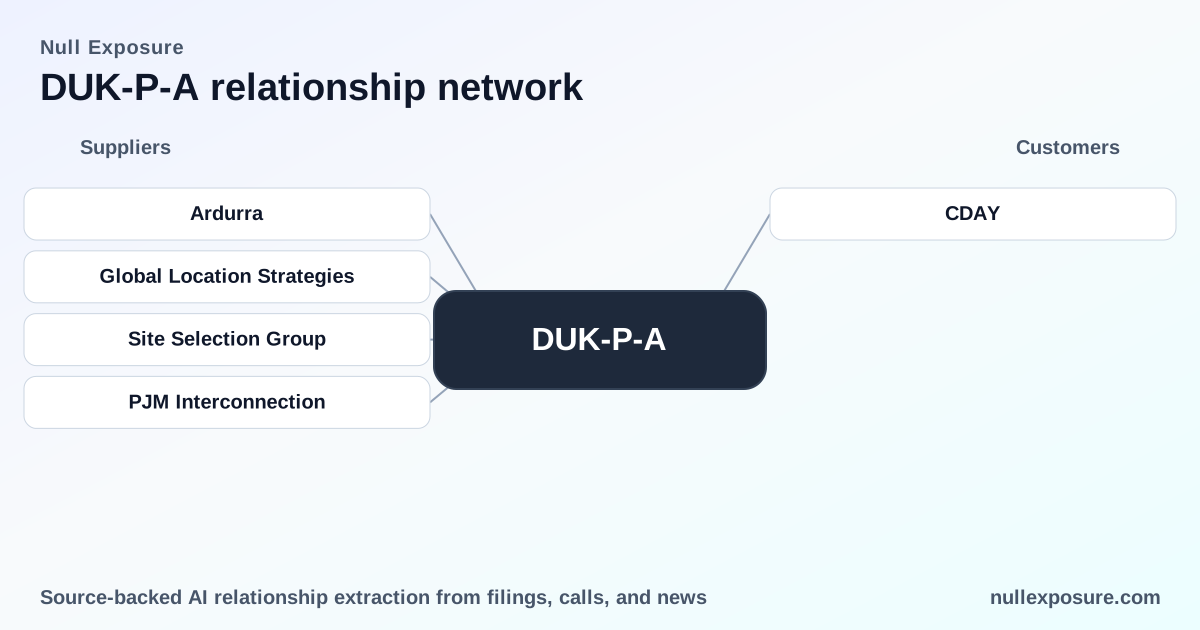
Ardurra — Duke retained Ardurra of Tampa, Fla., among consultants contracted for engineering services tied to a 2020 site-readiness program in Florida, supporting economic-development objectives and project siting. According to a Duke Energy press release from 2020, Ardurra was part of the consultant cohort for that initiative (Duke Energy news release, 2020: https://news.duke-energy.com/releases/florida-locations-selected-for-duke-energy-s-2020-site-readiness-program-to-attract-jobs-spur-economic-development).
-
Global Location Strategies — Duke engaged Global Location Strategies of Greenville, S.C., as one of the external consultants for site selection and location strategy under the same 2020 site-readiness program, indicating reliance on specialized advisory firms for siting and economic development work. This was documented in Duke Energy’s 2020 press release announcing the program (Duke Energy news release, 2020: https://news.duke-energy.com/releases/florida-locations-selected-for-duke-energy-s-2020-site-readiness-program-to-attract-jobs-spur-economic-development).
-
Site Selection Group — Site Selection Group of Dallas, Texas, was named alongside other consultants to provide site-readiness and location assessment services, reinforcing the company’s approach of outsourcing specialized site-planning tasks to multiple boutique advisors. Duke Energy’s 2020 announcement lists Site Selection Group among the consultants (Duke Energy news release, 2020: https://news.duke-energy.com/releases/florida-locations-selected-for-duke-energy-s-2020-site-readiness-program-to-attract-jobs-spur-economic-development).
-
PJM Interconnection — PJM, as the regional grid operator, reduced exports during a major storm event that constrained the reserves Duke planned to access for the Carolinas, demonstrating how independent-system-operator actions can materially affect Duke’s operational flexibility and reserve strategies. RigZone’s coverage of the January 2023 storm event reported that PJM limited exports, impacting Duke’s contingency plans (RigZone report, January 2023: https://www.rigzone.com/news/wire/usa_electric_grid_narrowly_dodged_huge_collapse_during_storm-04-jan-2023-171602-article/).
What these relationships imply for DUK-P-A investors
These supplier and grid interactions produce several actionable investor takeaways:
- Project execution is outsourced but diversified. The presence of multiple boutique consultants for site readiness signals a deliberate strategy to fragment advisory risk across firms rather than concentrating work with a single large vendor. This lowers single-vendor exposure on siting and pre-construction tasks, which supports predictable capital deployment timelines.
- Operational exposure to system operators is high. Interaction with PJM is not optional; it is structurally critical. Grid dispatch and interregional export limits can constrain Duke’s reserve and revenue strategies during stress events, which increases tail operational risk in adverse weather or market conditions.
- Commercial impact is primarily operational and regulatory, not balance-sheet exotic. The named relationships are consistent with utility norms—engineering consultants and regional grid operators—so investor focus should be on execution oversight, regulatory recovery mechanisms for capital, and contingency planning rather than unknown counterparty credit shocks.
- Transparency and disclosure are limited in the public notices. The press release identifies service providers by name but does not disclose contract value, term, or performance guarantees, which leaves a diligence gap on cost exposure and deliverable timelines.
If you are constructing a counterparty-risk heat map for Duke, these are the concrete signals to fold into your model. For further supplier-level analytics and to compare counterparties across utilities, check https://nullexposure.com/.
Constraints and governance signals
There are no supplier-specific contractual constraints recorded in the available results for DUK-P-A. The absence of explicit constraints in public records should be read as a company-level signal: either contracts are standard utility procurement arrangements without unusual covenants disclosed publicly, or the firm’s public reporting does not surface detailed contractual limitations. For preferred-share investors, this highlights the importance of looking beyond name mentions to obtain contract scope and indemnity language during deeper diligence.
Bottom line and next steps
Investors in DUK-P-A should treat the disclosed supplier relationships as strategic, operational complements rather than sources of concentrated counterparty credit risk, while recognizing that grid operator actions (PJM) are a material operational lever that can affect revenue timing and reliability outcomes. For targeted supplier intelligence and comparative counterparty analysis across utilities, visit https://nullexposure.com/ to access curated profiles and sourcing context.
Actionable next steps: review contract scopes for engineering engagements, interrogate regulatory recovery pathways for capital projects, and model reserve shortfall scenarios driven by RTO actions to stress-test preferred-share coverage. For a consolidated supplier view and ongoing monitoring, go to https://nullexposure.com/.