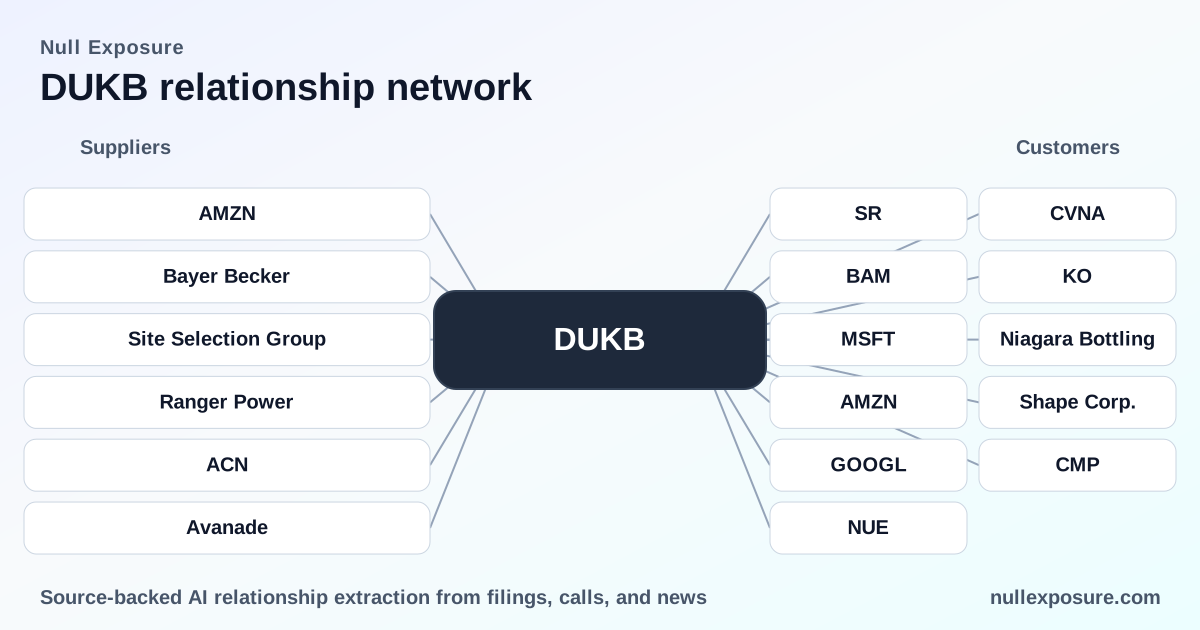
Duke Energy (DUKB) — Supplier Relationships and Operational Constraints Investors Should Know
Duke Energy operates as a large, regulated utility that monetizes through regulated rate-base returns, long-term power purchase and fuel arrangements, and commercial contracts that support generation, transmission and distribution to roughly 7.7 million customers. The company secures earnings stability through regulated tariffs and long-duration procurement while pursuing growth and decarbonization via PPAs and technology partnerships that reduce operating cost and enable grid modernization. For investors and operators evaluating supplier exposure, the critical lenses are counterparty concentration, contract tenor, and the strategic role of technology and renewable counterparties. Learn more about supplier risk mapping at https://nullexposure.com/.
Why supplier posture matters for Duke’s credit and operational performance
Duke’s supplier relationships follow a hybrid posture: predominantly long-term commitments for fuel, capacity and transmission, supplemented by spot purchases to manage short-term needs. Company disclosures describe long-dated contracts for uranium, conversion and enrichment services, multi-year pipeline and storage capacity commitments (some up to 18 years), and executory purchased-power contracts with terms exceeding one year. Those same filings also reference short-term spot market purchases for coal and other commodities as tactical complements to the long-term program.
This contracting mix creates predictable cash-flow obligations — supportive of utility-style valuation — but it also locks Duke into fixed commitments that can amplify credit and commodity exposure in stressed markets. The company acts primarily as a buyer for fuels, capacity and services and as a contracting counterparty for PPAs and technology integrations; it also operates formal procurement entities and programs to manage supplier credit and payment terms. In addition, public filings document large syndicated credit facilities and procurement structures that imply high annual spend and significant financing scale.
If you are building a supplier diligence playbook, prioritize: contract tenor, counterparty credit, operational criticality (e.g., cloud platforms vs. one-off consultants), and the degree to which payments are fixed versus indexed to market factors. For a concise supplier-intelligence approach visit https://nullexposure.com/.
Supplier and partner map — who Duke works with and why they matter
Below are the relationships surfaced in the recent intelligence set, each summarized in plain English with source context.
Amazon Web Services (AWS)
Duke uses AWS as its primary cloud provider, leveraging AWS capabilities for data processing and advanced analytics that underpin grid modernization and AI use cases. This strategic choice makes AWS a critical technology provider for Duke’s digital transformation initiatives. According to a March 2026 industry analysis published on Klover.ai, Duke’s internal expertise is amplified by that strategic decision (FY2025 / published 2026). Source: Klover.ai analysis, March 2026.
Accenture
Duke partnered with Accenture to develop a first-of-its-kind methane detection platform, indicating Accenture’s role as a technology and systems integrator for environmental monitoring and operational risk management. That collaboration underscores how consulting firms are being used to accelerate emissions-detection capabilities across Duke’s gas and distribution assets. Source: Klover.ai analysis, March 2026 (FY2025).
Avanade
Avanade is cited in connection with Duke’s Methane Detection Platform, signaling use of Microsoft-stack consulting and delivery partners for specialized cloud and analytics solutions. This partnership points to multi-vendor delivery models for mission‑critical monitoring tools. Source: Klover.ai analysis, March 2026 (FY2025).
Ranger Power
Duke executed a 199-MW solar power purchase agreement with Ranger Power in Indiana, demonstrating Duke’s use of PPAs to add clean generation to its supply mix and to meet renewables integration goals. That PPA reflects Duke’s approach to outsource new solar capacity through contractual offtake arrangements rather than wholly owned builds in every case. Source: Renewables Now report, 2023 (FY2023).
Bayer Becker
As part of Duke’s 2025 site-readiness program, Bayer Becker was engaged as a local engineering partner to support site assessments and readiness activities for industrial development. This illustrates Duke’s use of regional engineering firms to execute localized civil and permitting work tied to economic development and site preparation. Source: NKYTribune report, September 2025 (FY2025).
Site Selection Group
Site Selection Group serves as a consultant on site-readiness and site selection, working alongside local engineering firms in Duke’s 2025 program to accelerate industrial site preparedness. This engagement demonstrates Duke’s reliance on specialist consultants to shape large-scale development pipelines and community-facing projects. Source: NKYTribune report, September 2025 (FY2025).
Operating-model constraints that shape supplier strategy
Several company-level signals determine how Duke contracts and manages suppliers:
- Long-term contractual bias: Filings describe extensive long-term purchased-power, fuel and pipeline/storage commitments; these create durable cash-flow obligations and supplier dependence over multi-year horizons. Evidence includes documentation of executory purchased power contracts and long-dated fuel contracts for nuclear and thermal assets.
- Spot-market complement: Management uses short-term spot purchases for commodity flexibility, particularly coal, which reduces procurement rigidity for non-base requirements.
- Geographic focus in North America: Procurement and transportation are structured around interstate pipelines and intrastate investments that support service territories in the eastern U.S., concentrating operational exposure regionally.
- Buyer and procurement sophistication: Duke functions as a buyer at scale, operating procurement agents and voluntary supply-chain finance programs to optimize payment terms and working capital. That scale is consistent with high spend and centralized procurement governance.
- Material financing and spend scale: Public exhibits reference multi-billion-dollar credit agreements and syndications that support capital and procurement needs, indicating >$100m spend bands and available liquidity to underwrite large projects.
- Active, mature supplier relationships: The mix of long-term capacity contracts, large credit facilities, and strategic technology partnerships signals a mature supplier ecosystem with ongoing active relationships rather than ad hoc sourcing.
These constraints are company-level characteristics; they shape the value and risk profile of every supplier relationship even when specific counterparties are not named in the excerpts.
What investors and procurement teams should prioritize
- Counterparty credit checks for long-term PPAs and fuel suppliers. Long tenors concentrate credit exposure; counterparties’ solvency affects operational continuity and credit metrics.
- Operational criticality of technology partners. Cloud providers and systems integrators (e.g., AWS, Accenture, Avanade) support grid controls and monitoring; outages or integration failures are second-order risks to reliability and regulatory performance.
- Contract flexibility and indexation. Review how price escalators and market-index clauses allocate commodity price risk between Duke and its suppliers.
- Concentration and geographic risk. High regional exposure to interstate pipelines and local site activities means localized disruptions can have outsized impact. For a deeper supplier risk scorecard and relationship map, start here: https://nullexposure.com/.
Bottom line: risk-adjusted exposure is predictable but non-trivial
Duke’s supplier posture is deliberately structured for predictability: long-term contracts, high spend scale and strategic technology partnerships reduce volatility in earnings but introduce concentrated counterparty and contractual obligations that require active monitoring. Investors should treat Duke’s supplier base as an integral component of its credit and operations profile—paying particular attention to the credit health of long-term fuel and PPA counterparties and the resilience of cloud and systems integrators that now support critical monitoring and control functions.
For actionable supplier intelligence and ongoing monitoring solutions, visit https://nullexposure.com/ to map counterparties and surface material changes in relationships.