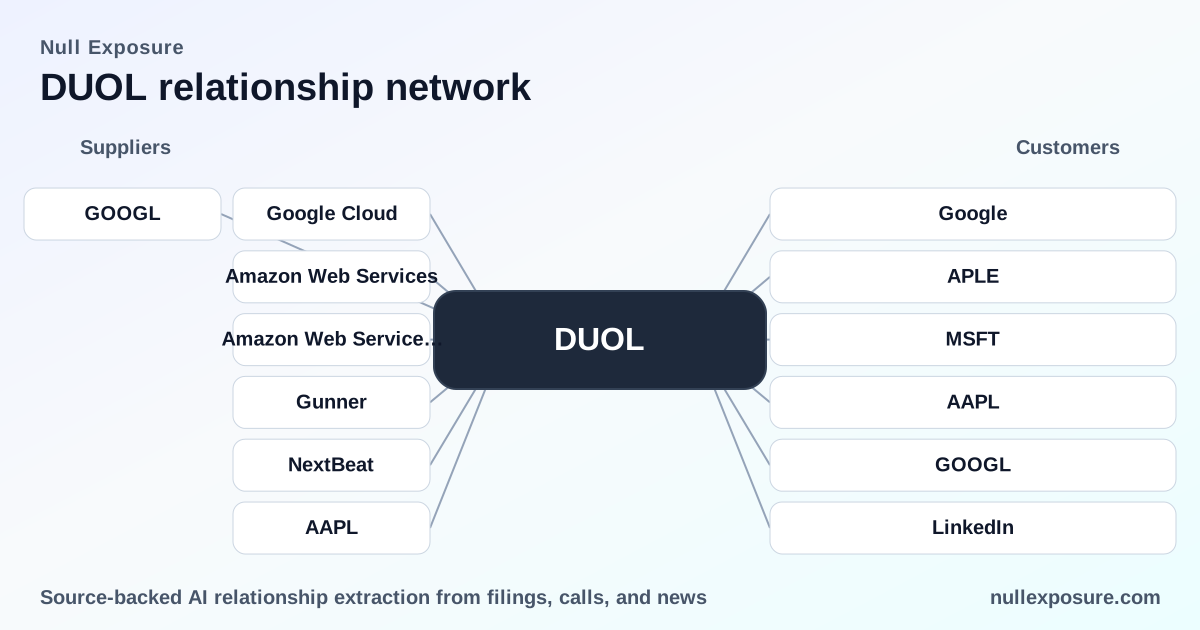
Duolingo’s supplier map: cloud, app stores, creative studios — what investors need to price in
Duolingo Inc. operates a freemium language-learning platform that monetizes through subscriptions, advertising, and in‑app purchases distributed via the Apple App Store and Google Play, while outsourcing core infrastructure to major cloud providers and contracting creative partners for content. The company drives revenue concentration through digital distribution and scales product engagement with acquisitions and in‑house content partnerships — a structure that delivers high gross margins but creates concentrated counterparty and operational risk investors must underwrite. For a concise view of supplier exposures and contract dynamics, visit https://nullexposure.com/.
Why suppliers matter for Duolingo’s economics and risk profile
Duolingo’s operating model deliberately trades fixed cost for platform reach: it outsources heavy infrastructure and distribution to third parties while owning the customer experience and product IP. That split produces three investment-relevant characteristics:
- Concentration: Duolingo derives a majority of revenue from two distribution platforms, which amplifies single‑counterparty risk and pricing leverage from those platforms.
- Short contracting posture for distribution: App-store agreements are contractually terminable on short notice, creating operational vulnerability despite high user scale.
- Service-provider dependency: Core compute, payment routing, advertising monetization, and content production run through external vendors, which makes supplier performance and cyber‑third‑party controls critical to uptime and monetization.
These are company-level signals drawn from Duolingo’s FY2024 10‑K and other filings. For immediate operational context and supplier screening, see https://nullexposure.com/.
Supplier roster: the relationships you must model
Below I list every supplier relationship flagged in the public record and give a plain-English positioning statement for each.
Google Cloud
Duolingo relies on Google Cloud as one of its third‑party hosting and cloud computing providers for operating aspects of the service, as disclosed in its FY2024 Form 10‑K. According to the 10‑K, Google Cloud is part of the company’s multi‑provider cloud posture that supports app operations and scalability (FY2024 filing, Duolingo 10‑K, first seen Feb 2026).
Amazon Web Services (AWS)
Amazon Web Services is explicitly named in Duolingo’s FY2024 10‑K as a hosting and cloud computing provider used to operate aspects of its business; the filing references both AWS and Google Cloud as core infrastructure partners (FY2024 filing, Duolingo 10‑K, first seen Feb 2026).
Gunner (animation partner / acquired studio)
Gunner served as Duolingo’s animation and design partner since 2020 and was the subject of an acquisition/partnership narrative in industry press; AWN reported in March 2026 that Gunner produced art and animation for Duolingo’s flagship app and Duolingo ABC (AWN news report, March 2026).
NextBeat (music gaming team acquisition)
Duolingo announced it acquired the team behind NextBeat — a London‑based music gaming startup — with press coverage describing the strategic intent to blend licensed music with engaging mobile gameplay (StockTitan report covering the FY2025 announcement, March 2026).
Apple App Store
The Apple App Store functions as both a distribution channel and payments gateway: Duolingo disclosed it derived 61% of revenue and 62% of bookings from the Apple App Store in the twelve months ended December 31, 2024, and also noted its distribution agreement is generally terminable by Apple with 30 days’ notice where local law allows (FY2024 Form 10‑K; distribution‑agreement excerpt, Duolingo 10‑K, FY2024).
Google Play
Google Play is the other primary distribution channel for Duolingo and accounted for 20% of revenue and 20% of bookings in the same twelve‑month period, with the company citing similar termination exposure through its distribution arrangements (FY2024 Form 10‑K; revenue concentration and distribution agreement excerpt, Duolingo 10‑K, FY2024). Promotional materials and earnings releases also highlight Duolingo’s top‑grossing position in Education on Google Play (company press/earnings commentary covered by QuiverQuant, Feb 2025).
What the constraints tell investors about operating posture
Duolingo’s filing exposes several constraint signals that should influence valuation and downside scenario design:
- Contract type: short‑term for distribution. The 10‑K explicitly says distribution agreements with Apple and Google are generally terminable with 30 days’ notice in many jurisdictions, which creates near‑term termination risk for app availability and payment processing (Duolingo 10‑K, FY2024).
- Materiality / concentration: critical dependence on app stores. The company reported 61% revenue from Apple and 20% from Google Play in the twelve months ended Dec 31, 2024, establishing single‑counterparty exposure that can quickly affect top-line and bookings (Duolingo 10‑K, FY2024).
- Counterparty type: large enterprise for monetization partners. Duolingo works with major programmatic ad networks and platform partners to monetize advertising inventory, indicating counterparties are large, sophisticated enterprises with negotiation leverage (company disclosures on ad monetization, Duolingo 10‑K).
- Relationship roles: distributor and service provider. App stores are distribution partners; cloud and creative vendors function as service providers supporting product delivery and content. Duolingo also documents an active third‑party risk management program for these providers (Duolingo 10‑K).
- Relationship stage: active and operational. Duolingo’s balance sheet shows operating lease security (standby letter of credit) and restricted cash tied to obligations, signaling active contractual arrangements are in place and accounted for (Consolidated Balance Sheet notes, Duolingo 10‑K).
These constraints are company‑level signals unless an excerpt names a specific counterparty; where Apple and Google are named, the contract and materiality constraints are directly relevant.
Risk checklist for modeling and due diligence
- Stress test revenue scenarios removing 30–61% of app store revenue for short windows to quantify cashflow sensitivity. The 61% Apple share is a first‑order shock to profit and bookings (Duolingo 10‑K, FY2024).
- Assess cloud provider concentration and potential cost inflation from large cloud vendors; the 10‑K lists AWS and Google Cloud as primary hosting partners (Duolingo 10‑K, FY2024).
- Validate third‑party risk controls and cyber insurance given reliance on external service providers and stated third‑party risk management processes (Duolingo 10‑K).
- Factor acquisition-driven content spend into user engagement ROI; recent studio/team acquisitions (Gunner, NextBeat) are execution levers for product differentiation (AWN and StockTitan coverage, March 2026).
For deeper supplier risk scoring and to benchmark Duolingo’s exposures across peers, explore the toolset at https://nullexposure.com/.
Investment implications and recommended next steps
Duolingo’s model delivers attractive unit economics through a lean operating footprint and high gross margins, but investors pay a premium for revenue concentration and externally managed infrastructure. The company’s strategic choices—outsourcing compute to AWS/Google Cloud and distributing through Apple/Google—accelerate scale while transferring critical operational dependencies to third parties. That creates clear downside scenarios that should be priced into multiples and stress tests.
Recommended next steps for investors:
- Reconcile revenue concentration figures to recent quarters and stress test cashflow under distribution interruption scenarios using the FY2024 figures as a baseline (Duolingo 10‑K).
- Monitor integration outcomes from Gunner and NextBeat acquisitions for evidence of incremental retention or ARPU uplift (AWN; StockTitan, March 2026).
- Confirm cloud and ad‑monetization contract terms and any potential for negotiated cost pass‑through or price increases.
For a supplier-focused screening of Duolingo and comparable edtech providers, visit https://nullexposure.com/ for research and supplier risk analytics.