DoubleVerify (DV): Measurement vendor, margin engine, and platform risk you can price
DoubleVerify is a global software platform that sells digital media measurement, brand safety, and attention analytics to advertisers and platforms. The company monetizes through recurring licensing fees, impression- and engagement-based measurement charges, and higher-margin analytics products, converting scale in programmatic advertising into predictable revenue and improving gross margins through software delivery. For investors, the core trade is exposure to secular growth in ad verification and measurement balanced against concentration and platform dependency risks.
If you want the underlying sourcing and supplier mappings used to reach these conclusions, start here: https://nullexposure.com/
How DoubleVerify runs the business and where it earns dollars
DoubleVerify operates as a measurement layer between buyers (advertisers, agencies) and sellers (publishers, platforms). Revenue is generated from subscriptions and per-impression measurement fees, plus upsells for advanced analytics and brand-safety modules. The economics show high gross margins (gross profit of $614.8M on $748.3M revenue TTM), which reflects software-led scale after fixed costs are spread across volumes.
Key operating characteristics investors should price into valuation:
- Recurring revenue backbone: licensing and platform fees create subscription-like stickiness and predictable cash flow.
- High top-line concentration potential: platform integrations can be strategic and concentrated, amplifying upside and downside around a few major partners.
- Margin leverage: operating margin (18.4% TTM) implies room for incremental EBIT improvement as sales mix shifts toward analytics.
- Public-market expectations: forward P/E ~12.85 vs trailing P/E ~33.8 indicates a market pricing of faster future earnings growth.
Explore detailed supplier mappings and relationship context at https://nullexposure.com/
Platform relationships investors need to watch: Meta Platforms
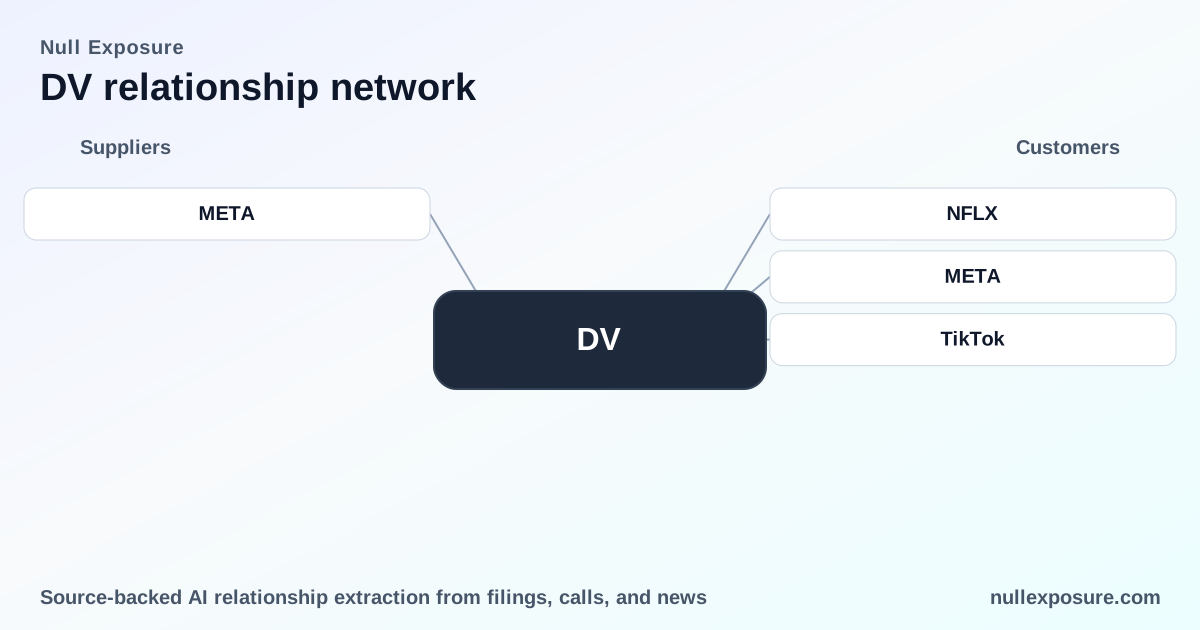
DoubleVerify’s supplier relationship dataset lists a collaboration with Meta Platforms, Inc. that expands brand-suitability measurement onto Meta’s Threads product. This is a strategic distribution tie that gives DoubleVerify measurement coverage on a high-reach social surface, strengthening its addressable market for brand-safety and suitability services. According to a March 9, 2026 news report, DoubleVerify expanded brand suitability measurement to Meta Threads, confirming active integration with Meta’s environment. Source: MarketScreener news, March 9, 2026 — https://www.marketscreener.com/news/doubleverify-holdings-inc-expands-brand-suitability-measurement-on-meta-threads-ce7d5adcdb8eff25
What this relationship implies operationally and commercially
The Meta link underscores three investable points:
- Distribution and credibility: having measurement on Meta surfaces validates DoubleVerify’s taxonomy for brand suitability and increases enterprise sales leverage into advertisers who buy Meta inventory.
- Revenue upside tied to usage: as advertisers increase spend on social formats, DoubleVerify captures incremental per-impression measurement revenue without equivalent incremental cost.
- Dependency risk: platform integrations are commercially valuable but concentrate commercial exposure; platform policy or competitive shifts at Meta would have direct implications for volume and pricing.
Constraints and company-level signals that affect supplier risk
There are no supplier-constraint excerpts in the available record that single out specific contractual limits. Use the following company-level signals to frame supplier risk and execution posture:
- Contracting posture: DoubleVerify operates on a mix of enterprise contracts and measurement agreements; this implies formal SLAs and integration complexity with major platforms. Expect negotiation leverage to favor large platforms for technical integrations, while advertisers accept measurement fees as an operational cost.
- Concentration: platform ties (example: Meta) create revenue concentration and counterparty exposure. Investors should model scenarios where top platform partners drive a meaningful share of measured impressions.
- Criticality: DoubleVerify’s services are mission-critical for brand-safety-conscious advertisers, which supports stickiness and renewals; however, measurement is also a competitive field, so product differentiation and accuracy matter for customer retention.
- Maturity and scaling: the company’s margin profile and recurring revenue base indicate a mature software business with scale economics, but growth will require continued platform integrations and international expansion to offset maturing core markets.
Risk factors investors should price explicitly
- Platform concentration: the business benefits from platform distribution but is exposed to single-platform policy or commercial changes.
- Competitive intensity: multiple verification providers and platform-native measurement solutions create pricing pressure over time.
- Data and regulatory environment: evolving privacy rules could raise compliance costs or limit measurement fidelity.
- Macroeconomic ad cycles: advertising budgets are cyclical; measurement revenue moves with ad spend but carries less downside than media spend because of contractual and governance needs.
Tactical takeaways for portfolio managers and operators
- Value proposition: DoubleVerify is a high-margin, software-centric vendor with clear monetization levers in measurement and analytics; investors should value recurring revenue and margin expansion potential.
- Monitor top-partner exposure: model sensitivity to platform-specific volume declines (e.g., Meta) and track contract renewal terms for large customers.
- Operational diligence: focus vendor diligence on integration depth, SLA terms, and product differentiation (brand suitability taxonomies and attention metrics).
If you want ongoing monitoring of platform relationships and supplier constraints, visit https://nullexposure.com/ for the full supplier intelligence toolkit.
Conclusion — where to position the trade
DoubleVerify balances durable, high-margin cash generation with concentrated platform relationships that create asymmetric outcomes. The stock trades on growth expectations; upside depends on continued platform integrations and share gains among advertisers, while downside is concentrated around platform policy or competitive displacement. For investors and operators evaluating supplier relationships, the priority is quantifying concentration risk, validating renewal mechanics, and verifying product differentiation on emerging surfaces like Meta Threads.
For source-led supplier intelligence and to see how these relationships evolve in real time, go to https://nullexposure.com/