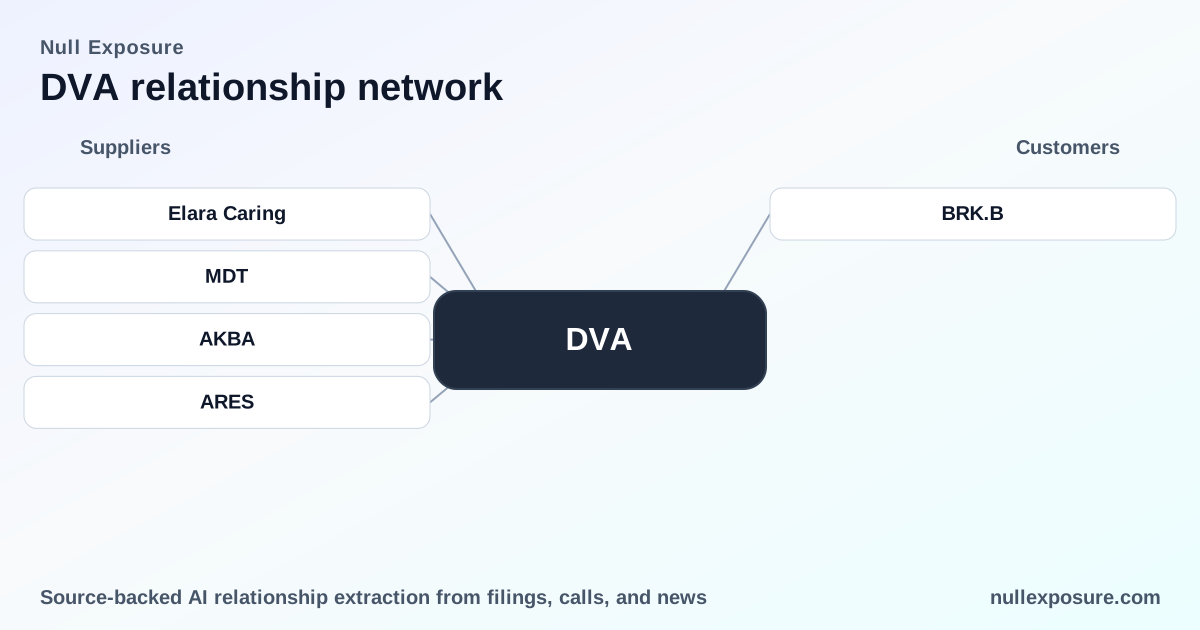
DaVita (DVA): Supplier relationships and what they signal for investors
DaVita operates the largest U.S. outpatient dialysis network and monetizes through a mix of fee-for-service dialysis, value-oriented care contracts, ancillary clinical services, device and supply arrangements, and selective equity investments that extend its care delivery platform. The business combines predictable service revenue with strategic partnerships and capital deployments that aim to lower care costs and capture adjacent margins; revenue totaled $13.64 billion (TTM) and market capitalization is about $9.9 billion. For a deeper read on supplier exposures and counterparty risk, visit https://nullexposure.com/.
Why supplier and partner posture matters for DVA investors
DaVita’s operating model is sensitive to the structure of its supply and partnership agreements because patient care continuity depends on timely delivery of equipment, clinical supplies, and third‑party services. The company reports multi‑year purchase agreements across equipment, pharmaceuticals, supplies and technology, and it has disclosed both operational disruptions and increased expense when critical supplier manufacturing halted. Those dynamics translate directly into margin volatility, operational risk, and capital allocation choices.
- Long‑term contracting supports cost predictability but creates lock‑in and headline risk if a manufacturer fails to meet demand.
- Criticality of suppliers is not academic: shortages of clinical supplies have produced measurable service disruptions and incremental expense in recent periods.
- Supplier roles are mixed: some counterparties act as manufacturers for critical clinical products, others provide outsourced services (claims processing, IT, financial accounting).
Collectively, these characteristics make supplier relationships a second‑order lever on DaVita’s operating performance and strategic flexibility.
Company-level constraints that shape supplier risk
DaVita’s public disclosures surface several operating‑model signals that influence supplier counterparty evaluations:
- Long‑term purchase agreements are an explicit element of the procurement posture; the company maintains multi‑year contracts for equipment, parts, pharmaceuticals, supplies, and technology services, which supports planning but increases dependency on those vendors.
- Supplier criticality is confirmed by prior service disruptions and supply shortages; the company has incurred increased expense to sustain care continuity when supply chains break.
- Dual supplier roles: vendors include manufacturers of clinical products and large third‑party service providers for essential back‑office functions.
- Material committed spend: company disclosures indicate multi‑year commitments consistent with a high spend band (company signal: $100M+), implying meaningful financial exposure if counterparties underperform.
These are company‑level signals that should factor into any counterparty risk assessment and valuation stress tests for DVA.
Supplier and partner relationships to watch
Below I cover every relationship disclosed in the available reporting and what each connection means for investors.
Elara Caring — a clinical partnership to extend home ESKD care
DaVita announced a strategic clinical partnership with Elara Caring to establish an ESKD‑focused home care offering, signaling a push to expand home‑based services and capture care continuum economics. According to DaVita’s 2025 Q4 earnings call, the partnership is intended to bolster home delivery for end‑stage kidney disease patients and accelerate integrated clinical pathways (2025 Q4 earnings call, March 2026). Takeaway: this expands DaVita’s clinical reach but increases operational reliance on a third‑party home‑care operator.
Ares Management Corporation — financial partner in Elara’s acquisition
DaVita disclosed signing an approximately $200 million minority investment alongside a majority private equity investment led by Ares to acquire Elara Caring, reflecting a capital‑allocation move to scale home health exposure without taking full ownership risk. The commitment was announced on the 2025 Q4 earnings call in conjunction with the Elara partnership (2025 Q4 earnings call, March 2026). Takeaway: DaVita is monetizing strategic scale through minority stakes, which shifts some execution risk to financial partners while retaining clinical integration upside.
Medtronic — device JV and asset transfer into Mozarc Medical
A public filing covering FY2026 disclosed that DaVita and Medtronic agreed to form a new, independent kidney care‑focused medical device company, Mozarc Medical, with equal equity ownership; a sale by Medtronic was part of that agreement. This is reported in a FY2026 Sec filing summarizing the transaction (Medtronic 10‑Q / related coverage, FY2026). Takeaway: the joint venture materially affects DaVita’s supplier/manufacturer footprint—creating potential vertical integration benefits but adding JV governance and execution risks.
Akebia Therapeutics — clinical research hosted in DaVita clinics
Akebia reported that the VOCAL study, conducted at DaVita clinics, is evaluating Vafseo dosed three times weekly, with results expected later in the year; the reference to DaVita’s sites appeared in Akebia’s FY2026 commentary. A Q4 2025 earnings call transcript for Akebia notes the study being run at DaVita locations (Akebia Q4 2025 earnings call transcript, FY2026 coverage). Takeaway: DaVita clinics are acting as clinical trial sites, increasing clinical activity and potential downstream adoption of therapies if results are favorable, but introducing trial‑related operational demands.
How these relationships alter the investment thesis
The disclosed relationships collectively reveal DaVita’s strategy to extend clinical scope and create adjacent revenue streams while managing capital through minority investments and JVs. Key implications for investors:
- Revenue diversification: partnerships with Elara and Akebia and the Medtronic JV position DaVita to monetize home‑based care and device economics, complementing center revenue.
- Operational leverage vs. counterparty risk: multi‑year procurement contracts and manufacturer dependencies give visibility for budgeting but concentrate downside if suppliers fail; prior disruptions materially increased expense and slowed growth.
- Capital allocation discipline: the $200 million minority investment alongside Ares demonstrates a willingness to deploy capital to scale new care models without sole ownership; this preserves cash but creates dependency on partner execution and alignment.
- Clinical upside balanced by trial and regulatory risk: hosting clinical trials (Akebia) could accelerate adoption of new regimens in DaVita channels, but outcomes and regulatory timing are binary variables that affect trajectory.
For an active evaluation of counterparties and supplier exposure, consult the full supplier intelligence at https://nullexposure.com/.
Practical risk checklist for managers and investors
- Stress test margins for supplier disruption scenarios and extended lead times for critical products.
- Model JV economics for Mozarc Medical under different commercialization and reimbursement scenarios.
- Monitor Ares‑led transaction milestones and governance terms for Elara to assess integration risk.
- Quantify operational burden of hosting clinical trials and the probability of therapeutic adoption within DaVita’s network.
Bottom line: DaVita is diversifying away from pure center‑based dialysis via partnerships and JVs that can lift long‑term margins, but these moves increase exposure to supplier manufacturing, third‑party service performance, and execution risk. For continued tracking of counterparty and supplier exposures, visit https://nullexposure.com/.
Investors should treat DaVita’s supplier relationships as strategic levers with tangible balance‑sheet and operational implications—evaluate both the upside from vertical integration and the downside from supplier criticality when setting valuations or structuring credit protections.