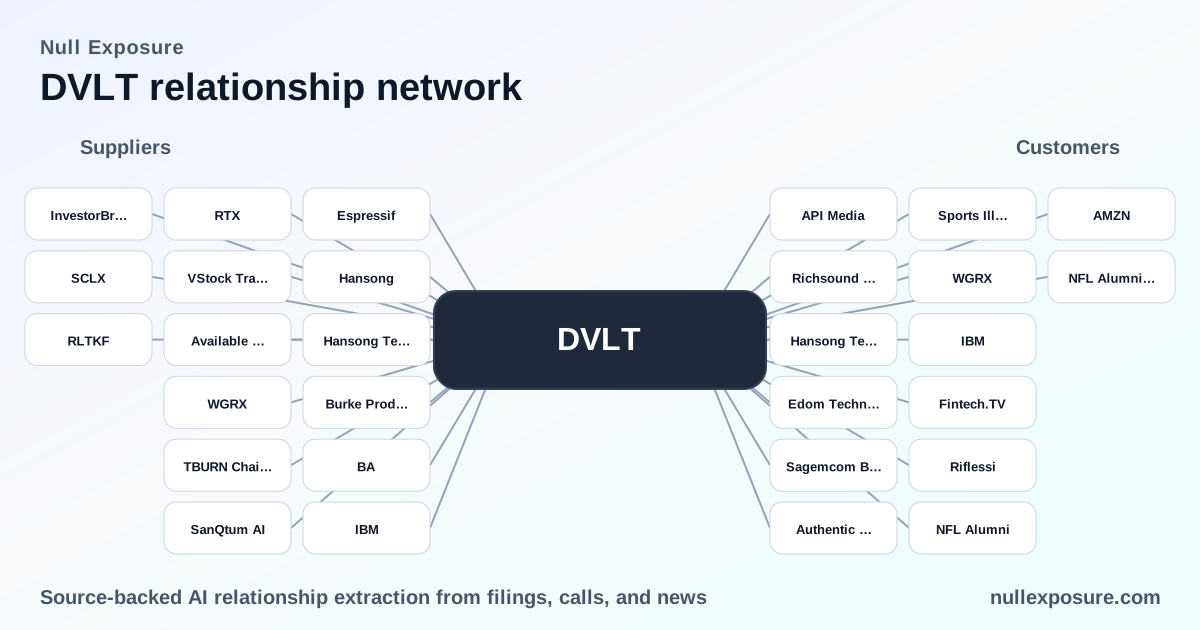
Datavault AI (DVLT): Supplier relationships that determine if the rollout scales
Datavault AI operates a hybrid edge computing and data-monetization business: the company builds and deploys micro-edge SanQtum AI units and a software stack (Information Data Exchange®, DataScore®, DataValue®) that tokenizes and scores data, then monetizes through enterprise deployments, IP licensing and token-enabled financial instruments. Revenue depends on hardware deployments, strategic partnerships for enterprise AI (notably IBM), and a mix of suppliers that deliver semiconductors, speakers and specialized services. For further supplier diligence and supplier-risk intelligence, visit https://nullexposure.com/.
How DVLT makes money and why suppliers matter
Datavault monetizes through a combination of device sales, enterprise software subscriptions, and tokenized transaction flows that attach value to on-premise data processing. Hardware margins and time-to-deploy are direct profit levers; supplier performance—especially for semiconductor and assembly partners—influences unit economics and deployment cadence. The company’s public filings and disclosures indicate a mix of low-spend concentration across many vendors but localized critical dependencies for specific components and contract services. This creates a dual profile: low supplier spend concentration overall yet high operational concentration for a handful of sole‑source components and assembly partners.
Key operating-model signals from filings:
- APAC manufacturing concentration is material to operational risk: Datavault identifies single contractors in China (assembly/testing and receive chips) and Japan (transmit chips), so geopolitical or logistics disruption in those regions would directly constrain deployments.
- Purchasing dispersion on paper: filings state no single materials supplier accounts for more than 10% of purchases, indicating immaterial spend concentration in aggregate.
- Critical single‑source components: despite dispersed spend, the company relies on sole‑source suppliers for specific components (speakers and some semiconductors), which raises supply fragility for device rollouts.
- Active manufacturing relationships and use of transition services in corporate acquisitions reflect a company in deployment and integration mode rather than a mature, vertically integrated manufacturer.
Supplier map: every reported relationship and what it means for investors
Below are the supplier and partner relationships disclosed in the public record, with concise takeaways and source notes.
Espressif
Datavault reports its WiSA E code runs on Espressif for 2.4 GHz wireless functionality, indicating an embedded software/hardware dependency for wireless connectivity. According to DVLT’s 2024 Form 10‑K, that implementation is explicit in the product stack (FY2024 10‑K).
Realtek
The company similarly ties its WiSA E code to Realtek for 5 GHz operation, creating a dual-supplier split across frequency bands that affects sourcing and firmware validation requirements. This detail comes from the 2024 Form 10‑K (FY2024 10‑K).
Hansong / Hansong Technology
Speakers are sole‑sourced from Hansong, and Hansong Technology is recorded as a seller with recorded sales and payments (approx. $28k sales in 2024 and $235k paid by the company), signaling a contractual procurement relationship for finished audio components. These specifics are disclosed in DVLT’s 2024 Form 10‑K (FY2024 10‑K).
Burke Products
Burke Products is a facilitator for government contracts and specialized sensor technologies, implying Burke acts as a channel or integrator for federal work. Management mentioned Burke’s role on the 2025 Q3 earnings call (2025 Q3 earnings call).
Boeing
Datavault lists Boeing among collaborators leveraged for systems development tied to federal laboratories and defense-adjacent programs, which underlines an enterprise/government pathway for product validation and potential long-term contracts. Management referenced Boeing on the 2025 Q3 earnings call (2025 Q3 earnings call).
Raytheon
Raytheon is named alongside other defense contractors as a collaborator, reinforcing Datavault’s engagement with defense primes for applied systems and technology transfer opportunities. This appeared on the 2025 Q3 earnings call (2025 Q3 earnings call).
IBM
Datavault has a strategic, deepening alliance with IBM—public announcements highlight Platinum Partner status and integration of IBM watsonx AI in SanQtum AI edge deployments for New York and Philadelphia, which elevates enterprise-grade security and AI capabilities for edge customers. The IBM collaboration is described in company press releases and a USA Today press release covering FY2026 deployments (March 2026 press release).
SanQtum AI / Available Infrastructure
SanQtum AI (operated by Available Infrastructure) provides the micro‑edge platform used in multi-city rollouts (New York and Philadelphia), combining Datavault software with operator infrastructure for local, low-latency compute. This deployment and operator relationship are covered in the company’s FY2026 press materials (FY2026 press releases).
Wellgistics Health
A partnership with Wellgistics Health integrates Datavault IP to tokenize patient data, enable pharmacy fulfillment and support telemedicine flows—an expansion into healthcare verticals that ties Datavault technology to regulated data and partner service delivery. This deal was reported in FY2026 news coverage (FY2026 news report).
Scilex
Scilex is mentioned as a partner for biotech and scientific research innovation, indicating Datavault’s push into scientific data markets that require domain-specific validation and collaboration. Management referenced Scilex on the 2025 Q3 earnings call (2025 Q3 earnings call).
TBURN Chain Foundation
Datavault executed a collaboration agreement with TBURN Chain Foundation to leverage high-performance blockchain infrastructure, reflecting strategic moves to anchor tokenization and on‑chain credentialing for data assets. The collaboration was announced in a company press release in FY2026 (FY2026 press release).
VStock Transfer, LLC
VStock Transfer is the warrant agent referenced in a FY2026 IR notice; Datavault’s warrant exercise mechanics are conditioned on token ownership inside Datavault accounts, establishing an operational link between financial instruments and the company’s token ecosystem. This is detailed in the company’s FY2026 investor release (FY2026 IR release).
InvestorBrandNetwork (IBN)
InvestorBrandNetwork is cited as a host for company newsroom content; media distribution through IBN/third‑party news feeds points to an investor‑communications channel rather than a technical supplier. TradingView referenced IBN-hosted newsroom content in FY2026 (FY2026 TradingView item).
What the supplier map implies for operations and risk
Datavault’s supplier pattern combines strategic enterprise partnerships (IBM, Boeing, Raytheon) with component-level sole‑source relationships (Hansong, Realtek, Espressif) and service/channel partners (Burke Products, Available Infrastructure, VStock). The result: commercial scaling depends on partner-led enterprise adoption while hardware supply fragility could limit deployment speed.
Core risks and operational considerations:
- Geopolitical and logistics exposure: reliance on APAC contractors for assembly and chips increases the company’s vulnerability to regional disruption.
- Concentration vs. materiality paradox: aggregate supplier spend is broadly immaterial (no single supplier >10% of purchases) yet specific sole‑source components are critical to product completion and deployment timelines.
- Dependency on partners for credibility and market access: IBM and defense primes provide go-to-market leverage but also place product integration and compliance demands on DVLT’s engineering teams.
- Early-stage manufacturing posture: evidence of transition services and sole-source manufacturing suggests a company still establishing repeatable supply chains rather than a mature, low-cost production model.
Consider these operational priorities when evaluating the supplier picture: vendor diversification for critical chips and speakers, onshore/nearshore assembly options to mitigate APAC risk, and contractual protections with strategic partners that preserve margins and IP control.
For deep supplier-risk scoring and comparative supplier analytics, visit https://nullexposure.com/ to see how these relationships stack up against peers.
Investment takeaway and next actions
Datavault AI’s commercial thesis rests on rapid edge deployments enabled by enterprise alliances and unique tokenization primitives. The supplier base is a mixed signal: strong enterprise partners materially de‑risk go‑to‑market, while single‑source components and APAC manufacturing concentration create execution risk for hardware rollouts. Investors should track two measurable items: (1) evidence of supplier diversification for chips and speakers, and (2) commercial contract announcements that convert pilot deployments (NY/Philadelphia) into recurring revenue streams.
If you evaluate supplier risk or manage portfolio exposure to early-stage edge‑AI firms, Datavault’s disclosures warrant active monitoring of supplier invoices, production milestones, and partner integration announcements. For a structured supplier-risk report or to compare DVLT’s supplier posture to industry benchmarks, explore our tools at https://nullexposure.com/.