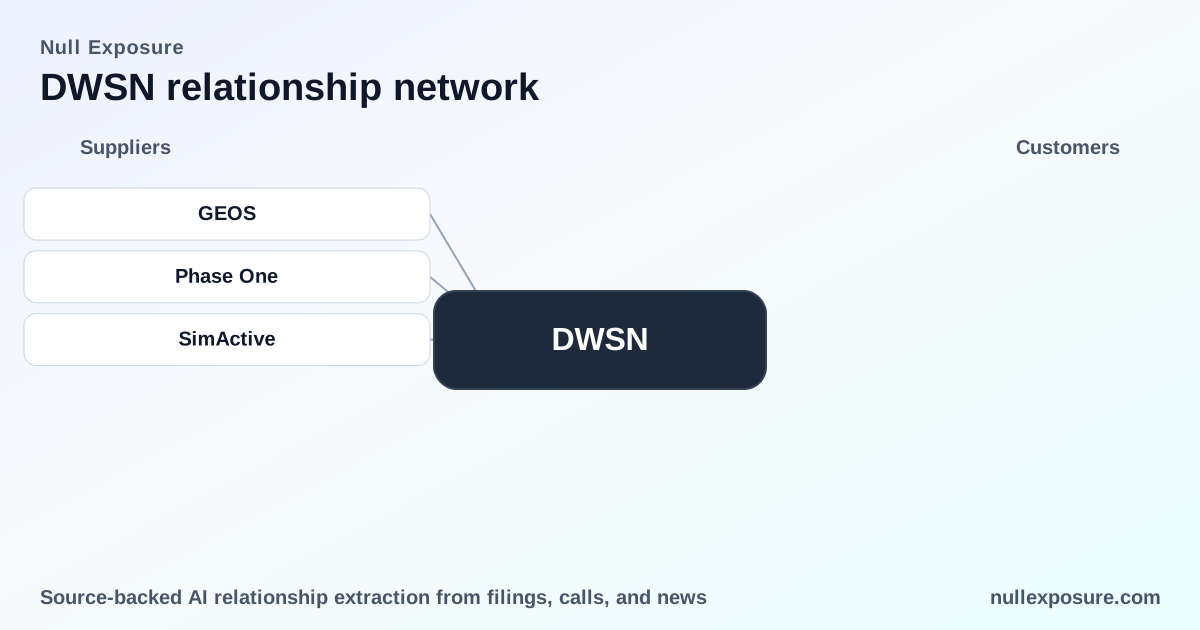
Dawson Geophysical (DWSN): supplier relationships and operational constraints investors should know
Dawson Geophysical is a North American ground seismic services firm that monetizes seismic acquisition and processing contracts for oil & gas operators across the United States and Canada. Revenue is generated by selling project-based field acquisition and processing services, supported by both owned equipment and leased facilities; the company’s supplier relationships therefore translate directly into its ability to deploy modern nodal equipment, run aerial survey workflows, and maintain on-the-ground operations. For investors and operators assessing counterparty risk, the supplier map reveals a mix of critical hardware suppliers and ancillary technology partners that influence capital intensity, operational cadence, and execution risk.
For a consolidated view of third‑party exposure and supplier connections, visit Null Exposure: https://nullexposure.com/
Key takeaways for investors
- Capital-equipment suppliers are strategically important. Purchases of ultralight seismic nodes indicate active reinvestment in field hardware that drives future revenue generation.
- Operational footprint is regionally concentrated. Facility leases are clustered in Midland and Plano, Texas, and Calgary/Wheatland County, Alberta, aligning the company with North American E&P activity cycles.
- Supplier mix spans mission-critical suppliers and planning/analytics vendors. Hardware suppliers support project delivery while aerial-imagery and processing software vendors improve survey efficiency and planning.
The supplier list — what each relationship actually means
Geospace Technologies Corporation (GEOS)
Dawson purchased the Geospace Pioneer ultralight seismic land node in what Geospace and Dawson described as the first major sale of that product to Dawson, signaling a direct vendor relationship for nodal acquisition hardware and a strategic equipment upgrade for field programs. According to a CityBiz report published in March 2026, the transaction was announced jointly by the two companies in FY2025 and frames Geospace as a primary hardware supplier for Dawson’s nodal deployments. (CityBiz, March 2026)
Phase One
Dawson uses a medium-format camera from Phase One to perform aerial imagery over large survey areas (20–200+ square miles) to support survey planning and site assessment, indicating an aerial-imagery equipment relationship that optimizes acquisition planning. This use case was described in a July 2020 industry piece covering Dawson’s survey workflows. (DroneLife, July 7, 2020)
SimActive
Dawson leverages SimActive’s Correlator3D software to generate orthomosaics and elevation models from aerial imagery to aid seismic survey planning, showing a software partnership that reduces on-site uncertainty and improves planning efficiency. This capability was documented alongside the aerial camera usage in the same July 2020 coverage. (DroneLife, July 7, 2020)
Operational constraints and what they imply for supplier risk
Company-level disclosures and evidence point to several operating-model characteristics investors must factor into supplier risk assessment.
-
Contracting posture — lessee mentality. The company’s filings state “The Company is the lessee in a lease contract when we obtain the right to control the asset,” and note that the majority of operating leases are non-cancelable for offices, shops and warehouses. This indicates a preference for leasing operational infrastructure over outright ownership, which shifts certain capital and counterparty exposures to landlords and service providers rather than to long‑term fixed assets.
-
Geographic concentration — North America heavy. Filings note that the majority of operating leases are in Midland and Plano, Texas and Calgary and Wheatland County, Alberta. That footprint ties Dawson’s operational risk profile closely to North American E&P cycles and regional supply chains.
-
Supplier criticality and maturity. The Geospace purchase highlights critical hardware suppliers whose product performance materially affects Dawson’s ability to execute surveys and generate revenue. The Phase One and SimActive relationships are supporting technologies that improve planning efficiency and reduce field time, but they are operationally less critical than nodal hardware. The Phase One and SimActive citations originate in 2020, suggesting multi-year use of planning tools rather than one-off pilots.
-
Concentration and counterparty exposure. Given the company’s regional clustering and capital intensity around nodal hardware, concentration risk is present at two levels: geographic (North America) and supplier-type (specialized seismic hardware vendors). This concentration elevates single-vendor and regional disruption risks.
What this means for investors and operators
-
Revenue sensitivity to equipment availability is high. When the company invests in nodal systems from vendors like Geospace, uptime and delivery schedules from those suppliers directly influence Dawson’s project pipeline and billing cadence. Expect capex cycles and vendor delivery to be leading indicators of near-term revenue trajectory.
-
Operational leverage favors flexible contracts. The company’s lessee posture and non-cancelable operating leases create predictable facility costs but limit nimbleness if market conditions deteriorate; supplier payment terms and equipment financing will be important to monitor for liquidity implications.
-
Technology partnerships reduce execution risk but don’t eliminate supply chain dependencies. Software and imaging partners such as Phase One and SimActive improve efficiency and site selection, reducing field days per project, but they are complementary rather than substitutive for core hardware suppliers.
If you want a structured supplier exposure map or to compare DWSN’s vendor concentration with peers, visit Null Exposure for detailed visualizations and analytics: https://nullexposure.com/
Actionable checklist for due diligence
- Verify vendor delivery schedules and warranties for recent hardware purchases (e.g., Geospace Pioneer nodes).
- Assess lease maturities and termination provisions in Texas and Alberta facilities to understand fixed-cost inflexibility.
- Review supplier diversification plans: how many alternative node vendors can Dawson source from without disrupting field operations?
Bottom line
Dawson Geophysical’s supplier ecosystem mixes critical hardware suppliers that determine execution capacity with planning and imaging vendors that improve project efficiency. Company disclosures show a lessee operating posture and a North American footprint, concentrating operational risk regionally and around specialized seismic hardware. For investors and operators, monitoring vendor delivery performance, lease commitments, and supplier diversification are the highest-value signals for predicting near-term operational stress or upside.
For tailored supplier risk reports and competitive supplier maps, visit Null Exposure: https://nullexposure.com/