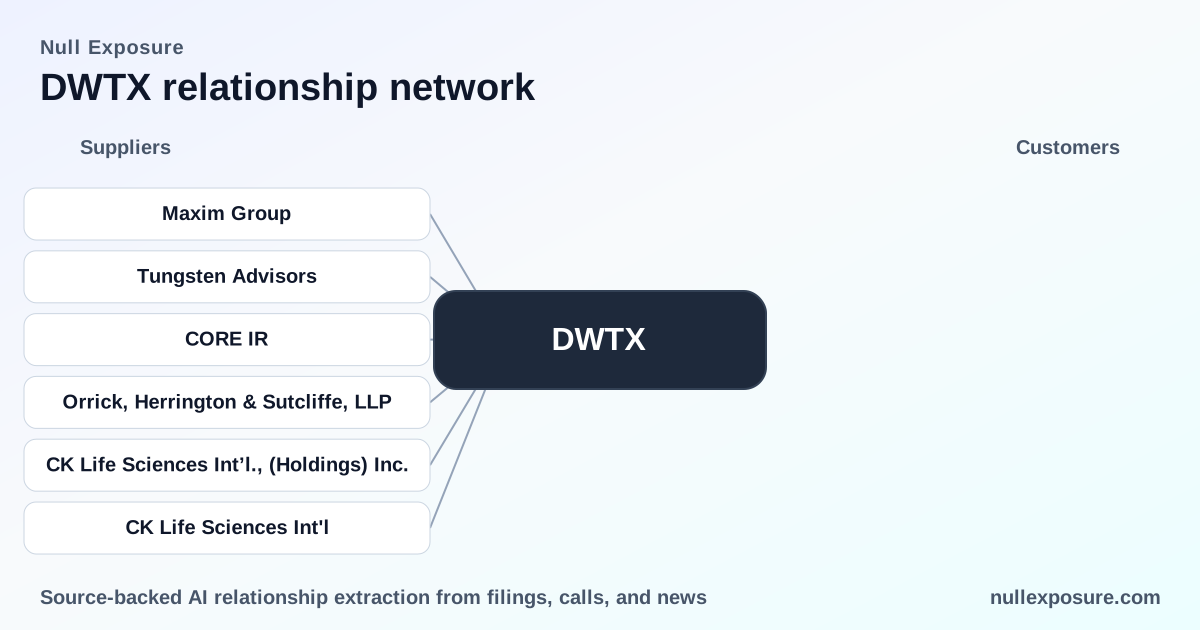
Dogwood Therapeutics (DWTX): Supplier Relationships and Operational Signals for investors
Dogwood Therapeutics is a development-stage biotechnology company developing antiviral and immune-modulating therapies, funding operations through capital markets and strategic financing while outsourcing critical development and manufacturing work. The company monetizes by advancing clinical-stage assets toward regulatory approval and commercial launch, relying on equity and debt financings, strategic loans from major shareholders, and placement agents to raise capital. For investors evaluating supplier and advisor counterparties, the most important characteristics are Dogwood’s heavy outsourcing of clinical and manufacturing operations, a concentrated capital structure, and recent balance-sheet actions that shift creditor relationships into equity. Learn more at https://nullexposure.com/.
How Dogwood runs the science engine: outsourcing and fixed commitments
Dogwood’s operating model is conventional for an early-stage biotech but with clear operational implications for counterparties. The company contracts out the full spectrum of clinical development and production work — clinical trial management (CROs), contractor laboratories, and contract development and manufacturing organizations (CMOs) produce clinical supply and would produce commercial supply if approvals are secured. This contracting posture makes third-party suppliers functionally critical to Dogwood’s path to value; the company retains regulatory responsibility but not direct control over execution.
A company-level signal: Dogwood carries a long-term office lease that runs through August 31, 2028, establishing a fixed overhead commitment that counterparty underwriters and lenders should factor into covenant and liquidity assessments. The firm’s disclosed R&D outlay of roughly $3.53 million (reported period) places it in the $1–10M spend band, indicating modest current program burn relative to larger peers and suggesting supplier engagements are likely small-to-mid sized contract agreements rather than large-scale manufacturing contracts.
- Contracting posture: Highly outsourced for clinical and manufacturing work.
- Criticality: CROs and CMOs are mission-critical suppliers.
- Concentration & maturity: Development-stage company with concentrated ownership and limited internal capacity.
- Fixed commitments: Long-term lease through 2028 increases fixed cost base.
If you are structuring counterparty engagement or assessing supplier exposure, these operating model traits drive negotiation leverage, payment terms, and due-diligence priorities. Learn how supplier signals affect counterparty risk at https://nullexposure.com/.
Who’s on the cap table, advising, or supporting operations — relationship-by-relationship
Maxim Group
Maxim Group acted as the sole placement agent on a Dogwood offering conducted under an existing shelf registration, positioning Maxim as the primary capital markets intermediary for that transaction. Source: StockTitan report, March 9, 2026.
Tungsten Advisors
A Yahoo Finance item (FY2024 reporting) names Tungsten Advisors as the exclusive financial advisor and placement agent to Virios Therapeutics (VIRI); this relationship is noted in the same news flow but relates to VIRI rather than Dogwood directly, signaling the advisory activity present in the broader sector coverage. Source: Yahoo Finance (article referencing VIRI, reported 2026).
CORE IR (Investor Relations)
CORE IR is listed as Dogwood’s investor relations contact on multiple press releases announcing trial enrollment and clinical results, indicating the outsourced IR function that handles market communications and investor outreach. Sources: GlobeNewswire press releases (Aug 7, 2025 and Dec 22, 2025).
Orrick, Herrington & Sutcliffe, LLP
Orrick is reported as legal counsel to Virios Therapeutics in the same finance coverage that mentioned Tungsten Advisors; this reflects the presence of large law firms in sector transactions but does not establish Orrick as Dogwood’s counsel. Source: Yahoo Finance (VIRI coverage, FY2024 reporting).
CK Life Sciences Int’l (CKLS) — loan financing and conversion to equity
CK Life Sciences provided a $19.5 million loan to the combined company, funded in tranches ($16.5M at closing and $3M in a subsequent quarter), and later converted that debt into preferred equity; this sequence materially altered Dogwood’s creditor and ownership profile by converting a major creditor into an equity holder. Sources: Yahoo Finance (FY2024 loan disclosure) and StockTitan (conversion reported March 9, 2026).
CK Life Sciences Int'l (conversion report)
StockTitan reported the conversion of the $19.5 million in outstanding loan amounts into 284.2638 preferred equity shares, confirming the formal equity conversion and concentration of ownership with CK Life Sciences as the largest shareholder. Source: StockTitan report, March 9, 2026.
What these relationships mean for suppliers and investors
- Capital access is centralized. Dogwood uses shelf offerings and single placement agents to raise capital; that centralization expedites execution but concentrates execution risk in the chosen underwriter. The Maxim Group placement underscores that dynamic.
- Largest shareholder controls financing dynamics. CK Life Sciences’ loan and subsequent conversion into preferred equity transforms a major creditor into an equity stakeholder, reducing near-term cash-service obligations while increasing ownership concentration; this has clear governance and counterparty-payment implications.
- Operational risk is outsourced and therefore management-dependent. Reliance on CROs and CMOs makes supplier performance and contractual clarity the principal operational risks; contracts should include clear milestones, IP protections, and rigorous quality and continuity clauses.
- Cost base is limited but fixed. R&D run-rate signals and a long-term lease through 2028 indicate limited current spend but persistent overhead commitments that will require continued access to capital until revenues exist.
Investment implications and counterparty negotiation posture
For investors and operators evaluating relationships with Dogwood, focus on contract terms that protect continuity and payment certainty: milestone-linked payments, escrow or letter-of-credit arrangements for large manufacturing runs, and termination rights tied to material adverse developments and change-of-control events. Concentration of ownership and the recent debt-to-equity conversion with CK Life Sciences increase single-party influence over corporate strategy, which suppliers should account for in pricing, covenant design, and dispute resolution.
Financial profile signals: market capitalization around $98 million, no reported revenue, and negative book and EPS metrics consistent with a development-stage biotech. Insider ownership is high (75%) and institutional ownership low (11%), reinforcing concentrated control and the potential for insiders to dictate strategic capital decisions.
If you need a deeper supplier-risk score or counterparty dossier to underwrite contracts with Dogwood, get an investor-focused report at https://nullexposure.com/.
Bottom line for operators and buy-side analysts
Dogwood is a small, development-stage biotech that outsources the functions that create valuation — clinical trials and manufacturing — while relying on concentrated capital relationships to finance operations. That combination produces a supplier landscape where performance clauses, continuity protections, and payment security are non-negotiable. Track placement-agent activity (Maxim), shareholder financing transitions (CK Life Sciences), and the outsourced IR function (CORE IR) as the material signals that will move governance and liquidity outcomes over the next 12–24 months.
For tailored counterparty intelligence and supplier exposure analysis, visit https://nullexposure.com/ and request a focused report.