Dynex Capital (DX): How agency rails shape a mortgage REIT’s supplier map
Dynex Capital is a leveraged mortgage REIT that earns spread by holding residential mortgage-backed securities (MBS)—principally agency MBS—and funding those positions with short-term repurchase agreements and other leverage. The company monetizes through net interest income and careful balance-sheet hedging: repo financing provides low-cost, flexible funding while interest rate swaps and futures are used to protect spread and market value, enabling dividend distribution to shareholders. For investors and operators evaluating supplier risk, Dynex’s business is defined less by single vendors and more by the structure of its funding counterparties and the government agencies that implicitly guarantee its assets.
Explore detailed supplier intelligence on Null Exposure
The supplier relationships that matter for Dynex are therefore twofold: the government-sponsored and government-guarantee ecosystem that supports agency MBS, and the network of large financial institutions that provide repurchase financing and trading services. Below I map those relationships and the operational constraints that determine their criticality.
Agency counterparty relationships: the backbone of the asset side
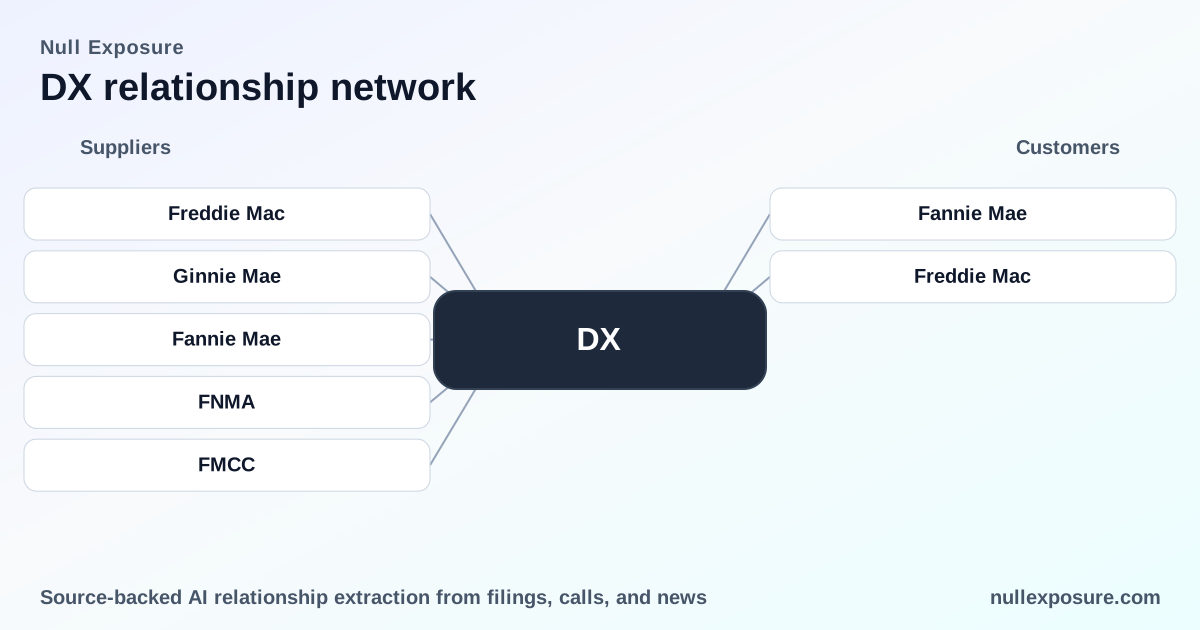
Dynex invests heavily in agency-backed RMBS—securities issued or guaranteed by Fannie Mae, Freddie Mac and Ginnie Mae—which creates an essential economic linkage to those agencies’ guarantee frameworks and servicing ecosystems. The relationship is implicit (the guarantor backs principal and interest on many agency securities), but it is a structural supplier relationship because the credit and liquidity characteristics of agency MBS flow directly from those guarantees.
- Fannie Mae — Dynex holds agency RMBS that are issued or guaranteed by Fannie Mae, making the GSE guarantee a primary support mechanism for the company’s asset base. According to a MarketBeat instant-alert filing summarizing Dynex disclosures (FY2026), the company’s primary business includes investing in RMBS, including pools issued or guaranteed by Fannie Mae. Source: MarketBeat instant-alert filing (Mar 6, 2026): https://www.marketbeat.com/instant-alerts/filing-dynex-capital-inc-dx-shares-acquired-by-vanguard-group-inc-2026-03-06/.
- Freddie Mac — Dynex’s portfolio likewise includes agency MBS guaranteed by Freddie Mac, which embeds Freddie’s credit and prepayment profile into Dynex’s earnings and risk calculus. MarketBeat filings for FY2026 list Freddie Mac among the guarantors for the agency pools Dynex holds. Source: MarketBeat instant-alert filing (Mar 2, 2026): https://www.marketbeat.com/instant-alerts/filing-waterfall-asset-management-llc-invests-184-million-in-dynex-capital-inc-dx-2026-03-02/.
- Ginnie Mae — A portion of Dynex’s agency exposure ties to Ginnie Mae-guaranteed pools, where the underlying loans are insured by government agencies (FHA/VA), which affects prepayment and credit characteristics. MarketBeat coverage of Dynex’s investor filings in FY2026 explicitly lists Ginnie Mae as a guarantor of RMBS the company invests in. Source: MarketBeat instant-alert filing (Mar 4, 2026): https://www.marketbeat.com/instant-alerts/short-interest-in-dynex-capital-inc-nysedx-increases-by-191-2026-03-04/.
Each of these agency relationships is best understood as a structural counterparty: Dynex depends on the guarantee architecture and market acceptance of agency pools rather than on a discrete commercial vendor contract.
Funding and servicing relationships: short-term lenders and third-party operators
Dynex’s funding ecosystem is concentrated among major financial institutions and broker-dealers that provide repurchase agreement financing and short-term liquidity. Repurchase counterparties function as de facto suppliers because they control access to leverage and can influence funding costs and rollability.
- Dynex’s repurchase financing is provided principally by large financial institutions and broker-dealers acting as intermediaries for short-term cash investors, including money market funds and securities lenders (company disclosure, FY2024–FY2025). MarketBeat filings covering institutional transactions and shareholder filings reiterate this financing posture. Source: MarketBeat instant-alert filing (Feb–Mar 2026 batch): https://www.marketbeat.com/instant-alerts/filing-centerbook-partners-lp-has-802000-stock-holdings-in-dynex-capital-inc-dx-2026-02-21/.
Dynex also relies on third-party service providers to operate critical trading and borrowing functions. The company discloses that certain trading and repurchase agreement activities are managed by a third-party service provider, making these vendors operationally critical.
What the contract and lifecycle constraints reveal about operational risk
The company disclosures surface clear, actionable signals about Dynex’s contracting posture and relationship maturity:
- Contracting posture is hybrid: repo financing is predominantly short-term and renewable at lenders’ discretion, with original repo terms typically overnight to six months, though occasional longer-dated repo exists. This structure creates ongoing roll and liquidity risk tied to market conditions. Evidence: company repurchase agreement tables and repo-term descriptions in FY2024 disclosures.
- Active hedging introduces longer-dated commitments: Dynex holds interest rate swaps with maturities out to 9–10 years, showing longer-term hedges coexist with short-term funding, which creates tenor mismatch but reduces interest-rate mark-to-market volatility. Evidence: interest-rate swap maturity table as of December 31, 2024.
- Counterparty profile skews to government and large enterprises: agency MBS bring an implicit government counterparty, while repo lenders are predominantly large financial institutions—this mix reduces single-counterparty credit risk but raises systemic concentration and market-roll risk. Evidence: agency MBS guaranty language and repo counterparty descriptions.
- Relationship stage is active and operationally critical: Dynex had borrowings under 27 repurchase agreements as of December 31, 2024, and reports that no single counterparty exposed more than 10% of equity at risk—this indicates an active, diversified but materially dependent funding network. Evidence: FY2024 disclosure of outstanding repurchase agreements and counterparty exposure limits.
Put plainly: short-term funding creates liquidity sensitivity; long-dated hedges create terminal exposure; and third-party service providers are mission-critical to execution.
Explore detailed supplier intelligence on Null Exposure
Trading, liquidity and governance implications for investors
For investors and operators assessing supplier risk in Dynex:
- Monitor repo rollability and haircuts as primary operational-risk indicators; sudden increases in haircuts or refusal to roll could force asset sales into stressed markets.
- Track swap positions and durations to understand residual interest-rate exposure when funding repricings occur. The company’s 4–10 year swap maturities are a visible lever for duration management.
- Evaluate third-party service provider resilience and counterparty diversification—Dynex’s dependence on external trade/borrow platforms is explicit and operationally material.
Final read: what this means for allocation and oversight
Dynex is not a single-vendor-dependent business; it is a balance-sheet-dependent operator whose supplier map is dominated by government-guarantee mechanisms and large financial intermediaries that supply leverage and trading capability. The investment thesis is therefore two-fold: asset credit support comes from agency guarantees, while earnings and solvency depend on continuous access to short-term wholesale funding and effective hedging. Investors must monitor both axes.
For a deeper supplier risk profile and ongoing monitoring of these relationships, visit Null Exposure for platform-level analysis and alerts.