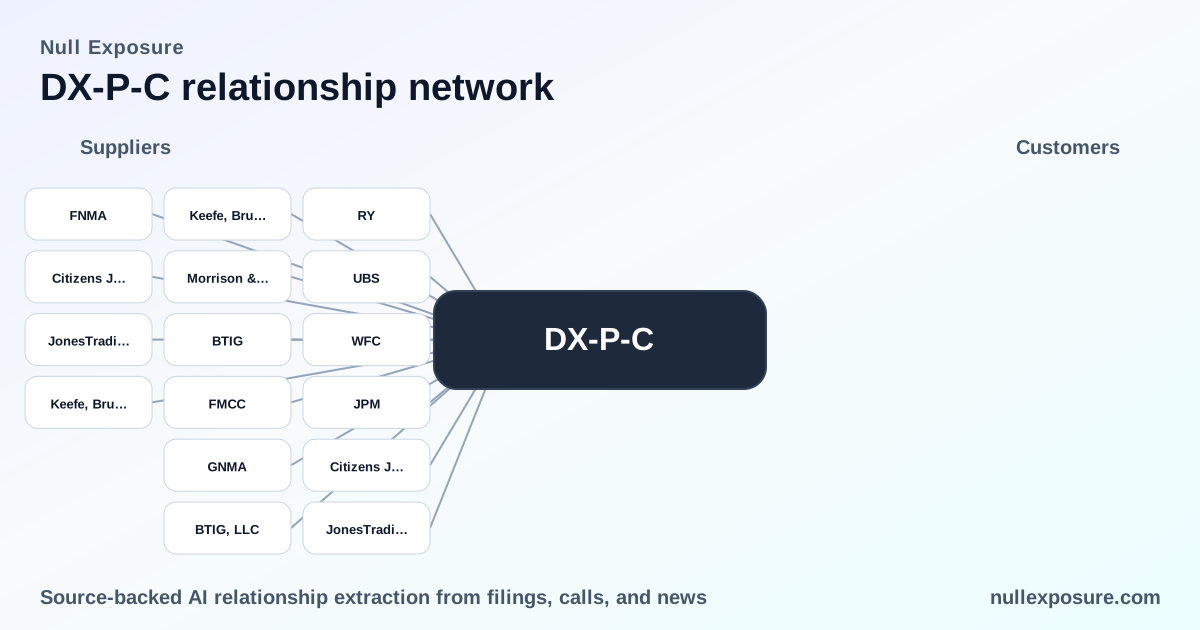
DX-P-C: What Dynex Capital’s supplier map tells investors about capital access and balance-sheet exposure
Dynex Capital (ticker DX-P-C as a preferred security) runs a closed-end investment vehicle that generates high current income by holding a diversified mix of residential mortgage-backed securities and yield-oriented credit instruments. The fund monetizes through portfolio income (interest and dividends) and recurring capital-marketing activity — principally at-the-market equity offerings executed through a syndicate of broker-dealers to replenish capital or fund portfolio allocations. For investors and counterparties evaluating supplier risk, the most important fact is that DX’s recurring access to equity markets is governed by an amended distribution agreement that names a broad dealer syndicate and external counsel. Learn more about supplier signals and counterparties at https://nullexposure.com/.
The short read: an amendment that preserves capital-market optionality
On January 27, 2026, Dynex filed Amendment No. 8 to its long-standing distribution agreement (originally dated June 29, 2018), renewing its at-the-market (ATM) distribution channel with a group of Sales Agents. That arrangement allows Dynex to offer and sell common stock through a set of broker-dealers under Rule 415(a)(4). An active ATM facility is a strategic lever for closed-end funds to manage leverage, liquidity and dividend coverage without fixed debt issuance — and Dynex has kept that lever operational and broad-based through repeated amendments. (Source: Dynex 8-K, filed January 27, 2026 via StockTitan; TradingView coverage, FY2026.)
If you want a concise supplier-risk dashboard on Dynex and similar funds, start here: https://nullexposure.com/.
Counterparty roll call — who Dynex is formally engaged with (and why that matters)
Below I cover every relationship disclosed in the filings and press summaries tied to the distribution amendment and the firm’s investment universe. Each entry is a short, plain-English summary followed by a source note.
-
BTIG, LLC — BTIG is one of the appointed Sales Agents under Amendment No. 8 and is authorized to execute at-the-market common-stock transactions for Dynex. (Source: Dynex 8-K, January 27, 2026 via StockTitan; TradingView FY2026 notice.)
-
Citizens JMP Securities, LLC — Citizens JMP is listed among the Sales Agents in the amended distribution agreement and participates in equity flows for the company’s ATM program. (Source: Dynex 8-K, January 27, 2026 via StockTitan; TradingView FY2026.)
-
JonesTrading Institutional Services LLC — JonesTrading is a named Sales Agent in the ATM arrangement, providing execution capacity for incremental share sales. (Source: Dynex 8-K, January 27, 2026 via StockTitan; TradingView FY2026.)
-
J.P. Morgan Securities LLC — J.P. Morgan is part of the dealer syndicate under Amendment No. 8, offering institutional distribution and secondary-market placement services for Dynex. (Source: Dynex 8-K, January 27, 2026 via StockTitan; TradingView FY2026.)
-
Keefe, Bruyette & Woods, Inc. (KBW) — KBW appears in the sales-agent roster and brings specialty coverage in financials and mortgage-related securities for ATM executions. (Source: Dynex 8-K, January 27, 2026 via StockTitan; TradingView FY2026.)
-
RBC Capital Markets, LLC — RBC is named among the Sales Agents and adds cross-border institutional reach and underwriting expertise to the syndicate. (Source: Dynex 8-K, January 27, 2026 via StockTitan; TradingView FY2026.)
-
UBS Securities LLC — UBS is included in the distribution agreement as a Sales Agent, contributing execution and placement capacity for share offerings. (Source: Dynex 8-K, January 27, 2026 via StockTitan; TradingView FY2026.)
-
Wells Fargo Securities, LLC — Wells Fargo is a Sales Agent in the amended agreement and is available to facilitate ATM sales and market-making. (Source: Dynex 8-K, January 27, 2026 via StockTitan; TradingView FY2026.)
-
Morrison & Foerster LLP — Dynex disclosed that Morrison & Foerster provided legal opinions filed as exhibits alongside Amendment No. 8, covering the legality of shares and certain federal tax matters. (Source: Dynex 8-K, January 27, 2026 via StockTitan.)
-
Freddie Mac (agency exposure) — Dynex states its core portfolio includes agency-backed RMBS issued or guaranteed by Freddie Mac, establishing an indirect operating relationship through holdings that depend on GSE guarantees. (Source: MarketBeat summary of Dynex portfolio positioning, FY2026.)
-
Ginnie Mae (agency exposure) — Ginnie Mae-guaranteed RMBS are named among Dynex’s holdings, creating a direct exposure to mortgage securities that carry federal guarantees. (Source: MarketBeat summary of Dynex portfolio positioning, FY2026.)
-
Fannie Mae (agency exposure) — Fannie Mae pools are also part of Dynex’s stated investment universe, reinforcing that the fund’s income stream is substantially tied to agency RMBS markets. (Source: MarketBeat summary of Dynex portfolio positioning, FY2026.)
What the counterparty mix tells you about Dynex’s operating model
-
Contracting posture: The distribution agreement has been amended repeatedly since 2018, culminating in Amendment No. 8 in January 2026. That history indicates an active, iterative contracting posture that prioritizes maintaining open capital channels rather than one-off offerings.
-
Counterparty concentration: The sales-agent group includes a range of national and specialist dealers, which reduces single-vendor concentration risk for equity placement but increases coordination complexity across counterparties.
-
Criticality: Sales Agents and outside counsel are mission-critical suppliers for capital formation and regulatory comfort; a breakdown in execution capacity or legal opinion could constrain issuance timing and pricing.
-
Maturity and predictability: Repeated amendments and the long-standing agreement since 2018 signal a mature and predictable market-access framework, valuable for managing dividend coverage and leverage in a cyclical mortgage-credit business.
-
Asset-linkage risk: The firm’s explicit reliance on agency RMBS ties portfolio performance to GSE policies, prepayment dynamics and rate cycles — policy and mortgage-market shifts are a primary second-order supplier risk even if they are not counterparty supply contracts.
How investors and operations teams should respond
- Monitor the actual cadence and volume of ATM executions relative to capital needs; an active facility is only useful if it is used prudently.
- Track execution quality across the sales-agent syndicate and whether certain dealers are consistently primary sellers; that is an early indicator of concentration risk.
- Review the firm’s legal exhibits and tax opinions filed with each amendment to confirm no change to share legality or tax treatment. (Source: Dynex 8-K exhibits referenced in the January 27, 2026 filing.)
If you want a supplier-risk scorecard built from filings like these for comparative due diligence, start here: https://nullexposure.com/.
Bottom line
Dynex’s Amendment No. 8 and the listed Sales Agents confirm a deliberate strategy to preserve market access through a broad dealer network while maintaining portfolio exposure to agency RMBS. For investors, the combination of a mature ATM program, diversified dealer relationships, and agency-backed holdings translates into manageable counterparty dispersion but concentrated exposure to mortgage-market and GSE policy dynamics. For operators, the focus is on execution discipline and legal clarity — both visible in the company’s public filings and counsel disclosures. For more in-depth supplier analytics and filing-driven alerts, visit https://nullexposure.com/.