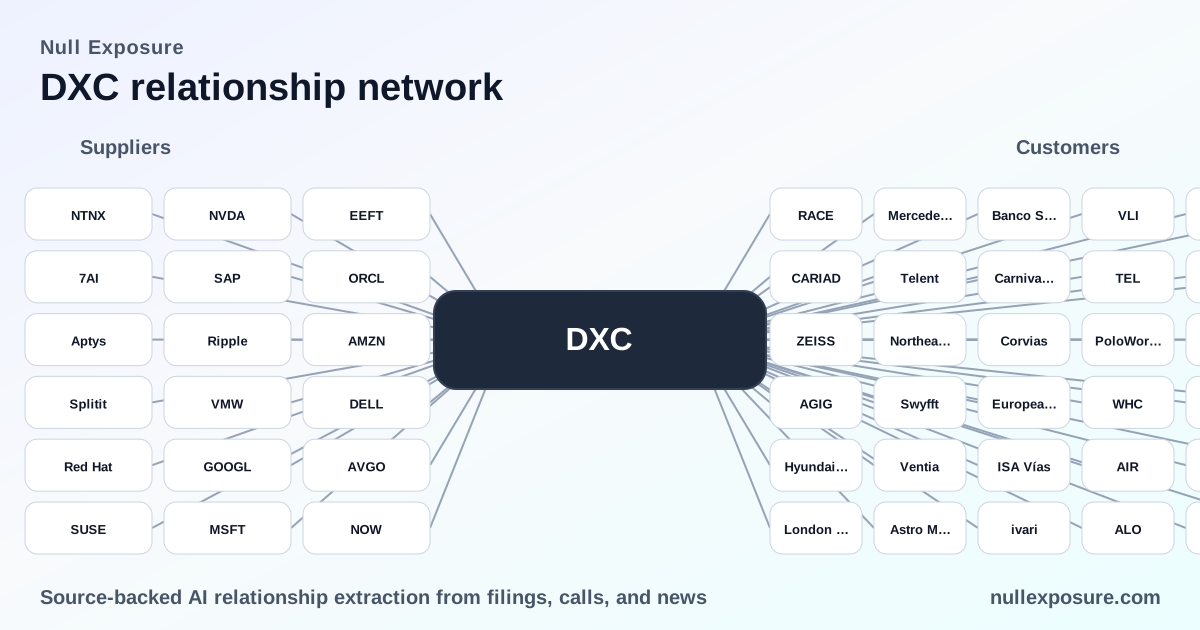
DXC Technology: what its supplier map means for investors
DXC Technology is an enterprise IT services and systems integrator that monetizes through multi-year managed services contracts, application and infrastructure transformation projects, platform integrations (including its Hogan core banking platform), and professional services that drive recurring and project revenue. Revenue is generated by operationalizing partner technology at scale for enterprise and financial clients, capturing implementation and managed-services margins while licensing or integrating third‑party platforms. For an investor, supplier relationships are the operational levers that determine margin squeeze, delivery risk and growth optionality.
Explore supplier intelligence at Null Exposure: https://nullexposure.com/
How DXC’s supplier posture shapes the business
DXC’s public disclosures and press activity reveal a contracting posture built on long-term arrangements, licensor and service‑provider roles, and material procurement commitments. Company filings document minimum purchase commitments totaling around $1.17bn across future years, which signals >$100m annual procurement exposure and meaningful supplier concentration as a business-level characteristic rather than a single-partner issue. The firm both licenses third‑party IP and relies on external hardware and platform providers to deliver managed services; DXC therefore operates as an integrator that is dependent on ecosystem partners for product differentiation and scalability.
Key company-level constraints:
- Long-term contracting posture: DXC discloses long-term purchase agreements to secure favorable pricing and continuity of service.
- Licensor and service-provider roles: DXC both licenses IP from vendors and acts as a service provider to its clients.
- Manufacturer/dependency signal: The company acknowledges reliance on third parties for critical hardware and software that support operations.
- Material spend: Minimum purchase commitments of approximately $1.17bn (reported as of March 31, 2025) indicate a high spend band (> $100m).
Supplier relationships: who DXC works with and what each link contributes
The list below covers every partner mentioned in the available supplier records and public notices. Each entry is a plain-English summary with the source noted.
Euronet Worldwide, Inc. (EEFT)
DXC announced a strategic partnership to integrate its Hogan core banking platform with Euronet’s Ren issuing and payments solution, expanding issuing, revolving credit and cross-border payment capabilities for financial-institution clients (DXC press release, Jan 21, 2026; PR Newswire Jan 21, 2026).
Oracle (ORCL)
DXC and Oracle collaborate on pragmatic cloud and application solutions; the relationship is positioned around joint implementation work and design at events such as Oracle Cloud World (DXC event page, Oracle Cloud World 2024).
Amazon / Amazon Web Services (AMZN)
DXC completed an enterprise-wide deployment of Amazon Quick across 115,000 employees and launched a dedicated DXC Amazon Quick Practice to help customers operationalize AI — a move that ties DXC’s workforce transformation and client offerings tightly to Amazon’s AI workspace (DXC newsroom, Feb 10, 2026; Finviz/PR Newswire Feb 10, 2026).
Dell (DELL)
DXC is developing GenAI on‑premises solutions alongside Dell (and NVIDIA), signalling co-engineering for edge and on-prem deployments in enterprise clients (DXC awards and recognition page, FY2025).
Broadcom (AVGO)
DXC was an early global managed-service provider to enter into Broadcom’s VMware Cloud Service Provider program, enabling DXC to resell and operate VMware‑based cloud services — a strategic route to customers modernizing virtualization and clouds (DXC VMware transformation page, FY2025).
ServiceNow (NOW)
DXC invests ServiceNow GenAI capabilities into its IP and accelerators, integrating ServiceNow technology into automation and operations toolchains (DXC awards and recognition page, FY2025).
NVIDIA (NVDA)
DXC’s GenAI on‑premises work uses NVIDIA technology in partnership with Dell for AI infrastructure and model deployments (DXC awards and recognition page, FY2025).
VMware (VMW)
DXC has a decades-long engineering and managed-services relationship with VMware, using VMware tech to modernize data centers, integrate public clouds and power digital workspaces (DXC VMware transformation page, FY2025).
SAP (SAP)
DXC is both an SAP partner and customer, having implemented RISE with SAP internally and positioning that experience as a selling point for client modernization projects (PRN Asia release / DXC partner announcement, FY2026).
Ripple
DXC disclosed a strategic partnership to integrate Ripple’s institutional blockchain custody and real-time payments technology directly into Hogan, expanding digital-asset custody and cross-border payments for banking clients (StockTitan reporting / DXC press commentary, Jan 21, 2026).
Google / Google Cloud (GOOGL)
DXC’s public materials highlight investments in GenAI including Google Cloud Gemini and the use of Google Cloud as a public-cloud migration option for clients (DXC awards page and VMware solutions materials, FY2025).
Microsoft (MSFT)
DXC cites Microsoft Copilot among its GenAI investments and lists Microsoft Azure as a core public cloud option for migrating client workloads (DXC awards and VMware transformation pages, FY2025).
Nutanix (NTNX)
Nutanix is listed among the supported public and hybrid cloud and platform vendors used in DXC’s infrastructure modernization offerings (DXC VMware transformation page, FY2025).
Red Hat
DXC includes Red Hat in its multi-vendor cloud and infrastructure ecosystem for customer modernization and hybrid cloud integration (DXC VMware transformation page, FY2025).
SUSE
SUSE appears on DXC’s platform list as a supported enterprise Linux distribution for enterprise modernization engagements (DXC VMware transformation page, FY2025).
7AI
DXC’s security operations center references 7AI technology to protect against millions of threats daily and automate threat resolution, reflecting a partnership in managed security operations (Q3 FY2026 earnings call transcript, InsiderMonkey).
Aptys
DXC partnered with Aptys to give banking partners access to FedNow and real‑time payments rails, extending the Hogan platform’s real‑time payments capabilities (Q3 FY2026 earnings call transcript, InsiderMonkey).
Splitit
DXC partnered with Splitit to enable buy‑now‑pay‑later functionality for banks delivering new payment options through Hogan (Q3 FY2026 earnings call transcript, InsiderMonkey).
What the partner map tells investors about operational risk and upside
- Diversified cloud and AI exposure: DXC’s partnerships across AWS, Google Cloud, Microsoft Azure, Oracle and VMware indicate a deliberate multi‑cloud go‑to‑market that reduces single‑vendor lock‑in but increases integration complexity; this is a structural advantage for enterprise customers and a margin pressure point for DXC when it bears integration costs.
- Fintech acceleration: Strategic ties to Euronet, Ripple, Aptys and Splitit show a focused push into banking payments and real‑time rails—this increases growth optionality in financial services while introducing execution and regulatory complexity.
- Material procurement and concentration risk: Reported minimum purchase commitments (totaling roughly $1.17bn) are evidence of substantial vendor spend and confirm the company-level signal of >$100m procurement scale, which supports negotiated pricing but creates counterparty dependency.
- IP and delivery dependency: Licensing third‑party IP and co‑developing GenAI on‑premises solutions with hardware vendors implies both revenue leverage and operational dependency; DXC’s margin resiliency depends on execution and the ability to capture service premium over commodity platform offerings.
If you track DXC’s partner signals for portfolio risk and supplier concentration, Null Exposure’s platform makes that analysis repeatable and comparable: https://nullexposure.com/
Investment takeaways and next steps
DXC’s supplier ecosystem is a core determinant of growth trajectory and margin profile: the company monetizes by operating and integrating partner platforms at scale, and its commercial commitments demonstrate both scale and concentration. For investors, the focus should be on contract renewal cadence with major platform partners, organic ability to capture services margin, and execution against the fintech partnerships announced in FY2026.
- For a quick operational risk check and relationship monitoring, see more at Null Exposure: https://nullexposure.com/
- For portfolio due diligence, prioritize vendor‑concentration monitoring, the Hogan partner rollouts, and DXC’s ability to upsell AI/managed‑services into existing clients.
Bottom line: DXC’s partner map provides growth pathways in cloud, AI and fintech but also creates meaningful procurement exposure and execution risk; active monitoring of partner contracts and delivery metrics is essential for investors evaluating DXC.