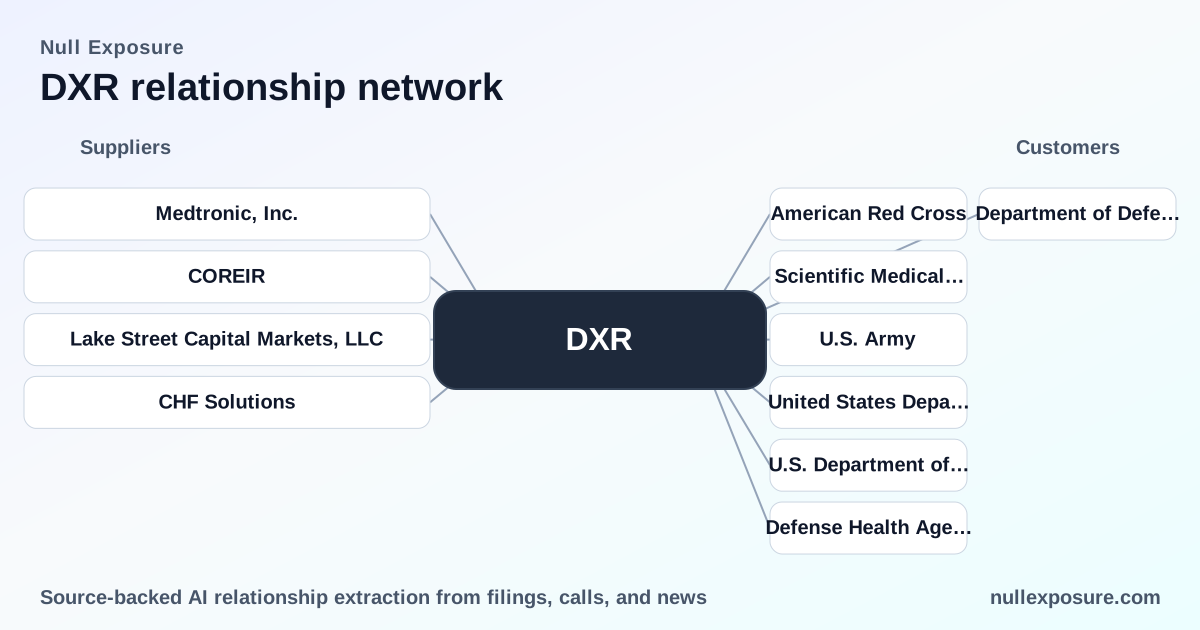
Daxor (DXR) — supplier relationships that determine product availability and capital pathway
Daxor Corporation commercializes a niche medical diagnostic platform (the BVA-100 Blood Volume Analyzer and Volumex blood volume syringes) and monetizes through device sales, consumable syringe fills and adjunct clinical services; revenue and operating continuity depend on a small number of manufacturing and service relationships and periodic capital raises to fund growth. Investors should evaluate supplier concentration, regulatory manufacturing dependencies and the company's capital markets relationships with at least equal weight to its clinical data — those structural ties determine revenue stability and scaling velocity. For a quick gateway into relationship intelligence, visit https://nullexposure.com/.
Why supplier mapping matters to an investor in a small medical-device company
Daxor is a small-cap medical instruments company with a concentrated product set and an outsized exposure to single-source manufacturing for a regulated consumable. The company’s margins and ability to serve the installed base hinge on two operational levers: the uninterrupted supply of FDA-approved Volumex syringes and third-party services for employment, payroll and investor relations. Separate capital market relationships influence liquidity and the pace of execution for commercial rollouts. That combination — regulatory single-source manufacturing plus thin institutional ownership and occasional equity placement activity — creates asymmetric operational and financing risk for investors.
Visit https://nullexposure.com/ for deeper supplier-risk profiles and comparative benchmarking.
Supplier and partner relationships — line-by-line coverage
Medtronic, Inc.
Daxor supported a clinical study with Medtronic to evaluate whether the OptiVol implantable cardiac device accurately estimates patient blood volume status, an arrangement that positions Daxor’s BVA technology in cardiology device validation work. (Source: Daxor 10‑K filing, fiscal 2011.)
COREIR (investor relations firm)
COREIR has repeatedly acted as Daxor’s investor relations contact on several press releases in 2025–2026, with Bret Shapiro listed as COO – Head of Capital Markets, indicating Daxor outsources investor engagement and placement communications. Multiple GlobeNewswire and industry placements in 2025 and early 2026 list COREIR as the dedicated IR contact for investor meetings and product announcements. (Sources: GlobeNewswire releases and news placements, FY2025–FY2026.)
Lake Street Capital Markets, LLC
Lake Street Capital Markets served as the exclusive placement agent for a Daxor securities offering announced in early 2026, demonstrating the company’s reliance on boutique capital markets intermediaries for equity raises. (Source: Yahoo Finance coverage of the March 2026 offering.)
CHF Solutions
Daxor entered an agreement with CHF Solutions to explore clinical synergies between Daxor’s BVA-100 analyzer and CHF Solutions’ Aquadex FlexFlow system for heart-failure fluid management, positioning Daxor in clinical pathway collaborations that support commercial adoption. (Source: DICardiology coverage, FY2018.)
What these relationships tell an investor about operating posture and strategic priorities
- Commercial validation and clinical channeling: The Medtronic collaboration and the CHF Solutions agreement indicate Daxor pursues co-validation and clinical integration opportunities to accelerate adoption of BVA measurement in cardiology workflows. These are growth-oriented partnerships that increase the clinical credibility of the technology.
- Capital intermediation through small brokers and IR firms: Multiple press releases and at least one offering placement show Daxor uses boutique capital-markets firms (Lake Street, COREIR) for financing and investor engagement rather than large, permanent banking relationships. That structure scales capital quickly but increases transaction timing and pricing risk for the company and its shareholders.
- Outsourced investor relations as an operating lever: Repeated COREIR mentions as the investor relations contact signal intentional externalization of investor communications, which reduces fixed G&A but concentrates external messaging control in a third party.
(For a broader view of how supplier exposures translate into valuation risk, see our analysis at https://nullexposure.com/.)
Operational constraints that shape risk, margins and continuity
Company filings and public excerpts reveal a small set of binding operational constraints that materially influence the risk profile:
-
Single-source, FDA-approved manufacturer for Volumex syringes (high concentration and criticality). Daxor discloses that all Volumex syringe orders are filled by a single FDA-approved radiopharmaceutical manufacturer, and that this manufacturer is the only U.S. facility approved to manufacture Volumex for interstate commerce. Company statements emphasize that a loss of that manufacturer would have a material effect on operating revenue. This is a structural supply concentration: regulatory gatekeeping creates a stickier and higher-impact supplier risk than a generic component vendor. (Source: company filings.)
-
Geographic/regulatory constraint — U.S. manufacturing approval required. The manufacturing approval is U.S.-centric and tied to interstate commerce; that creates a regional regulatory dependency that elevates switching costs and elongates contingency timelines. (Source: company filings.)
-
Service-provider outsourcing for HR/payroll (ADP TotalSource). Daxor contracts with ADP TotalSource to provide professional employment services — including health insurance, a retirement plan and payroll — indicating reliance on third-party HR services to manage small-employee infrastructure efficiently. This lowers fixed costs and administrative burden but concentrates critical employee-administration functions externally. (Source: company filings.)
-
Materiality flagged by management. Filings explicitly state that cessation of the syringe-filling manufacturer would be material to both operating revenue and business operations, which makes supplier continuity a first-order investment risk rather than a secondary consideration. (Source: company filings.)
Together, these constraints describe an operating model that is lean and partnership-driven but vulnerable to a small number of externally governed points: an FDA-limited manufacturer, outsourced employment services, and intermittent capital raises through boutique markets.
Investment implications and risk checklist
- Supply continuity is the dominant idiosyncratic risk. The FDA-approved manufacturer for Volumex syringes is a single point of failure that directly affects revenue. Monitor contract terms, inventory buffers and any secondary manufacturer qualification efforts disclosed in filings.
- Capital dependency is visible and episodic. The Lake Street placement demonstrates reliance on equity markets and placement agents; watch future financing cadence and dilution metrics.
- Clinical partnerships are a growth lever but not a substitute for manufacturing redundancy. Medtronic and CHF Solutions collaborations improve adoption pathways but do not mitigate a regulatory single-source supplier risk.
If you want a comparable supplier-risk heatmap and relationship scoring for DXR versus peers, explore our portal: https://nullexposure.com/.
Bottom line and next steps for operators and investors
Daxor’s commercial opportunity is real: clinical partnerships and a specialized consumable business create attractive unit economics when supply is steady. However, a single FDA-approved manufacturer for a core consumable and outsourced investor relations and payroll arrangements concentrate operational and financing risk. Investors should press management on contingency manufacturing plans, inventory strategy and the terms of placement agreements while operators should prioritize supplier redundancy and contractual protective clauses.
For continuous updates and deeper supplier intelligence on Daxor and similar small-cap medical suppliers, visit https://nullexposure.com/ and subscribe to our supplier-risk briefings.